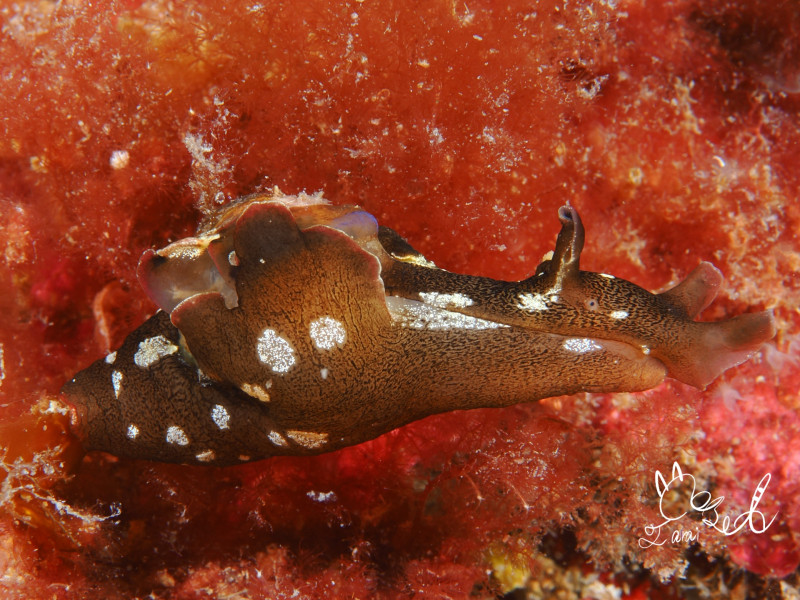
Aplysia punctata (Cuvier, 1803)
- Location
- SOL SKORVEN, West Coast of Sweden, Sweden
- Date
- 2025/06/28
- Length
- 10mm
- Depth
- 10.0m
- Water temperature
- 14.5℃
Description
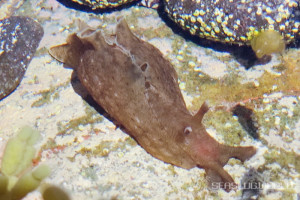
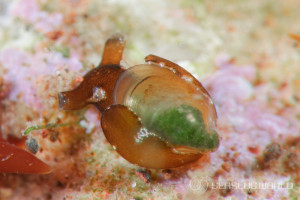
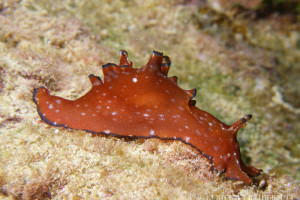
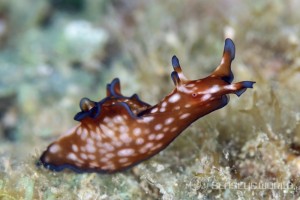
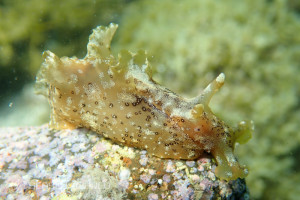
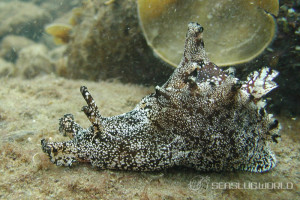
A mid-sized aplysiid reaching well over 100 mm in length. Body of typical aplysiid form, slightly elongate; the mantle is anteriorly produced and bears the characteristic long wing-like parapodia along the sides. Body colour is a deep purplish black overall, conspicuously sprinkled with small pale spots — the diagnostic character that Cuvier noted in the original description. The supraorbital tentacles are extremely long, much longer than in A. depilans, and the mantle border is more strongly raised, particularly toward the rear of the body. Like other aplysiids, the animal releases a purple secretion when disturbed, but this purple "ink" was reported as less pronounced than in some other species.Distribution
Northeastern Atlantic and Mediterranean Sea. The type locality is Marseille, southern France, where Cuvier observed the species alive together with Aplysia fasciata; both species are very common on the Provençal coast and the local fishermen distinguished them readily.Etymology
The specific epithet punctata is the Latin for "dotted" or "spotted" (from punctum, "point"), in reference to the diagnostic small pale spots scattered across the body — the chief character separating this species from the larger A. fasciata with which it is sympatric in the Mediterranean.Remarks
Originally described as Laplysia punctata in Cuvier's "Mémoire sur le genre Laplysia, vulgairement nommé Lièvre marin; sur son anatomie, et sur quelques-unes de ses espèces" (Annales du Muséum d'Histoire Naturelle 2: 287-330, 1803). Cuvier observed the species alive at Marseille together with A. fasciata, and confirmed by direct field observation that they were not life stages of the same species. Subsequently transferred to the modern combination Aplysia punctata (Cuvier, 1803).References
A Kindle field guide by the site author

Kimoto N. (2026). Sea Slugs of Japan & the Indo-Pacific, 2nd Edition.
Kindle Edition
View on Amazon PR (Amazon Associates)Seasonality
Shooting Locations
Loading shooting locations...
Photos of Aplysia punctata

Same Genus Nudibranchs
Academic Database
Sea slug observation data is available in international marine biodiversity databases.