Bullina nobilis T. Habe, 1950
Description
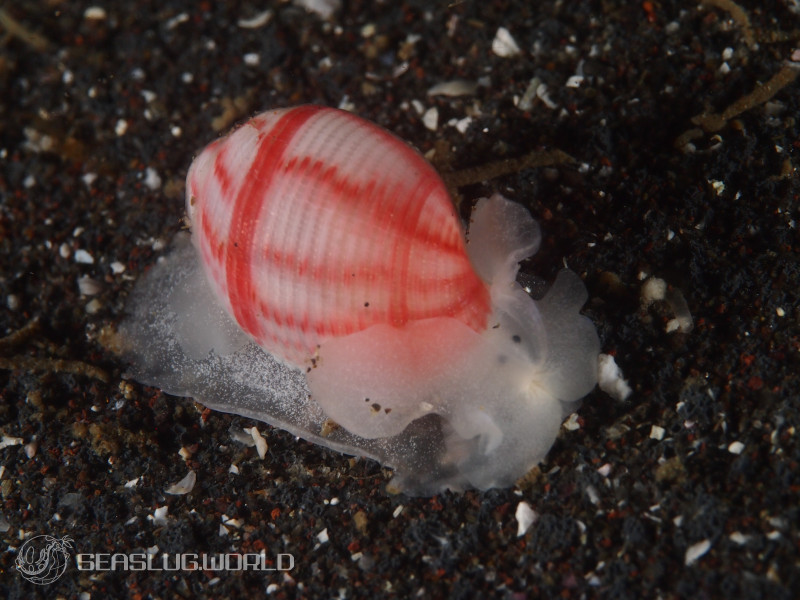
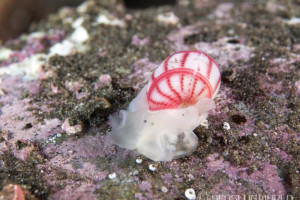
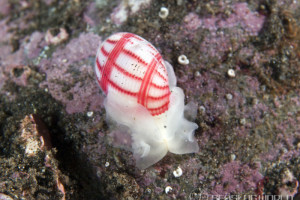
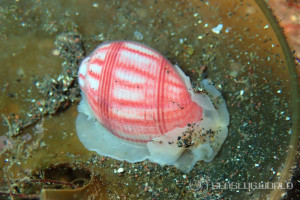
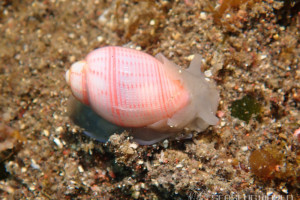
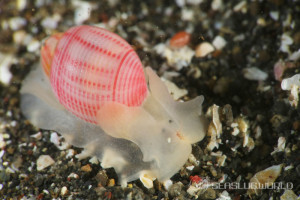
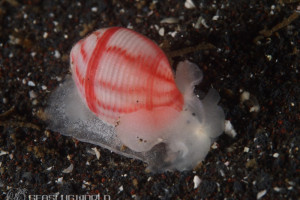
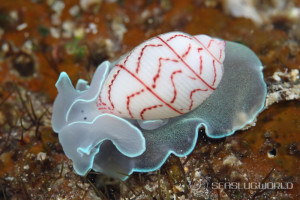
Similar to Bullina lineata but noticeably larger, with a shell up to 30 mm in length. The ovoid white shell bears two wide pink spiral bands, with finer pink vertical lines curving between them. The soft body is translucent white to creamy white, scattered with fine white specks.Distribution
Known primarily from Japan, with records also from coastal China and Vietnam. The type locality is in Japanese waters.Etymology
The specific epithet nobilis is Latin for "noble" or "eminent," probably alluding to this species' larger size and more showy coloration compared with B. lineata. Described by Tadashige Habe in 1950 in Kuroda T. (ed.), Illustrated Catalogue of Japanese Shells, vol. 1(3): 17–24, pl. 3, in the section "Hydatinidae, Bullidae and Akeridae in Japan."Remarks
Like Hydatina physis and Bullina lineata, Bullina nobilis is a specialised predator on cirratulid polychaete worms.The Japanese name Ōbenishibori ("great crimson shibori") reflects both the larger size (ō- = "great") and the red spiral pattern, which recalls the dyed bands of traditional benizome shibori textiles.
References
- Bullina nobilis n.sp., Habe T. (1950). Hydatinidae, Bullidae and Akeridae in Japan. In: Kuroda T. (ed.) Illustrated Catalogue of Japanese Shells, 1(3): 17-24, pl. 3.
- オオベニシボリ Bullina nobilis Habe, 1950, 奥谷喬司. (2000). 日本近海産貝類図鑑. 東海大学出版会.
A Kindle field guide by the site author
Kimoto N. (2026). Sea Slugs of Japan & the Indo-Pacific, 2nd Edition.
Kindle Edition
View on Amazon PR (Amazon Associates)Seasonality
Shooting Locations
Loading shooting locations...
Photos of Bullina nobilis




Same Genus Nudibranchs
Similar Colors Nudibranchs
Academic Database
Sea slug observation data is available in international marine biodiversity databases.