Edmundsella pedata (Montagu, 1816)
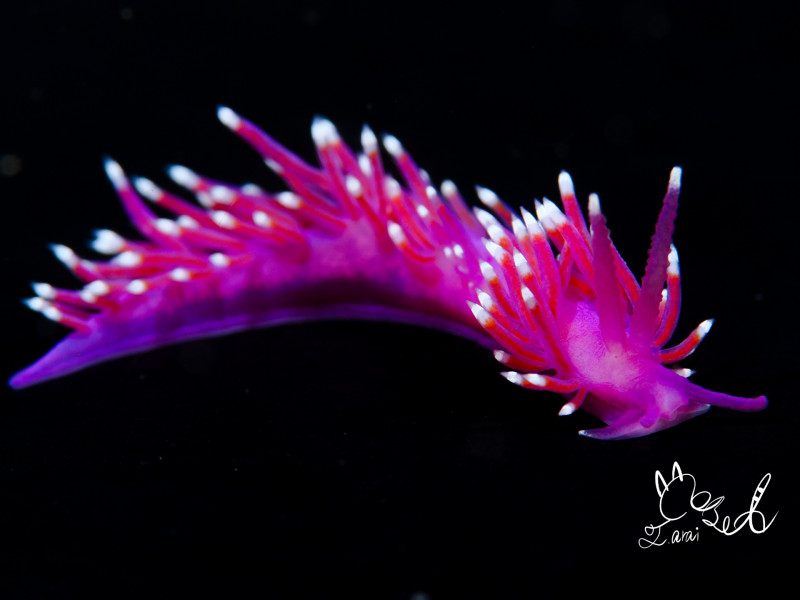
- Location
- NORRA ÄRHOLMEN, West Coast of Sweden, Sweden
- Date
- 2025/06/28
- Length
- 10mm
- Depth
- 15.0m
- Water temperature
- 14.5℃
Description
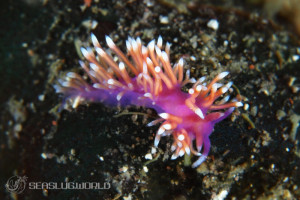
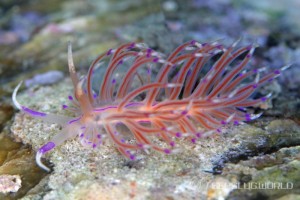
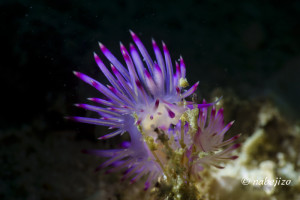
A small aeolid nudibranch reaching about 50 mm in length. The body is pale to deep violet, somewhat elongate, and bears clusters of cerata along the dorsum. Each ceras is filled internally with the purple digestive gland and ends in a clean white tip. The rhinophores and oral tentacles are also tinged with purple, and the rhinophores often show fine annulate folds.Distribution
Originally described from the south-west coast of England (Devon). Subsequently recorded broadly across the north-east Atlantic — from the Norwegian coast south to Portugal — throughout the Mediterranean, and out to the Canary Islands and the Azores.Etymology
The specific epithet pedata is Latin for "footed" or "having feet".Remarks
Feeds primarily on hydroids of the genus Eudendrium. The species is the type species of the genus Edmundsella.References
- Doris pedata, Montagu G. (1816). An account of some new and rare marine British shells and animals. Transactions of the Linnean Society of London. 11(2): 179-204, pls 12-14.
- Edmundsella pedata (Montagu, 1815), comb. n., Korshunova T., Martynov A., Bakken T., Evertsen J., Fletcher K., Mudianta I.W., Saito H., Lundin K., Schrödl M. & Picton B. (2017). Polyphyly of the traditional family Flabellinidae affects a major group of Nudibranchia: aeolidacean taxonomic reassessment with descriptions of several new families, genera, and species (Mollusca, Gastropoda). ZooKeys. 717: 1-139. https://doi.org/10.3897/zookeys.717.21885
A Kindle field guide by the site author
Kimoto N. (2026). Sea Slugs of Japan & the Indo-Pacific, 2nd Edition.
Kindle Edition
View on Amazon PR (Amazon Associates)Seasonality
Shooting Locations
Loading shooting locations...
Photos of Edmundsella pedata

Same Genus Nudibranchs
Similar Colors Nudibranchs

Academic Database
Sea slug observation data is available in international marine biodiversity databases.