Micromelo undatus (Bruguière, 1792)
Micromelo undatus
No field photograph submitted for this species yet
Have you photographed this species?Description
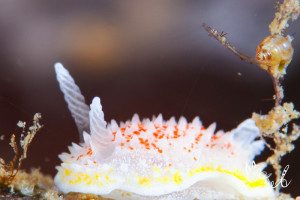
A small shelled cephalaspidean reaching about 30 mm in shell length. The egg-shaped shell is milky white with three brown spiral bands, and arched longitudinal lines fill the spaces between the bands. The animal's body is translucent white, densely scattered with large white spots, and the mantle and foot edge are bordered by a vivid yellow rim.Distribution
The neotype is from Discovery Bay, Jamaica, in the western Atlantic (Bruguière's 1792 description predates the neotype designation). True Micromelo undatus is restricted to the Atlantic (Caribbean) basin. Specimens previously identified as M. undatus from the Indo-Pacific are now treated as separate species (notably M. guamensis).Etymology
The specific epithet undatus is Latin for "wavy" or "undulate", in reference to the wave-like longitudinal lines on the shell.Remarks
Recent molecular and morphological analyses split the traditional concept of M. undatus into four species: M. undatus s.s. (Atlantic), M. scriptus, M. guamensis (western Pacific), and M. barbarae sp. nov. Japanese material formerly identified as M. undatus very likely corresponds to M. guamensis.References
- Bulla undata, Bruguière J.G. (1792). Histoire naturelle des vers. In: Encyclopédie Méthodique. Volume 1. Panckoucke, Paris.
- Micromelo undatus, Feliciano, K., Malaquias, M.A.E., Stout, C., Brenzinger, B., Gosliner, T.M. & Valdés, Á. (2021). Molecular and morphological analyses reveal pseudocryptic diversity in Micromelo undatus (Bruguière, 1792) (Gastropoda: Heterobranchia: Aplustridae). Systematics and Biodiversity. DOI: 10.1080/14772000.2021.1939458: 1-25.
A Kindle field guide by the site author
Kimoto N. (2026). Sea Slugs of Japan & the Indo-Pacific, 2nd Edition.
Kindle Edition
View on Amazon PR (Amazon Associates)Seasonality
Shooting Locations
Loading shooting locations...
Same Genus Nudibranchs


Similar Colors Nudibranchs
Academic Database
Sea slug observation data is available in international marine biodiversity databases.