Akera soluta (Gmelin, 1791)
Description
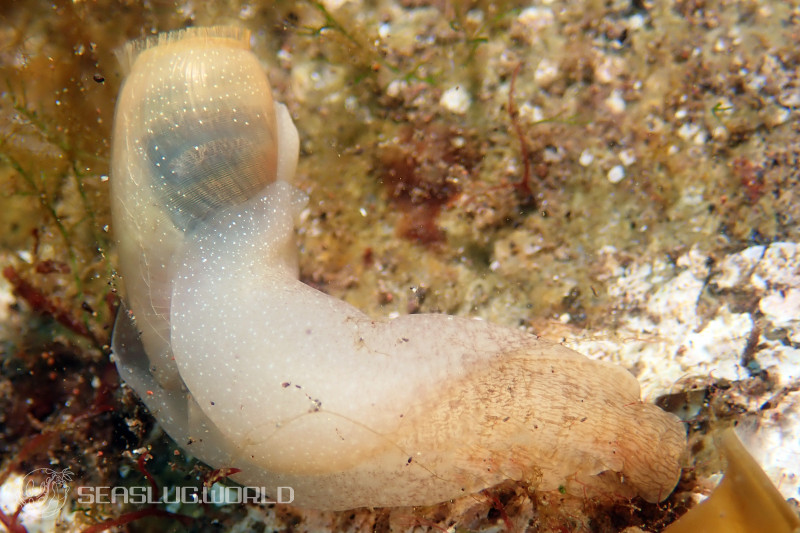
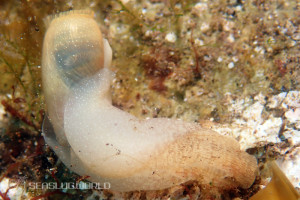
A small anaspid (sea-hare relative) about 2.5 cm in shell length and 4 cm in total body length when extended. The shell is external, large, ovate, and fragile, with several whorls and a flattened apex; a sutural slit is present but there is no operculum. The body cannot withdraw into the shell. The body is elongate with a small head and no rhinophores; the parapodia are large and well-developed, used by the animal to swim above algae. Feeds on macroalgae in shallow waters.Distribution
According to Okutani (ed.) 2000 (Marine Mollusks in Japan), recorded from Boso Peninsula southward to Australia and the Indian Ocean, on shallow-water algae.Etymology
The specific epithet soluta is the feminine perfect passive participle of the Latin verb solvere, meaning "loosened" or "set free".Remarks
Japanese specimens were treated by Habe (1961) as a separate species, Akera constricta Kuroda, 1947; WoRMS regards A. constricta as a junior subjective synonym of Akera soluta.References
- Bulla soluta n. sp., Gmelin J.F. (1791). Caroli a Linné Systema Naturae, ed. 13. Tome 1(6). Vermes. G.E. Beer, Lipsiae [Leipzig]. pp. 3021-3910.
- ウツセミガイ(ミナワガイ) Akera constricta KURODA (jr. syn. of A. soluta), 波部忠重. (1961). 続原色日本貝類図鑑. 保育社, 大阪. xii + 183 + 42 pp., 66 pls. [Habe T. (1961). Coloured illustrations of the shells of Japan (II). Hoikusha, Osaka.]
- ウツセミガイ Akera soluta Gmelin, 1791, 奥谷喬司. (2000). 日本近海産貝類図鑑. 東海大学出版会.
- Akera soluta, Terrence Gosliner, Ángel Valdés and David Behrens. (2018). Nudibranch and Sea Slug Identification Indo-Pacific 2nd Edition. New World Pubns Inc.
- ウツセミガイ, 小野篤司 & 加藤昌一. (2020). 新版 ウミウシ. 誠文堂新光社.
Featured in this book
Terrence Gosliner, Ángel Valdés and David Behrens. (2018). Nudibranch and Sea Slug Identification Indo-Pacific 2nd Edition. New World Pubns Inc.
New World Publications
This species, Akera soluta, is included in the book.
View on Amazon PR (Amazon Associates)Seasonality
Shooting Locations
Loading shooting locations...
Photos of Akera soluta



Similar Colors Nudibranchs

Color:
Brown
Academic Database
Sea slug observation data is available in international marine biodiversity databases.