Ancula gibbosa (Risso, 1818)
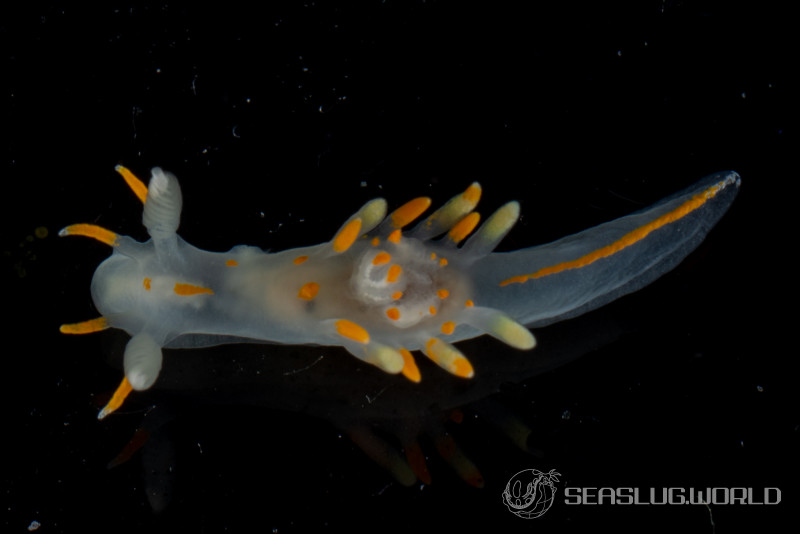
- Location
- Beach, Oyashirazu, Niigata, Japan
- Date
- 2020/03/11
- Length
- 10mm
- Depth
- 4.0m
- Water temperature
- 12.0℃
Description
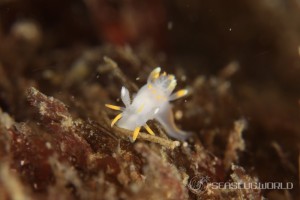
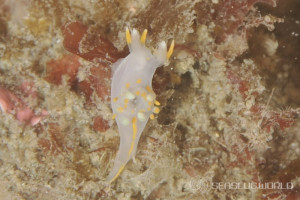
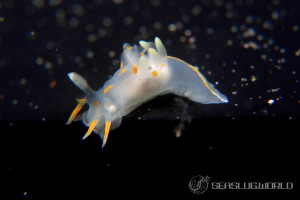
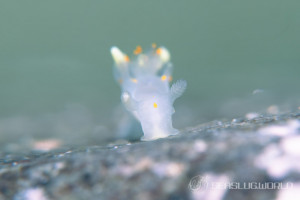
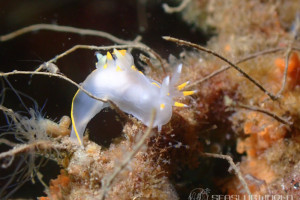
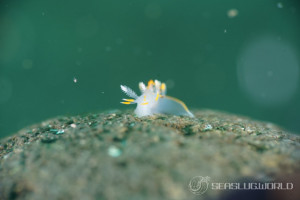
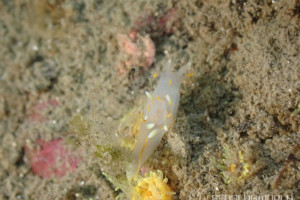
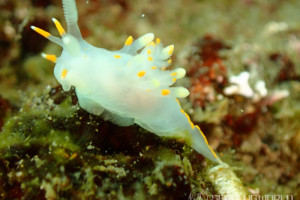
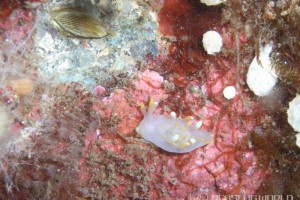
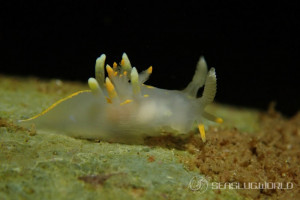
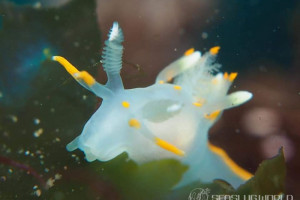
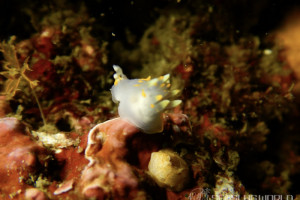
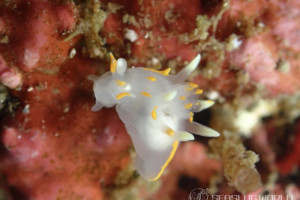
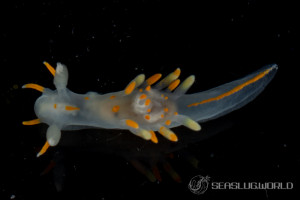
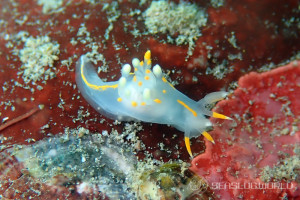
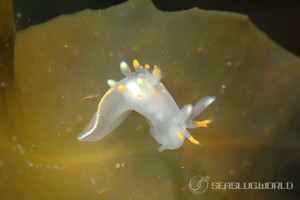
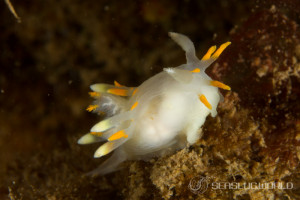
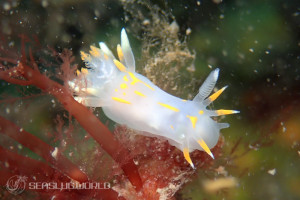
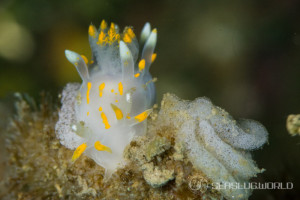
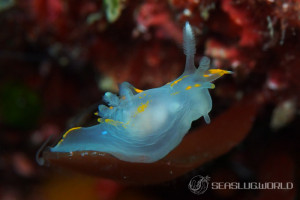
A goniodoridid up to about 40 mm in body length. The body is translucent white, with an orange-yellow line running along the midline between the rhinophores and along the dorsum of the tail. Two pairs of slender lateral processes flank the rhinophores, each tipped with orange-yellow. Additional slender processes surround the gills, with pale yellow tips. The rhinophores are translucent white with opaque white tips; the gills are translucent white with orange-yellow tips. A colour variant lacking the orange-yellow pigmentation and bearing only small white spots scattered over the body is considered conspecific.Distribution
A cold-water species widely distributed in the cold-temperate to boreal waters of both the Indo-Pacific and Atlantic Oceans. Type locality: off Nice, Mediterranean Sea. Records extend across the North Sea and the Atlantic coast of Europe (United Kingdom, Norway, etc.), the Pacific coast of North America (Alaska to California), Canadian waters, the Russian Far East, the Korean Peninsula, and northern Japan.Etymology
The specific epithet gibbosa is Latin for "humped" or "swollen". The Japanese vernacular name "Hagoromo-umiushi" alludes to the row of slender lateral processes and the crown of papillae around the gills, which are likened to a feathered robe (hagoromo).Remarks
Ancula gibbosa is the type species of the genus Ancula (subfamily Anculinae), originally described as Tritonia gibbosa from Mediterranean material off Nice. Species of Ancula are thought to feed primarily on entoprocts (kamptozoans) that grow on colonies of bryozoans, hydroids, and ascidians.References
- Tritonia gibbosa n. sp., Risso A. (1818). Mémoire sur quelques Gastéropodes nouveaux, Nudibranches et Tectibranches observés dans la mer de Nice. Journal de Physique, de Chimie, d'Histoire Naturelle et des Arts. 87: 368-377.
- ハゴロモウミウシ, Baba, K. 1990. Notes on the rare genera Trapania and Ancula from Japan with the description of a new species (Nudibranchia: Goniodorididae). Venus 49(1):8-18.
- Ancula gibbosa (type species of Ancula, Clade A), Paz-Sedano S., Moles J., Smirnoff D., Gosliner T.M. & Pola M. (2024). A combined phylogenetic strategy illuminates the evolution of Goniodorididae nudibranchs (Mollusca, Gastropoda, Heterobranchia). Molecular Phylogenetics and Evolution. 192: 107990. https://doi.org/10.1016/j.ympev.2023.107990
A Kindle field guide by the site author
Kimoto N. (2026). Sea Slugs of Japan & the Indo-Pacific, 2nd Edition.
Kindle Edition
View on Amazon PR (Amazon Associates)Seasonality
Shooting Locations
Loading shooting locations...
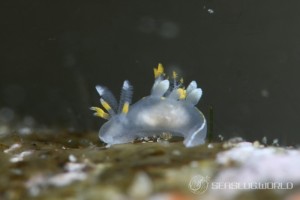
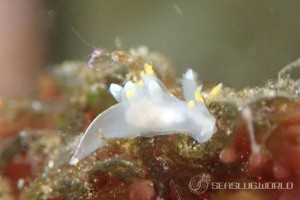
Photos of Ancula gibbosa
Tag:




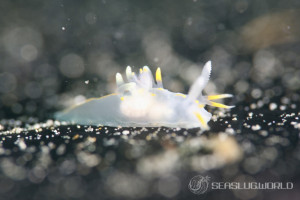

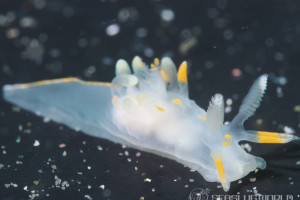

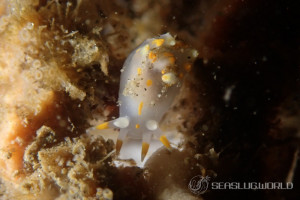

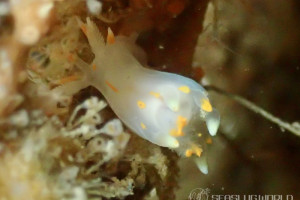













Specimen & DNA
| Observation | Database | COI | 16S | H3 |
|---|---|---|---|---|
| #19995 | BOLD Systems | SSWBP275-25 |
Same Genus Nudibranchs
Similar Colors Nudibranchs

Academic Database
Sea slug observation data is available in international marine biodiversity databases.