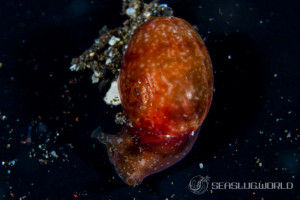
Bulla orientalis T. Habe, 1950
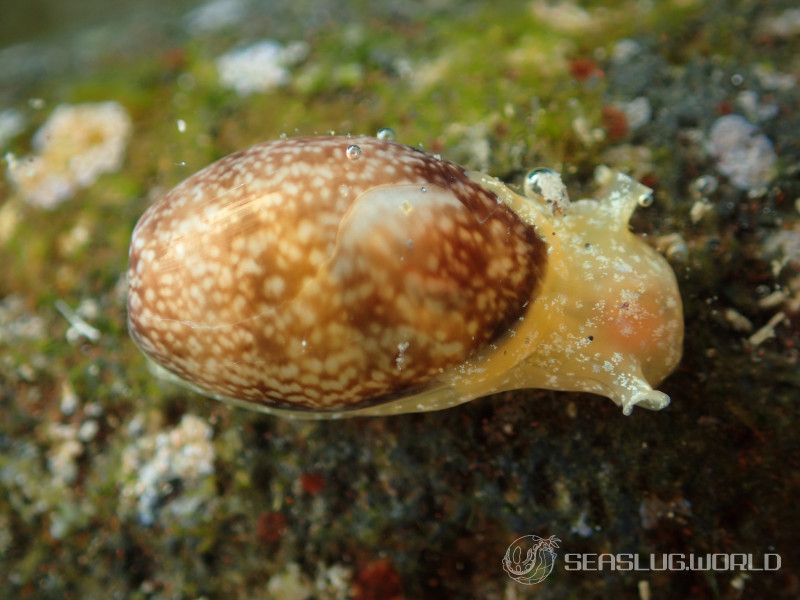
- Location
- Sidem, Tulamben, Pulau Bali, Indonesia
- Date
- 2017/03/10
- Length
- 12mm
- Depth
- 2.0m
- Water temperature
- 28.0℃
Description
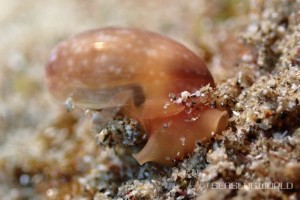
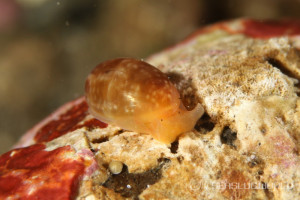
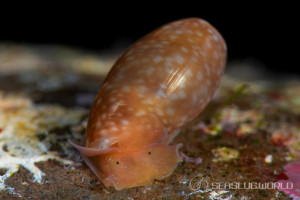
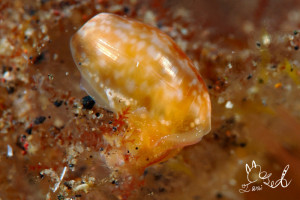
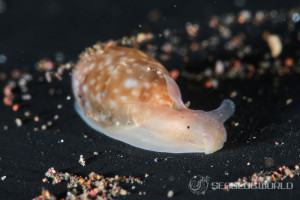
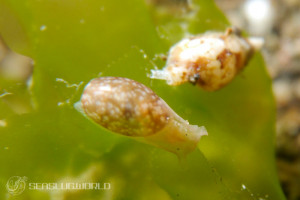
A cephalaspidean gastropod with a thin, oval, bubble-shaped shell. Maximum shell height about 35 mm, typically 20–30 mm. The spire is involute and the body whorl expands anteriorly, with a wide aperture. Western Pacific specimens have thinner, elongate shells with a pale background scattered with brown dots shadowed in yellow, while Indian Ocean specimens are thicker and more squarish, reddish brown with faint darker spiral bands. The aperture lip is reddish and the columella is white. The living animal has skin covered with fine purple spots and lacks bright white dots.Distribution
Widely distributed throughout the Indo-West Pacific. The type locality is Karenkō, Formosa (now Hualien, Taiwan). In Japan it is recorded from the Ryukyu Islands. Indian Ocean records include South Africa, Tanzania, Madagascar, Seychelles, Mauritius, the Maldives and the Andaman Islands; western Pacific records include Vietnam, New Guinea, north-eastern Australia, New Caledonia, the Solomon Islands and Fiji.Etymology
From the Latin orientalis, meaning "eastern".Remarks
The Japanese vernacular name is コナツメガイ. This is an uncommon species, active at night and found on sand and dead coral in shallow water, also among seagrass. It is generally smaller than the congener Bulla vernicosa and is distinguished by the absence of bright white dots on the body. Japanese records previously identified as Bulla punctulata are misidentifications; B. punctulata is an eastern Pacific species and does not occur in Japan (Malaquias & Reid, 2008).References
- Bulla orientalis n.sp., Habe T. (1950). Hydatinidae, Bullidae and Akeridae in Japan. In: Kuroda T. (ed.) Illustrated Catalogue of Japanese Shells, 1(3): 17-24, pl. 3.
- Tibiriçá Y. & Malaquias M.A.E. (2017). The bubble snails (Gastropoda, Heterobranchia) of Mozambique: an overlooked biodiversity hotspot. Marine Biodiversity. 47(3): 791-811. https://doi.org/10.1007/s12526-016-0500-7
A Kindle field guide by the site author
Kimoto N. (2026). Sea Slugs of Japan & the Indo-Pacific, 2nd Edition.
Kindle Edition
View on Amazon PR (Amazon Associates)Seasonality
Shooting Locations
Loading shooting locations...
Photos of Bulla orientalis








Same Genus Nudibranchs
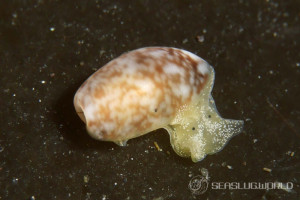
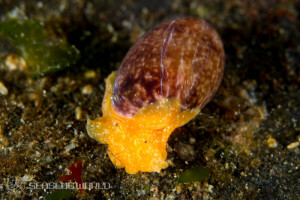
Similar Colors Nudibranchs

Color:
Brown
Academic Database
Sea slug observation data is available in international marine biodiversity databases.