Catriona venusta (Baba, 1949)
Catriona venusta
No field photograph submitted for this species yet
Have you photographed this species?Description
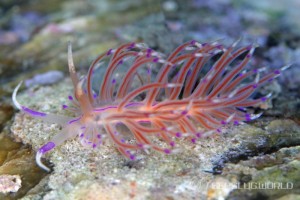
A small Aeolidacea, body length 4-10 mm. The rhinophores are simple (no rings, no lamellae) — a key diagnostic feature. Cerata in 6-7 oblique rows per side: 1st row 1, 2nd 2, 3rd-4th 3 each, 5th onward 1-2 each. Right (and left) liver branches into 3 oblique rows. The genital orifice opens directly below the 2nd row on the right side; the anus opens just before the inner end of the 4th row. Anterior foot corners rounded. Ground colour orange-yellow; the cerata have a red-purple central vein and yellow tips. The masticatory edge of the jaw plate bears a single row of 12-15 denticles. Radula formula 55-60×0.1.0. The central tooth has a recessed median cusp flanked by 4-6 denticles on each side.Distribution
Type locality is off Nishi-no-saki, Sagami Bay (500 m offshore, 10 m depth, January 1941, 1 specimen) and Hayama-Samejima, Sagami Bay (intertidal, April 1941, 4 specimens), 5 specimens total. The original description (Baba, 1949) records the species only from Sagami Bay.Etymology
The specific epithet venusta is Latin for beautiful or graceful. The original description does not give an explicit etymology paragraph; the descriptive sense reflects the brilliant orange-yellow ground with red-purple central veins. The Japanese name "Hanazono-mino-umiushi" (flower-garden aeolid) likewise refers to the beautiful coloration.Remarks
Originally described as Cratena venusta and later transferred to Catriona. Distinguished from the conspecifically described Cratena anulata and Cratena pinnifera by the simple rhinophores (no rings, no lamellae) and by the orange-yellow ground with red-purple central veins.
References
- Catriona venusta (Baba, 1949), Baba K. (1949). Opisthobranchia of Sagami Bay collected by His Majesty the Emperor of Japan (相模湾産後鰓類図譜). Iwanami Shoten, Tokyo. 4+2+194+7 pp., pls. 1-50.
- Catriona venusta = Cratena venusta, Baba K. (1961). THREE NEW SPECIES OF THE GENUS CATRIONA FROM JAPAN (NUDIBRANCHIA-EOLIDACEA). Publications of the Seto Marine Biological Laboratory. 9(2): 367-372. https://doi.org/10.5134/175287
A Kindle field guide by the site author
Kimoto N. (2026). Sea Slugs of Japan & the Indo-Pacific, 2nd Edition.
Kindle Edition
View on Amazon PR (Amazon Associates)Seasonality
Shooting Locations
Loading shooting locations...
Same Genus Nudibranchs

Similar Colors Nudibranchs
Academic Database
Sea slug observation data is available in international marine biodiversity databases.