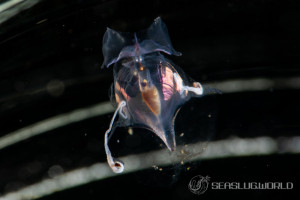
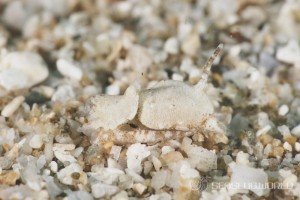
Cavolinia uncinata (A. d'Orbigny, 1835)
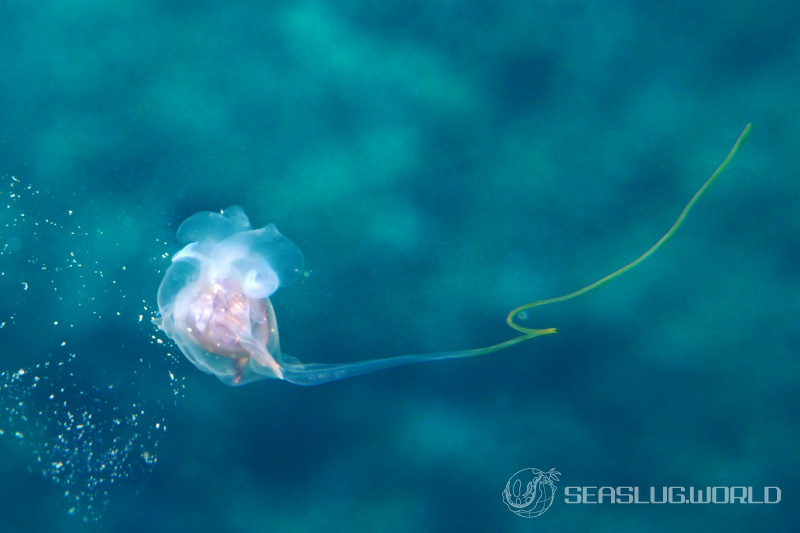
- Location
- Horse Shoes Kita, Okinawa Island (Onna and Yomitan area), Okinawa, Japan
- Date
- 2016/05/10
- Length
- 7mm
- Depth
- 15.0m
- Water temperature
- 24.0℃
Description
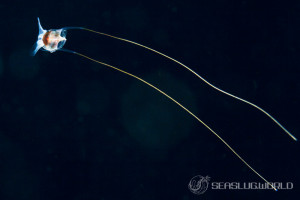
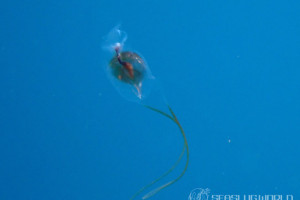
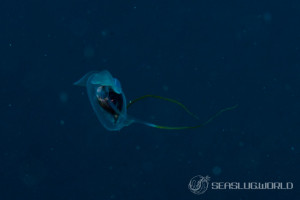
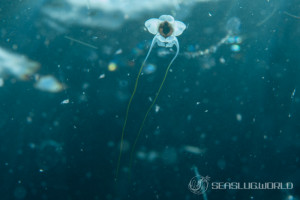
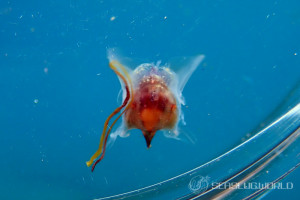
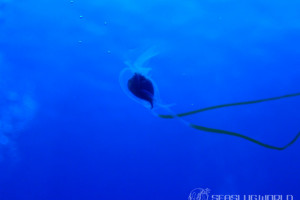
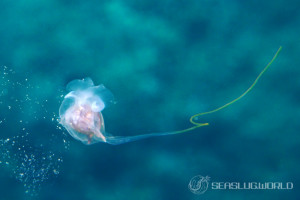
A pelagic shelled pteropod with a rounded, amber-coloured shell bearing three hook-like spines posteriorly. Indo-Pacific specimens carry five longitudinal dorsal ribs while Atlantic specimens have three. The body is semi-translucent white, with two slender thread-like appendages extending posteriorly, grading from white at the base to brown or yellow-brown at the tips. The foot is expanded into broad wing-like parapodia used for swimming and drifting throughout the entire life cycle. Shell length 6-9 mm depending on locality.Distribution
Widely distributed in tropical to subtropical oceans worldwide. Recorded from both Indo-Pacific and Atlantic basins, with rare incursions into the Mediterranean Sea and the Red Sea. Off Japan, occurs along the Kuroshio Current with periodic mass strandings. Type locality: the South American coast, based on specimens from d'Orbigny's South American voyage.Etymology
The specific epithet uncinata is the Latin adjective meaning "hooked".Remarks
The species feeds by secreting a vast mucous web, several times the body size, that traps drifting diatoms and other microplankton — a feeding mode characteristic of shelled pteropods. Van der Spoel 1969 described an Indian Ocean form as Cavolinia pulsata and an Atlantic form as C. u. roperi, but both are now treated as a single species, C. uncinata.References
- Hyalaea uncinata, Orbigny A.D. d' (1834-1847). Voyage dans l'Amérique méridionale (le Brésil, la république orientale de l'Uruguay, la République argentine, la Patagonie, la république du Chili, la république de Bolivia, la république du Pérou), exécuté pendant les années 1826, 1827, 1828, 1829, 1830, 1831, 1832 et 1833. 5(3): Mollusques. Paris: Pitois-Levrault.
- Cavolinia uncinata (Rang, 1829), Rampal J. (2017). Euthecosomata (Mollusca, Gastropoda, Thecosomata). Taxonomic review. https://doi.org/10.1101/098475
A Kindle field guide by the site author
Kimoto N. (2026). Sea Slugs of Japan & the Indo-Pacific, 2nd Edition.
Kindle Edition
View on Amazon PR (Amazon Associates)Seasonality
Shooting Locations
Loading shooting locations...
Photos of Cavolinia uncinata
Tag:







Same Genus Nudibranchs
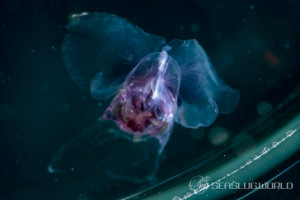
Similar Colors Nudibranchs
Academic Database
Sea slug observation data is available in international marine biodiversity databases.