Chromodoris hamiltoni Rudman, 1977
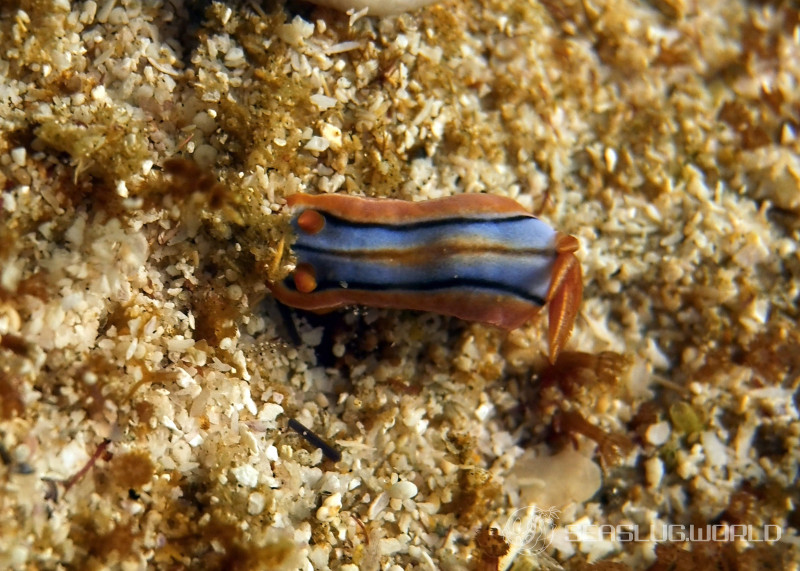
- Location
- Ribbon Reef, 5 Mile, Sodwana Bay, South Africa
- Date
- 2018/07/30
- Length
- 35mm
- Depth
- 19.0m
- Water temperature
- ??℃
Description
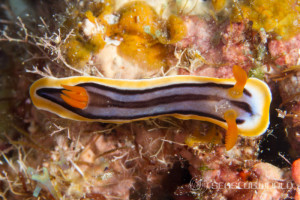
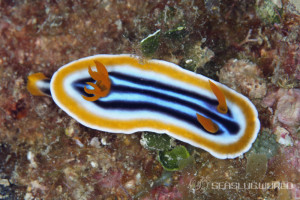
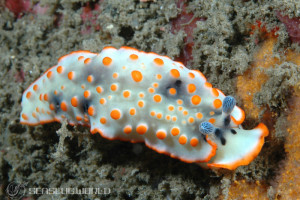
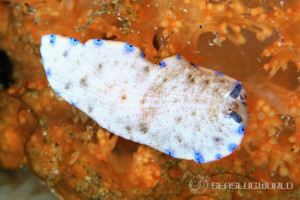
Mantle ground colour pale blue. There is a broad band of orange around the edge and a thinner band of white inside this. Three deep blue lines run longitudinally down the mantle: a central one runs from the white inner border between the rhinophores back to the gill pocket; the other two start in front of each rhinophore, run alongside the white inner border, and finish behind the gills. Behind the gills the lateral lines often merge with the orange border. A thin very light blue (almost white) line runs along each side of the central dark blue line, and a thin blue line runs from each rhinophore to the gill pocket. Gill pocket and rhinophore pocket edged with orange. Gills and rhinophores orange. Sides of the foot pale blue with three dark blue lines running from head to tail; the central line on each side joins the other in the posterior midline. Foot has a wide orange border; genital pore ringed with orange. Head and oral tentacles orange. Radular formula 72 × 56.0.56 to 78 × 54.0.54; innermost lateral has a single large cusp with three inner denticles and two outer denticles at the base; remaining laterals have four or five denticles on the outer edge. Body length to 40 mm alive.Distribution
Type locality is Fungu Mkadya, 3 km N.E. of Kunduchi, Dar es Salaam, Tanzania. The type series also includes specimens from Horns Bay, Watamu and Mlango Reef, Diani (Kenya); Ras Kankadya, Dar es Salaam; and Pangavini Is. Subsequently recorded across the western Indian Ocean and the tropical west Pacific.Etymology
The specific epithet hamiltoni honours the late H. G. H. (Hamish) Hamilton, who was tragically killed in a road accident in Nairobi in May 1976; he had contributed material and photographs to the study of East African opisthobranchs.Remarks
Distinguished from the Red Sea C. quadricolor by its blue ground with deep-blue longitudinal lines, broad orange border and thin inner white line.References
- Chromodoris hamiltoni, Johnson R.F. & Gosliner T.M. (2012). Traditional taxonomic groupings mask evolutionary history: a molecular phylogeny and new classification of the chromodorid nudibranchs. PLoS ONE 7(4): e33479.
- Chromodoris hamiltoni, Layton K.K., Gosliner T.M. & Wilson N.G. (2018). Flexible colour patterns obscure identification and mimicry in Indo-Pacific Chromodoris nudibranchs (Gastropoda: Chromodorididae). Molecular Phylogenetics and Evolution. 124: 27-36. https://doi.org/10.1016/j.ympev.2018.02.008
A Kindle field guide by the site author
Kimoto N. (2026). Sea Slugs of Japan & the Indo-Pacific, 2nd Edition.
Kindle Edition
View on Amazon PR (Amazon Associates)Seasonality
Shooting Locations
Loading shooting locations...
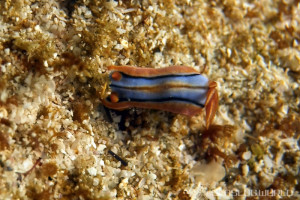
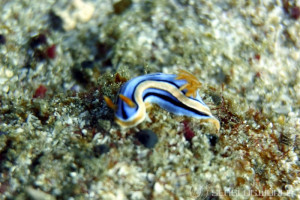
Photos of Chromodoris hamiltoni

Same Genus Nudibranchs

Similar Colors Nudibranchs
Academic Database
Sea slug observation data is available in international marine biodiversity databases.