Chromolaichma dalli (Bergh, 1879)
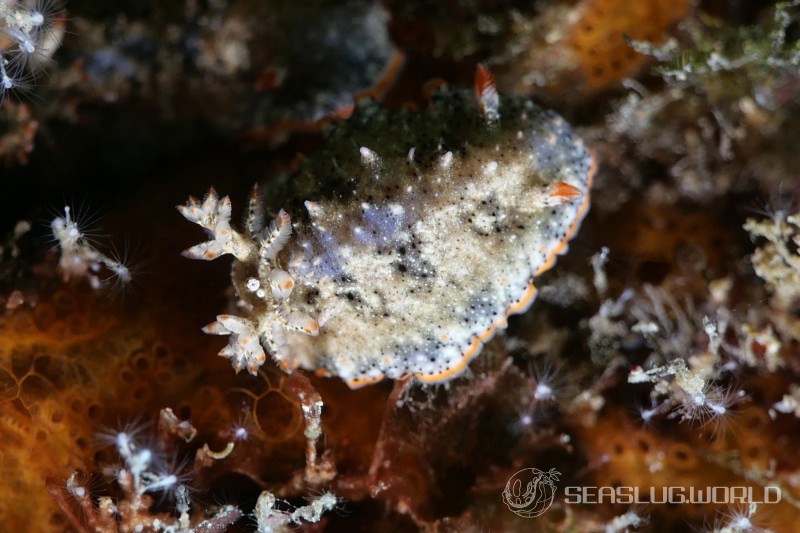
- Location
- Punta Santa Cruz, Huatulco, Oaxaca, Mexico
- Date
- 2021/03/23
- Length
- ??mm
- Depth
- ??m
- Water temperature
- ??℃
What is Dall's chromodorid?
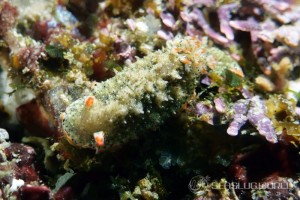
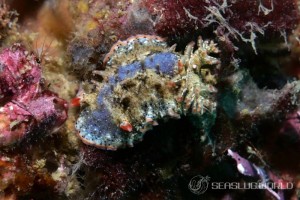
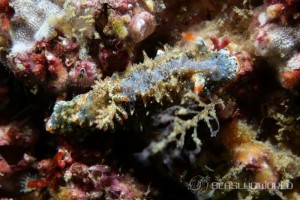
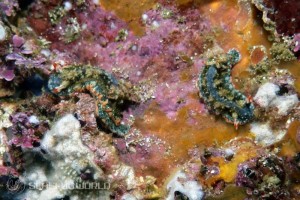
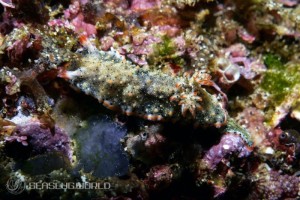
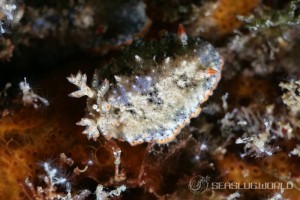
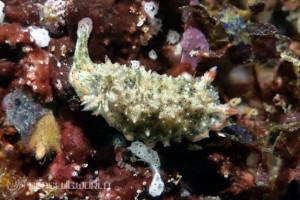
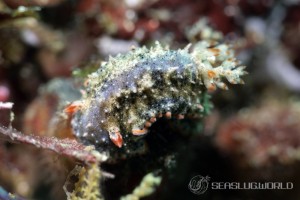
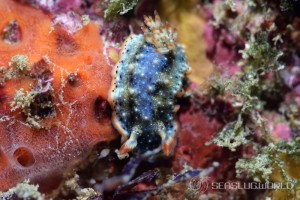
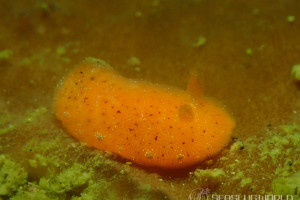
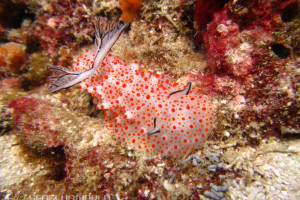
Dall's chromodorid (Chromolaichma dalli) is a white, heavily dark-speckled dorid nudibranch of the tropical eastern Pacific, ranging from Baja California to the Galápagos Islands; an orange band around the mantle edge and orange-tipped gills and rhinophores set it apart from the other spotted sea slugs of the region.Description
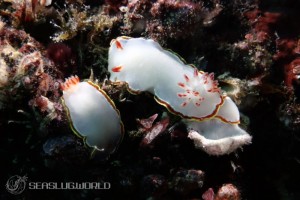
The notum and foot are white, with brown-black spots of varying size scattered over the notum and the sides of the body. Larger animals carry more numerous but smaller dark dots, and the ground colour turns greyish towards the centre of the dorsum. Cream-coloured spots are mixed among the dark ones, and bigger animals also show orange to red spots. An orange band runs around the mantle edge. The gills and rhinophores are white, tipped with orange or light red. The number of branchial plumes varies widely, from 9 to 34. Living animals measure 14-46 mm, averaging about 28 mm.Chromolaichma sedna, the other eastern Pacific species of the genus, is plain white with narrow yellow and red bands confined to the mantle margin, and is told apart from the densely dark-spotted C. dalli at a glance.
Distribution
Tropical eastern Pacific. The species is common throughout the Gulf of California and is also recorded from Bahía Magdalena on the Pacific coast of Baja California, from the Mexican states of Nayarit and Jalisco, and from Costa Rica; it is reported south to the Galápagos Islands. The type locality was originally given as Puget Sound, Washington, but this is regarded as a labelling error, and in 1978 it was proposed that the type locality be emended to 3.7 km south of Puertocitos, Baja California.Etymology
The specific epithet dalli honours the American malacologist William Healey Dall, who supplied the North Pacific material on which the original description was based. Dall had been surveying the marine invertebrates of the Alaskan coast and the Bering Sea since 1865; he invited Bergh to work up the nudibranchs in his collections, and Bergh named two of the new species he found there after him.The generic name Chromolaichma is a coinage from the Greek words for "colour" and "the point of a spear", referring to the bright colours of the living animals and to the elongate, spear-like radula; the letter "l" was inserted for euphony.
Remarks
The original description rests on a single preserved specimen 11.5 mm long, and the colours of the living animal were never recorded. That specimen was labelled as coming from Puget Sound, Washington, but the species has never been collected on the coasts of California, Oregon, Washington or Canada. Because the Chromodorididae are essentially a tropical group, the 1978 revision concluded that the label had been mixed up and that the specimen had almost certainly come from the Gulf of California.The same revision showed that Chromodoris banksi, described in 1963 from south of Puertocitos in Baja California, and its subspecies Chromodoris banksi sonora, named in 1967, both fall within the range of variation of this species, and both are now treated as synonyms.
A sponge feeder: the gut of the type specimen was packed with fragments of a horny sponge. Animals from Costa Rica have been reported to feed on Hyrtios erecta, and scalarane-type compounds of sponge origin have been isolated from the tissues of this species.
References
- Chromodoris Dalli n. sp., Bergh R. (1879). On the nudibranchiate gasteropod Mollusca of the North Pacific Ocean, with special reference to those of Alaska. Part I. Proceedings of the Academy of Natural Sciences of Philadelphia. 31: 71-132.
- Chromodoris banksi n. sp., Farmer W.M. (1963). Two new opisthobranch mollusks from Baja California. Transactions of the San Diego Society of Natural History. 13(6): 81-84.
- Chromodoris banksi sonora subspec. nov., Marcus Er. & Marcus Ev. (1967). American Opisthobranch Mollusks. Studies in Tropical Oceanography, Miami. 6: 1-256.
- Chromolaichma dalli, Bertsch H. (1977). The Chromodoridinae nudibranchs from the Pacific coast of America. Part I. Investigative methods and supraspecific taxonomy. The Veliger. 20(2): 107-118.
- Chromolaichma dalli comb. nov., Bertsch H. (1978). The Chromodoridinae nudibranchs from the Pacific coast of America. Part III. The genera Chromolaichma and Mexichromis. The Veliger. 21(1): 70-86.
- Glossodoris dalli, Johnson R.F. & Gosliner T.M. (2012). Traditional taxonomic groupings mask evolutionary history: a molecular phylogeny and new classification of the chromodorid nudibranchs. PLoS ONE 7(4): e33479.
- Chromolaichma dalli, Matsuda S.B. & Gosliner T.M. (2018). Molecular phylogeny of Glossodoris (Ehrenberg, 1831) nudibranchs and related genera reveals cryptic and pseudocryptic species complexes. Cladistics. 34(1): 41-56. https://doi.org/10.1111/cla.12194
- Chromolaichma dalli, Behrens D.W., Hermosillo A., Fletcher K. & Jensen G.C. (2022). Nudibranchs & Sea Slugs of the Eastern Pacific. Molamarine.
Featured in this book
Behrens D.W., Hermosillo A., Fletcher K. & Jensen G.C. (2022). Nudibranchs & Sea Slugs of the Eastern Pacific. Molamarine.
Molamarine
This species, Chromolaichma dalli, is included in the book.
View on Amazon PR (Amazon Associates)Seasonality
Shooting Locations
Loading shooting locations...
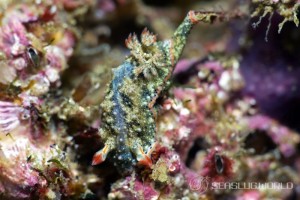
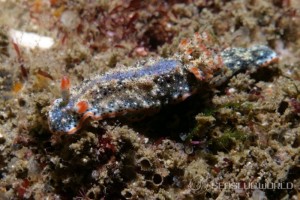
Photos of Chromolaichma dalli

Same Genus Nudibranchs
Similar Colors Nudibranchs


Academic Database
Sea slug observation data is available in international marine biodiversity databases.