Crimora papillata Alder & Hancock, 1862
- Location
- NORRA ÄRHOLMEN, West Coast of Sweden, Sweden
- Date
- 2025/06/28
- Length
- 15mm
- Depth
- 20.0m
- Water temperature
- 14.5℃
Description
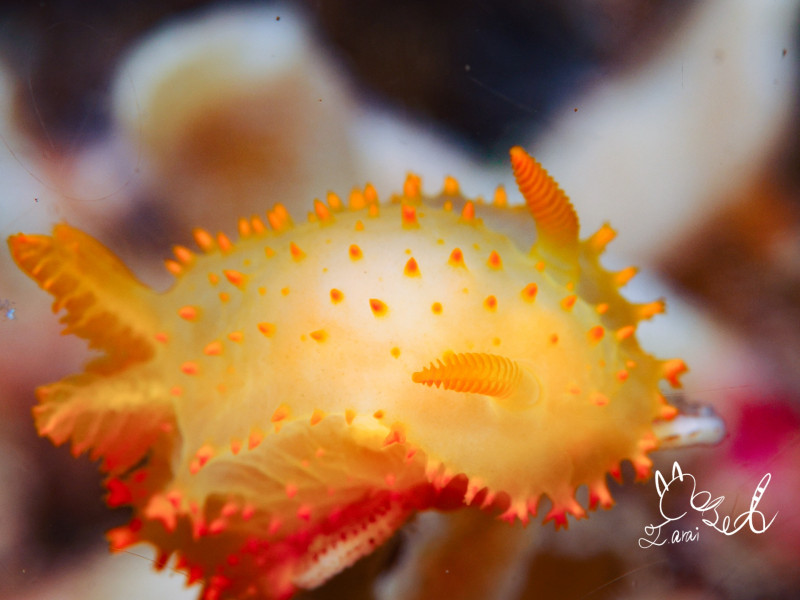
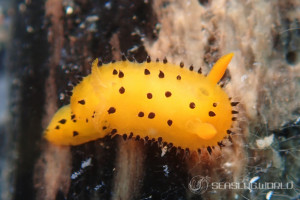
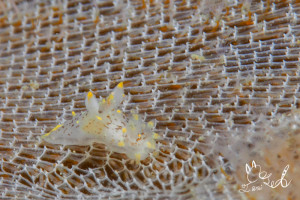
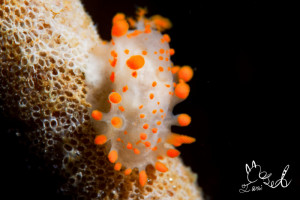
A small to medium-sized polycerid up to about 25 mm in body length. The body is oval and slightly flattened. Ground colour ranges among individuals from translucent white to a clear lemon yellow. The entire dorsum is densely covered with finger-like to wart-like papillae, each tipped with bright yellow to orange. The papillae extend beyond the mantle proper to the mantle margin, the foot, and the dorsal surface of the tail.A diagnostic feature is the tendency for papillae on the anterior margin of the head to be arborescent, with branched tips. Rhinophores are short and lamellate, the basal portion the ground colour and the tips yellow-orange. The gill consists of three simply pinnate plumes set in a row on the posterior dorsum.
Distribution
Type locality: Cape of Good Hope, South Africa (Alder & Hancock, 1862). Subsequent records extend to the north-east Atlantic (Ireland, Britain, southern Norway, France, Spain, Portugal) and the western Mediterranean, indicating a wide temperate-water distribution. The species inhabits the lower intertidal and shallow subtidal of rocky shores.Etymology
The specific epithet papillata derives from the Latin papilla ("nipple, small projection"), meaning "bearing papillae", in reference to the dense covering of papillae on the body.Remarks
Crimora papillata is the type species of the genus Crimora Alder & Hancock, 1862, erected in their seminal account of South African nudibranchs. The genus is small, including for example C. lutea from the Japanese coast, with members being bryozoan-feeders.References
- Crimora papillata Alder & Hancock, 1862 — type species, Alder J. & Hancock A. (1862). Descriptions of a new genus and some new species of naked Mollusca. Annals and Magazine of Natural History. (3)10(57): 261-265.
A Kindle field guide by the site author
Kimoto N. (2026). Sea Slugs of Japan & the Indo-Pacific, 2nd Edition.
Kindle Edition
View on Amazon PR (Amazon Associates)Seasonality
Shooting Locations
Loading shooting locations...
Photos of Crimora papillata

Same Genus Nudibranchs
Similar Colors Nudibranchs

Academic Database
Sea slug observation data is available in international marine biodiversity databases.