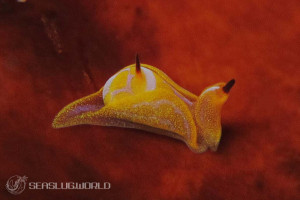
Eubranchus ocellatus (Alder & Hancock, 1864)
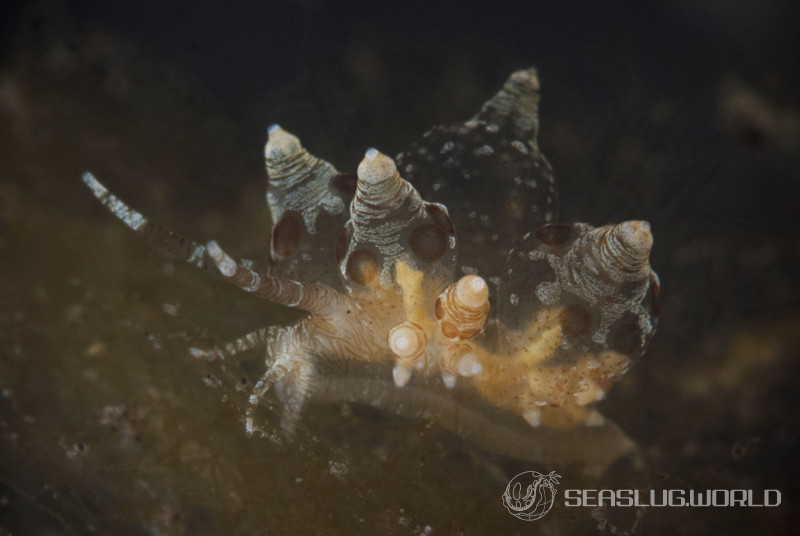
- Location
- Pulau Bali, Indonesia
- Date
- 2006/08/25
- Length
- 15mm
- Depth
- 21.0m
- Water temperature
- 28.0℃
Description
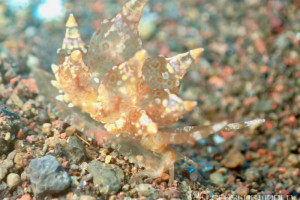
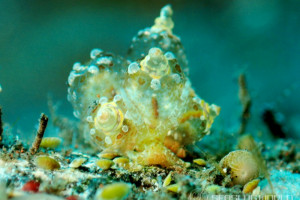
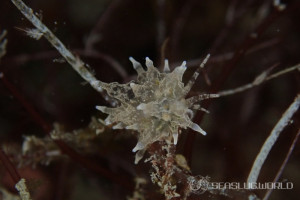
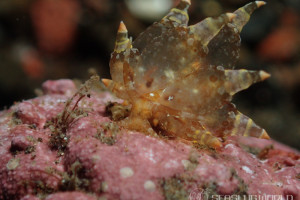
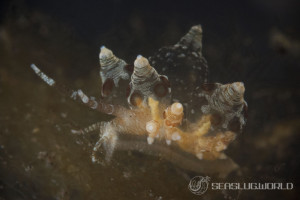
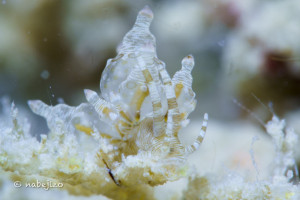
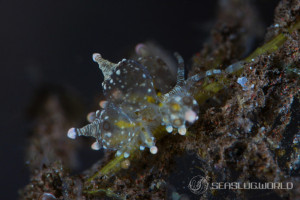
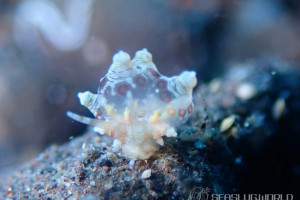
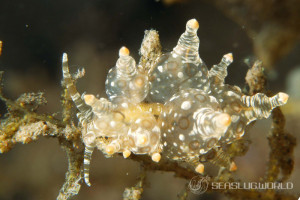
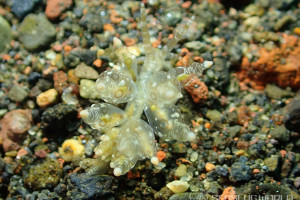
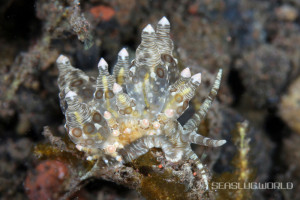
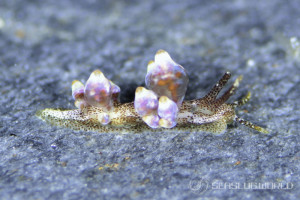
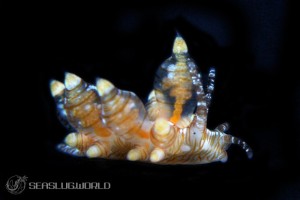
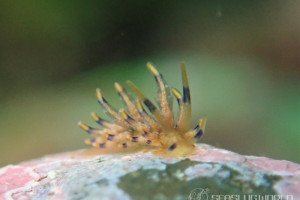
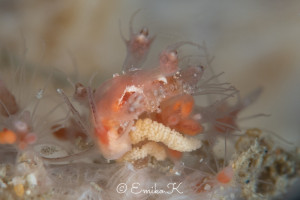
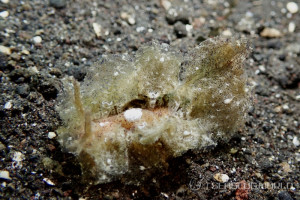
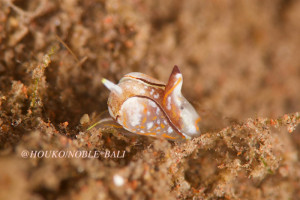
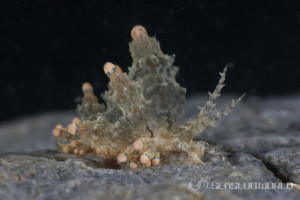
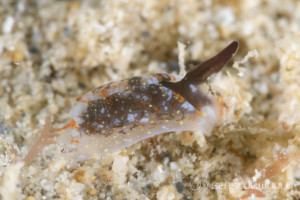
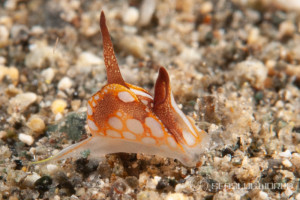
A small aeolid reaching about five-eighths of an inch (ca. 1.6 cm) in body length. The body is linear, white, spotted and blotched with yellow. The dorsal tentacles are long and slender, smooth, tapering to a fine point; yellowish brown in the centre, and white above and below, with a few yellowish spots near the base. The oral tentacles are about half the length of the dorsal pair, white, confluent with the line of the head. The branchial papillae are rather inflated for about two-thirds up, where they become suddenly contracted, and linear towards the apex, which is encircled with brown; five or six brown rings form a chain-like circle round the upper part of the inflated portion, the rest of the surface is white, spotted with yellow, and there is a narrow brown central gland. The papillae are set in four clusters, the front ones much the largest. The foot has the angles produced into long tentacular processes in front, rather broad and fin-like towards the tail. The spawn forms a narrow white riband, loosely coiled in one or two volutions. Alder & Hancock noted that the species is rare; no specimen was preserved.Distribution
Type locality: Waltair, near Vizagapatam, Coromandel coast, Madras Presidency, India (now Visakhapatnam, Andhra Pradesh). Based on a specimen collected by Walter Elliot in 1853–1854 (figured but not preserved). The species has subsequently been recorded from Tanzania, the Red Sea, the Philippines, Indonesia, and New Caledonia, across the tropical Indo-West Pacific.Etymology
The specific epithet ocellata is Latin for "with little eyes / ocellated", in reference to the chain of brown rings on the upper part of each cerata that resembles a circle of small eye-spots.Remarks
In the original description Alder & Hancock placed the species in Eolis. The species was later transferred to Eubranchus Forbes, 1838 (the parentheses in the author citation reflect this generic transfer). The Japanese name "マトミノウミウシ" ("target-aeolid") refers to the chain-like brown rings on the cerata resembling archery targets.References
- Eolis ocellata n. sp., Alder J. & Hancock A. (1864). Notice of a collection of nudibranchiate Mollusca made in India by Walter Elliot Esq., with descriptions of several new genera and species. Transactions of the Zoological Society of London. 5(3): 113-147.
- Eubranchus ocellatus, Terrence Gosliner, Ángel Valdés and David Behrens. (2015). Nudibranch and Sea Slug Identification Indo-Pacific. New World Pubns Inc.
- マトミノウミウシ(新称), 中野理枝. (2018). 日本のウミウシ. 文一総合出版.
Featured in this book
Terrence Gosliner, Ángel Valdés and David Behrens. (2018). Nudibranch and Sea Slug Identification Indo-Pacific 2nd Edition. New World Pubns Inc.
New World Publications
This species, Eubranchus ocellatus, is included in the book.
View on Amazon PR (Amazon Associates)Seasonality
Shooting Locations
Loading shooting locations...
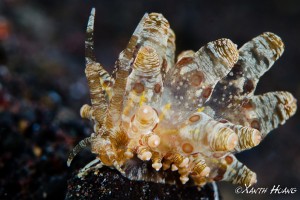
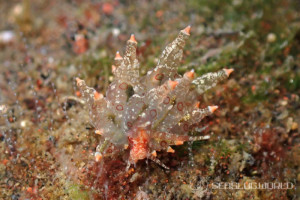
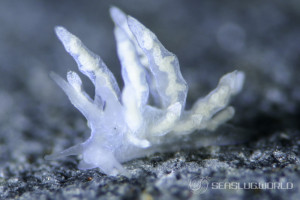
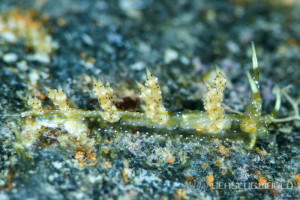
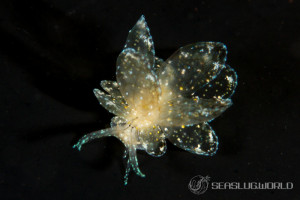
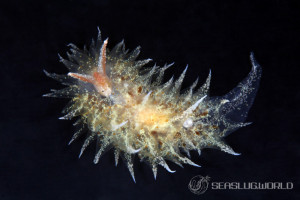
Photos of Eubranchus ocellatus











Same Genus Nudibranchs
Similar Colors Nudibranchs


Academic Database
Sea slug observation data is available in international marine biodiversity databases.