Lamprohaminoea cymbalum (Quoy & Gaimard, 1833)
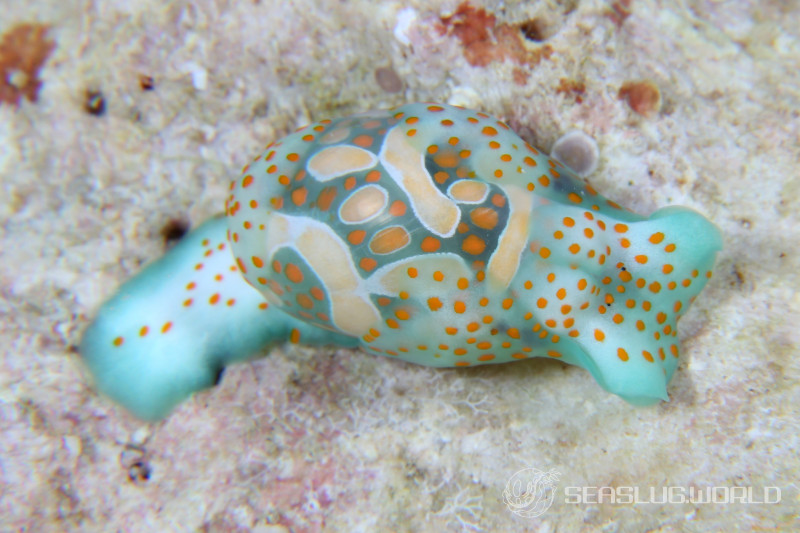
- Location
- Cape Maeda, Okinawa Island (Onna and Yomitan area), Okinawa, Japan
- Date
- 2015/06/16
- Length
- 20mm
- Depth
- 5.0m
- Water temperature
- 27.0℃
Description
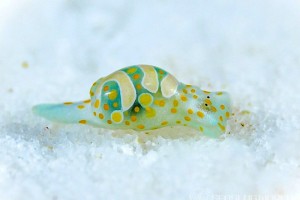
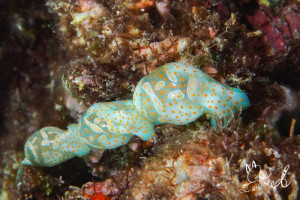
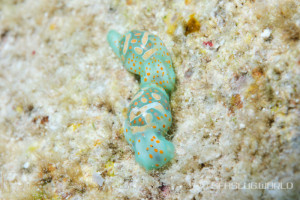
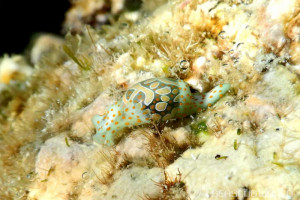
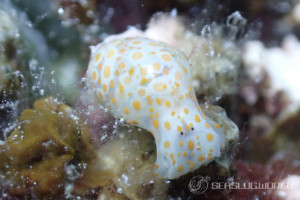
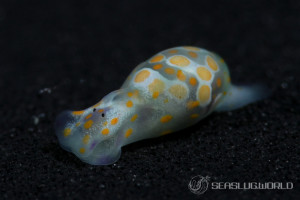
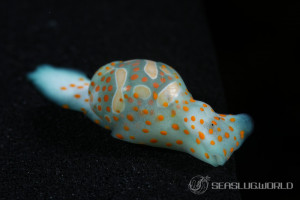
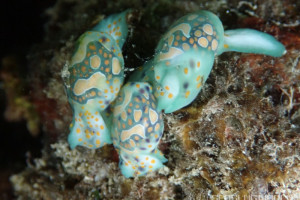
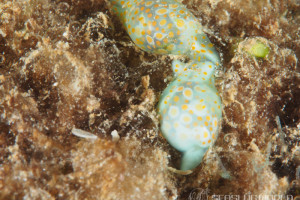
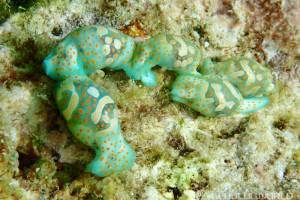
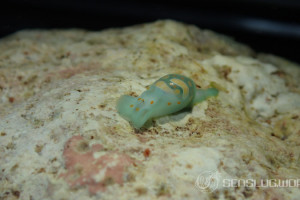
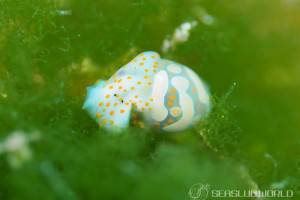
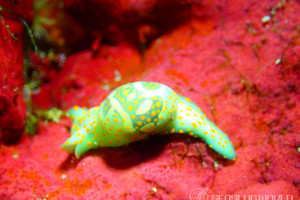
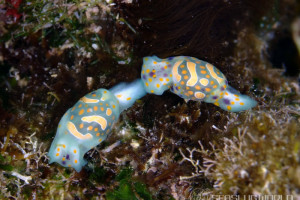
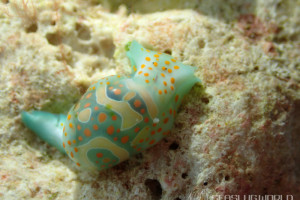
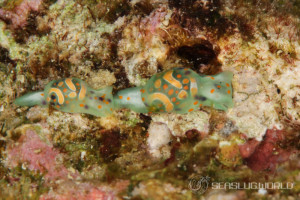
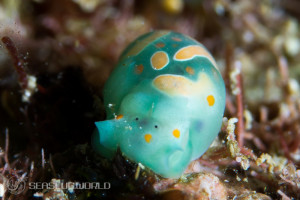
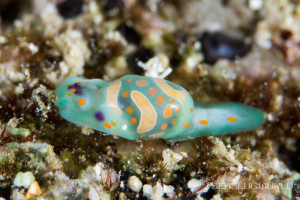
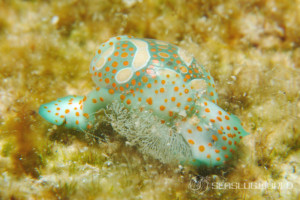
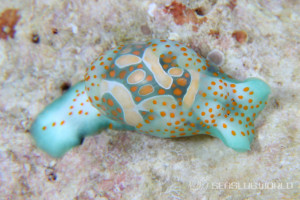
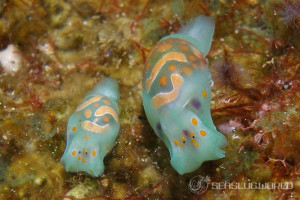
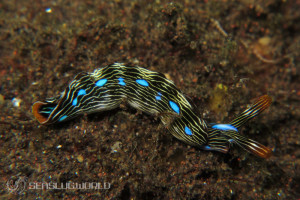
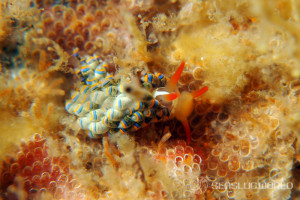
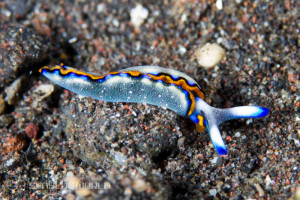
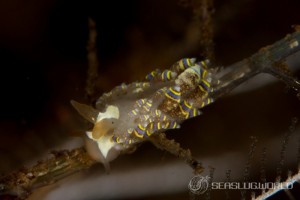
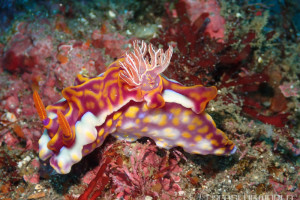
A small cephalaspidean reaching 6-27 mm, commonly around 10 mm. The shell is internal, thin, translucent and white, hidden inside the soft body. The soft body is bright blue-green, overlaid with large, irregular citrus-orange blotches outlined in white, plus scattered dark-orange and bluish-purple markings. The head shield is rounded with a short median notch at the posterior margin. Pairs of animals are often seen following one another in tandem trailing behaviour, thought to be related to pair formation.Distribution
Widely distributed across the Indian Ocean, western Pacific and central Pacific. The type locality is the island of Guam, probably Umatac Bay (baie d'Humata), where the Astrolabe called. Recorded localities include Mozambique, Madagascar, Australia, Indonesia, the Philippines, Japan, Guam, Hawaii, the Cook Islands, Réunion and Christmas Island.Etymology
The specific epithet cymbalum is the Latin for a small cymbal or shallow cup-like vessel, in reference to the rounded translucent shell.Remarks
Originally described as Bulla cymbalum in 1833; the authors knew only the empty shell. The species is the type species of the genus Lamprohaminoea and effectively defines it. Herbivorous, feeding on filamentous green algae (such as Ulva) and algal films on sandy-mud bottoms; sequesters a sesquiterpene metabolite (kumepaloxane) thought to act as a fish-feeding deterrent. Recent molecular phylogenetic analyses confirm Lamprohaminoea as a distinct Indo-West Pacific clade of brightly coloured species within Haminoeidae sensu lato.References
- Bulla cymbalum, Quoy J.R.C. & Gaimard J.P. (1832-1834). Mollusques. In: Dumont d'Urville J. (ed.) Voyage de la corvette l'Astrolabe exécuté par ordre du Roi pendant les années 1826-1827-1828-1829, Zoologie. Tome 2, parts 1 (1832) & 2 (1833). J. Tastu, Paris.
- Haminoea cymbalum, Terrence Gosliner, Ángel Valdés and David Behrens. (2018). Nudibranch and Sea Slug Identification Indo-Pacific 2nd Edition. New World Pubns Inc.
- Lamprohaminoea cymbalum, Oskars T.R. & Malaquias M.A.E. (2019). A molecular phylogeny of the Indo-West Pacific species of Haloa sensu lato gastropods (Cephalaspidea: Haminoeidae): Tethyan vicariance, generic diversity, and ecological specialization. Molecular Phylogenetics and Evolution. 139: 106557. https://doi.org/10.1016/j.ympev.2019.106557
- Oskars T.R., Too C.C., Rees D., Mikkelsen P.M., Willassen E. & Malaquias M.A.E. (2019). A molecular phylogeny of the gastropod family Haminoeidae sensu lato (Heterobranchia: Cephalaspidea): a generic revision. Invertebrate Systematics 33(3): 426-472.
- ミガキブドウガイ, 小野篤司 & 加藤昌一. (2020). 新版 ウミウシ. 誠文堂新光社.
Featured in this book

Terrence Gosliner, Ángel Valdés and David Behrens. (2018). Nudibranch and Sea Slug Identification Indo-Pacific 2nd Edition. New World Pubns Inc.
New World Publications
This species, Lamprohaminoea cymbalum, is included in the book.
View on Amazon PR (Amazon Associates)Seasonality
Shooting Locations
Loading shooting locations...
Photos of Lamprohaminoea cymbalum
Tag:
















Same Genus Nudibranchs
Similar Colors Nudibranchs
Academic Database
Sea slug observation data is available in international marine biodiversity databases.