Notobryon clavigerum Baba, 1937
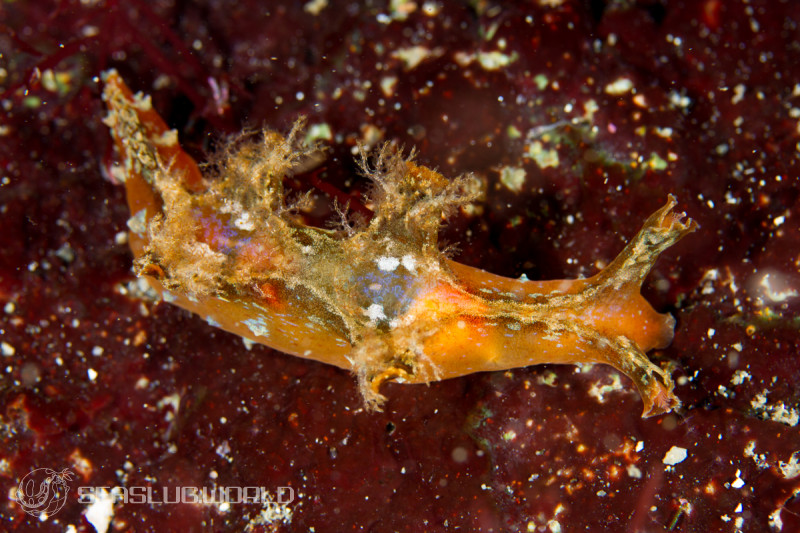
- Location
- Futou beach, Tago, Futou, Dougashima, Shizuoka, Japan
- Date
- 2016/03/04
- Length
- 20mm
- Depth
- 5.0m
- Water temperature
- 15.0℃
Description
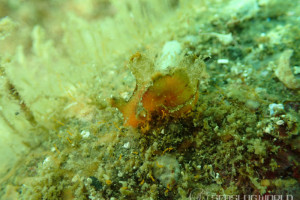
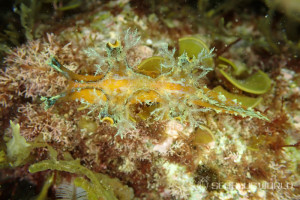
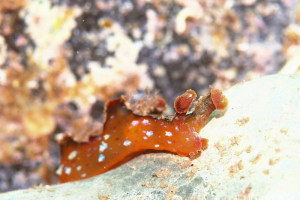
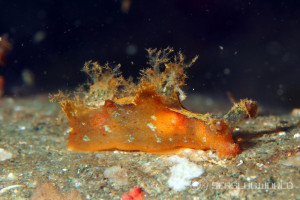
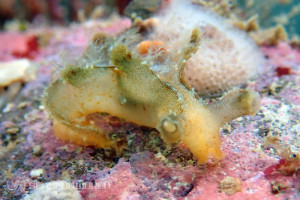
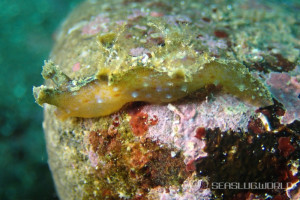
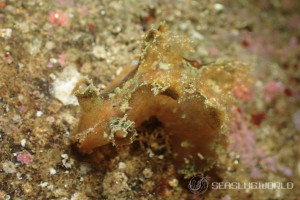
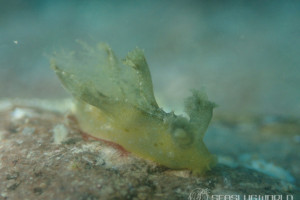
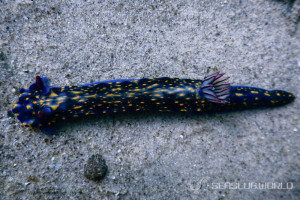
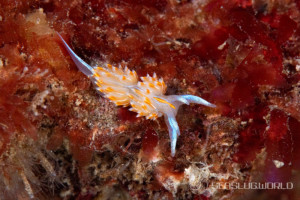
A large notobryid, body length about 80 mm. The head forms an expanded semicircular veil with a wavy margin. The rhinophore sheath has a longitudinal crest along both the anterior and the posterior margin — the most diagnostic external character of this species. Of the dorso-lateral lobes, the posterior pair are slightly smaller than the anterior; the lobes are smooth-edged except at the tip, which curls outward bearing a row of small claw-like papillae (5 on each anterior lobe, 3 on each posterior lobe). The branchiae are large dendritic tufts, 3-4 on each anterior and posterior lobe with one further tuft on the rear of the back. The tail is long and bears a low smooth-edged crest in the middle line, with a row of small conical tubercles along each side.From the coloured field sketch the animal is yellowish with blue markings mainly on the upper sides of the dorso-lateral lobes and the body sides.
Distribution
Type locality: Amadaiba, Sagami Bay, Japan (about 91 m).Etymology
The specific epithet clavigerum is the neuter form of a Latin compound from clava ("club, claw") and -ger ("bearing"), "claw-bearing", in reference to the row of claw-like papillae at the tips of the dorso-lateral lobes.Remarks
Distinguished externally from Notobryon wardi and Notobryon bijecurum by (1) the 3-5 claw-like papillae at the tip of the dorso-lateral lobes and (2) a longitudinal crest along both the anterior and posterior margins of the rhinophore sheath (other congeners have only a posterior crest).References
- Notobryon clavigerum, Baba, K. 1937i. Two new species of the nudibranchiate genus Notobryon from Sagami Bay, Japan. Venus 7(4):165-170.
- ツメウミウシ, Baba K. (1949). Opisthobranchia of Sagami Bay collected by His Majesty the Emperor of Japan (相模湾産後鰓類図譜). Iwanami Shoten, Tokyo. 4+2+194+7 pp., pls. 1-50.
- ツメウミウシ, 鈴木敬宇. (2000). ウミウシガイドブック〈2〉. TBSブリタニカ.
- ツメウミウシ, 小野篤司. (2004). 沖縄のウミウシ. ラトルズ.
- ツメウミウシ, 中野理枝. (2004). 本州のウミウシ. ラトルズ.
- POLA M., CAMACHO-GARCÍA Y.E. & GOSLINER T.M. (2012). Molecular data illuminate cryptic nudibranch species: the evolution of the Scyllaeidae (Nudibranchia: Dendronotina) with a revision of Notobryon. Zoological Journal of the Linnean Society. 165(2): 311-336. https://doi.org/10.1111/j.1096-3642.2012.00816.x
- ツメウミウシ, 奥谷喬司. (2015). 日本近海産貝類図鑑. 第二版. 東海大学出版部.
A Kindle field guide by the site author
Kimoto N. (2026). Sea Slugs of Japan & the Indo-Pacific, 2nd Edition.
Kindle Edition
View on Amazon PR (Amazon Associates)Seasonality
Shooting Locations
Loading shooting locations...
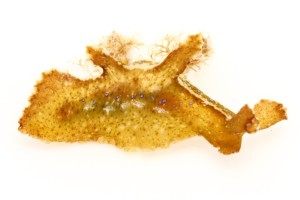
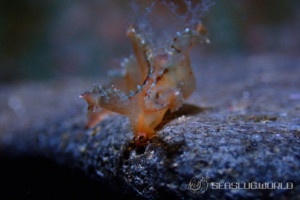
Photos of Notobryon clavigerum










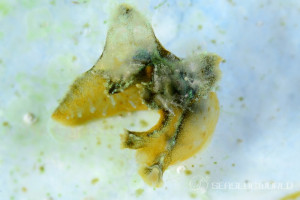

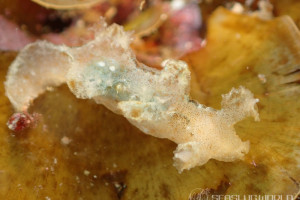


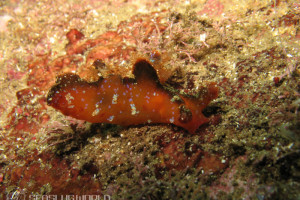

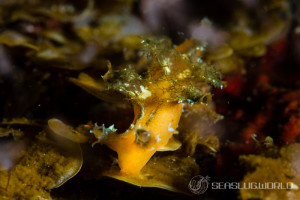
Same Genus Nudibranchs


Similar Colors Nudibranchs



Academic Database
Sea slug observation data is available in international marine biodiversity databases.