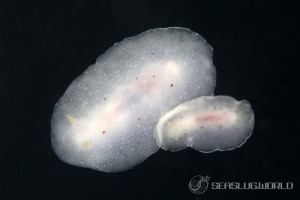
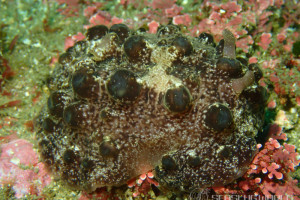
Peltodoris rubra (Bergh, 1905)
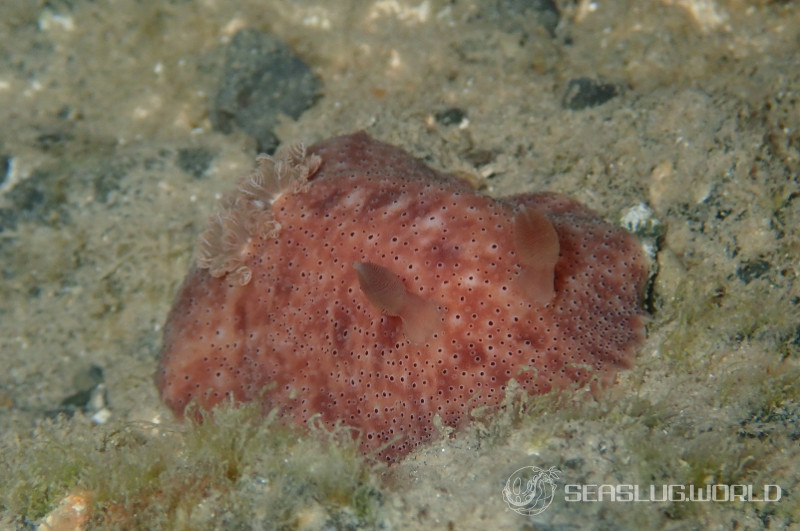
- Location
- Beach, Nanki kushimoto, Wakayama, Japan
- Date
- 2018/10/20
- Length
- 40mm
- Depth
- 2.0m
- Water temperature
- 20.0℃
Description
A medium-sized dorid reaching 7.5 cm in body length when alive. From the original description (Bergh 1905, p.104) the verbatim notes on the living specimen read: "Dasselbe hatte eine Länge von 7,5 cm. bei einer Breite von 4,5; die Höhe der Rhinophorien betrug 8 mm., der Durchmesser des Kiemensterns 30 mm. Die Farbe der Rückenseite war etwas marmorirt roth, mit zwei Reihen von einigen (3) dunkleren grossen Flecken; das Laub der Kieme hell gelb." — body length 7.5 cm, breadth 4.5 cm, rhinophore height 8 mm, gill star diameter 30 mm; the dorsum somewhat marbled red, with two rows of some (3) larger darker blotches; the gill foliage pale yellow.The preserved specimen measured 7.8 cm in length, 4 cm in breadth and 1.7 cm in height; the mantle skirt was usually 11 mm wide, reaching 17 mm posteriorly. The ground colour was whitish but largely replaced on the dorsum by red-brown marbling, which on the mantle skirt and tail edge ran out in a radiating pattern; the dorsum proper bore 2-3 rows of larger blackish-brown blotches in groups of 3-4. Low whitish papillae up to 0.5 mm in diameter were scattered over the whole dorsum, most of them carrying a deep black central dot (Fig. 11). The rhinophores had a red-brown stalk and a paler club; the gill consisted of 5 plumes with red-grey rachides, the white-rimmed anal papilla central, the foliage whitish. The underside of the mantle skirt was whitish with scattered irregular blackish-brown to red-brown spots up to 4 mm across; the sole bore similar but smaller and more numerous spots; the foot edge had a strong anterior groove, and the tail was short.
The body was elongate-oval, somewhat flattened, of fairly soft consistency. The dorsum was almost level; the broad mantle skirt margin was slightly undulating. The rhinophores were stout, the club bent slightly backwards. The gill aperture was round, 8 mm across, with a 1 mm raised rim, and the 5 gill plumes were connected at their bases. The oral tentacles were small and almost conical. The foot was overhung all round by the mantle, rounded both anteriorly and posteriorly; its margin was rather narrow, the anterior border with a strong marginal groove, the tail short. The radula had 32 rows with up to 105 plates per row (of which 12 still developing in the sheath), giving a total of 44 rows. The plates were almost colourless; the inner hook reached a height of 0.10 mm, the plates rose to a maximum of 0.22 mm and decreased again outwards (outermost plates 0.08-0.11 mm). The pharyngeal bulb was 7 mm long with a height and breadth of 4 mm; on either side of the mouth was a strong yellow lip plate, formed by rod-shaped elements 0.075 mm long and 0.005 mm in diameter.
Distribution
Type locality: reef at Pasir Pandjang on the west coast of Binongka, southeast Sulawesi, Indonesia (Siboga Expedition station 220, collected 3 November). A second specimen referred to the same species was obtained at the anchorage between Gisser Island and Ceram Laut (station 172, 28 August). Now known to be widely distributed in the Indo-West Pacific.Etymology
The specific epithet rubra is the feminine form of the Latin adjective ruber ("red"), referring to the bright red colour of the living dorsum: "Die Farbe der Rückenseite war etwas marmorirt roth".Remarks
The species was originally printed in the body text and on the plates as Discodoris ? Sibogae Bergh, 1905 (p.104-106; Taf. I Fig. 8; Taf. XIV Fig. 11-14). The Corrigenda at the end of the same monograph contain the correction "Seite 104 Discodoris} Sibogae Bgh. ist Discodoris rubra Bgh.; zu dieser Art gehört Taf. I, Fig. 7; Taf. XIV, Fig. 11-14." — Taf. I Fig. 7 having been labelled Discodoris rubra, this name is the one Bergh fixed for the species and Discodoris rubra Bgh. became the formal epithet. The species was later transferred from Discodoris Bergh, 1877 to Peltodoris Bergh, 1880, hence the parenthesised authorship of the present combination. Bergh himself, unable to examine the anterior genital mass in detail, noted that the species might equally belong to Diaulula ("es wäre möglich, das sie der Gattung Diaulula angehörte").References
- Discodoris rubra Bgh. n. sp., Bergh R. (1905). Die Opisthobranchiata der Siboga-expedition. https://doi.org/10.5962/bhl.title.11223
- Peltodoris rubra, Terrence Gosliner, Ángel Valdés and David Behrens. (2015). Nudibranch and Sea Slug Identification Indo-Pacific. New World Pubns Inc.
- アカコダテウミウシ(新称), 中野理枝. (2018). 日本のウミウシ. 文一総合出版.
Featured in this book
Terrence Gosliner, Ángel Valdés and David Behrens. (2018). Nudibranch and Sea Slug Identification Indo-Pacific 2nd Edition. New World Pubns Inc.
New World Publications
This species, Peltodoris rubra, is included in the book.
View on Amazon PR (Amazon Associates)Seasonality
Shooting Locations
Loading shooting locations...
Photos of Peltodoris rubra

Same Genus Nudibranchs
Similar Colors Nudibranchs
Academic Database
Sea slug observation data is available in international marine biodiversity databases.