Phanerophthalmus purpura Austin, Gosliner & Malaquias, 2018
Phanerophthalmus purpura
No field photograph submitted for this species yet
Have you photographed this species?Description
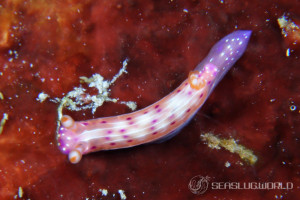
Maximum total length 25 mm (live). Body cylindrical, elongated; purple to nearly reddish. Anterior half of cephalic shield quadrangular, posterior half triangular, notched, ending in a pair of posterior lobes, slightly separated; white pigment can be present. Left parapodial lobe overlapping right lobe. Shell not visible. Eyes visible; periocular area ?pigmented. Shell maximum H = 5.5 mm (spc. TL = 22 mm); plate-like, thin, fragile; white to translucent; squarish oval, left and right sides slightly convex; shoulder present, pointed, sometimes with sharp tip; anterior end angled, oblique, rounded. Jaws semi-circular, elongate; rods ending in multiple finger-like denticles. Radula formula 42×13.1.13 (spc. TL = 22 mm), 44×13.1.13 (spc. TL = 10 mm fixed) and 35×9.1.9 (fixed spc. TL = 8 mm); lateral teeth hook-shaped with wide base and narrow-elongated pointed cusp; rachidian with central cusp surrounded by broad rounded brim and one smaller cusp on either side. Gizzard plates with one row of rods on top of ridge only. Penial sheath wider than seminal duct; seminal duct nearly twice the length of penial sheath, slender; prostate cylindrical-elongate, bulbous, longer than seminal duct.Distribution
Bali, Indonesia; the Philippines; and the Ryukyu Islands, Japan (Fig. 24). Subtidal, between 18-21 m depth.Etymology
Verbatim from the original description:Named after the purple colouration of this species (L. purpura = purple).
Remarks
Described as a new species in 2018. The authors noted:these two species [P. purpura and its sister species P. anettae] are nearly indistinct and difficult to separate without the aid of genetics (COI uncorrected p-distance = 10.9%; Table 2; PP = 1, BS = 100; Fig. 1). Phanerophthalmus purpura is distinguished from all other species in the genus by four molecular synapomorphies in the region of the COI gene here studied ... and from its sister species P. anettae by 70 unique mutations(p.1381). Ontogenetic differences were observed between adults and a smaller fixed specimen (TL = 8 mm, CAS-IZ 203073, paratype): the smaller specimen had a rounder anterior shell, fewer lateral teeth, about half the number of gizzard ridges, an undeveloped male reproductive system, and white pigmentation on the posterior cephalic shield.
References
- Phanerophthalmus purpura, Adams A. (1850). Monograph of the family Bullidae. In: Sowerby G.B. (II) Thesaurus Conchyliorum, or Monographs of Genera of Shells. Vol. 2. London: Sowerby. pp. 553-608, pls. 119-125.
- チョウチョウミドリガイ, 小野篤司. (1999). ウミウシガイドブック. TBSブリタニカ.
- チョウチョウミドリガイ, 小野篤司. (2004). 沖縄のウミウシ. ラトルズ.
- チョウチョウミドリガイ, 中野理枝. (2004). 本州のウミウシ. ラトルズ.
- Phanerophthalmus sp. 3, Terrence Gosliner, Ángel Valdés and David Behrens. (2015). Nudibranch and Sea Slug Identification Indo-Pacific. New World Pubns Inc.
- Austin J., Gosliner T. & Malaquias M.A.E. (2018). Systematic revision, diversity patterns and trophic ecology of the tropical Indo-West Pacific sea slug genus Phanerophthalmus A. Adams, 1850 (Cephalaspidea, Haminoeidae). Invertebrate Systematics. 32(6): 1336-1387. https://doi.org/10.1071/is17086
- Phanerophthalmus sp. 10, Terrence Gosliner, Ángel Valdés and David Behrens. (2018). Nudibranch and Sea Slug Identification Indo-Pacific 2nd Edition. New World Pubns Inc.
- Oskars T.R., Too C.C., Rees D., Mikkelsen P.M., Willassen E. & Malaquias M.A.E. (2019). A molecular phylogeny of the gastropod family Haminoeidae sensu lato (Heterobranchia: Cephalaspidea): a generic revision. Invertebrate Systematics 33(3): 426-472.
Featured in this book
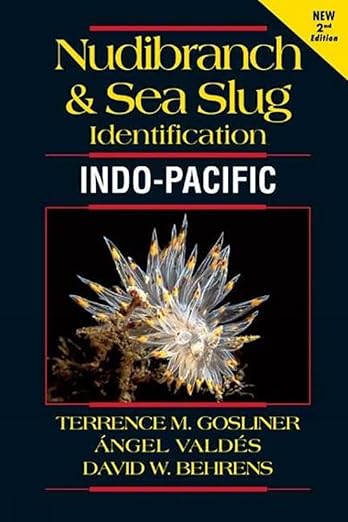
Terrence Gosliner, Ángel Valdés and David Behrens. (2018). Nudibranch and Sea Slug Identification Indo-Pacific 2nd Edition. New World Pubns Inc.
New World Publications
This species, Phanerophthalmus purpura, is included in the book.
View on Amazon PR (Amazon Associates)Seasonality
Shooting Locations
Loading shooting locations...
Same Genus Nudibranchs

Similar Colors Nudibranchs
Academic Database
Sea slug observation data is available in international marine biodiversity databases.