Phanerophthalmus albotriangulatus Austin, Gosliner & Malaquias, 2018
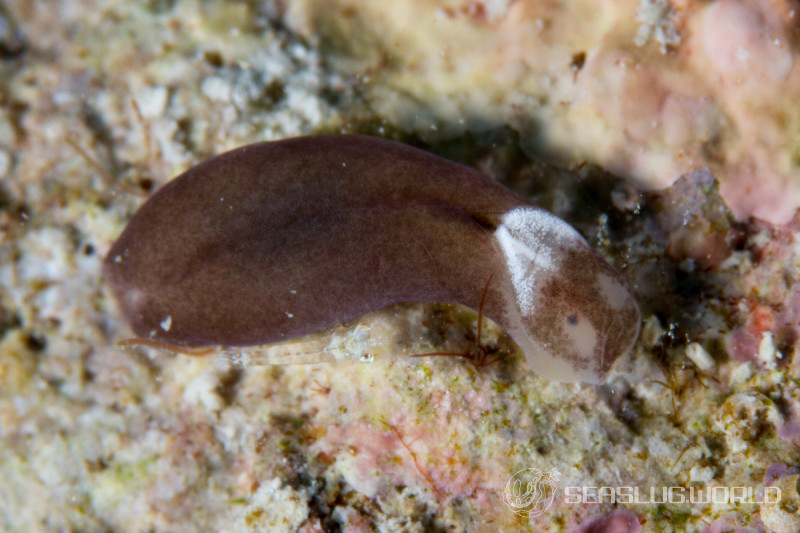
- Location
- Taketomi South, Ishigaki and Yaeyama, Okinawa, Japan
- Date
- 2017/02/14
- Length
- 10mm
- Depth
- 6.0m
- Water temperature
- 24.0℃
Description
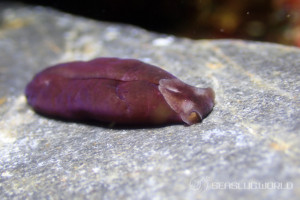
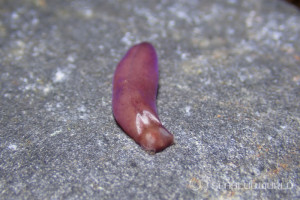
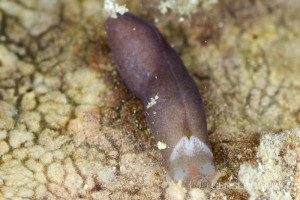
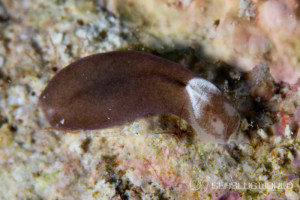
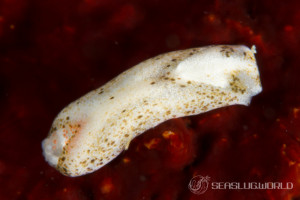
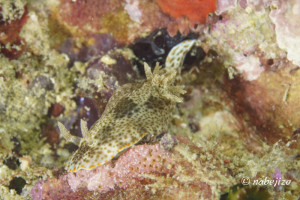
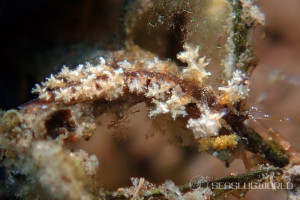
Body cylindrical, elongated; dark brown. Anterior half of cephalic shield quadrangular, posterior half triangular, notched, ending in a pair of posterior lobes, slightly separated. Posterior triangular area white. Left parapodial lobe overlapping right lobe. Shell not visible. Eyes visible; periocular area unpigmented. Shell H = 2 mm (fixed spc. TL = 4 mm); external, plate-like, thin, fragile; white to translucent; squarish oval, right and left sides straight; anterior aperture expanding slightly outwards beyond columella; shoulder present, pointed; anterior end angled and rounded. Jaws semi-circular, elongate; rods ending in finger-like denticles. Radula formula 36×10.1.10; lateral teeth hook-shaped with wide base, slim, elongated, pointed cusp with thinner margins; rachidian with triangular-rounded central cusp with developed brim and one smaller triangular cusp on either side. Gizzard plates with single row of rods on top of ridges; inner rods present only along rachis of plate on anterior side of ridges. Penial sheath long, similar in length to prostate; seminal duct slender, shorter; prostate cylindrical, bulbous, elongate.Distribution
The Philippines (current study), the Ryukyu Is., Japan (Atsushi 1999, 2004: as P. smaragdinus var.), and Madang, Papua New Guinea (Gosliner et al. 2008, 2015: as P. albocollaris) (Fig. 25). Type locality: Lubang Island, Mindoro, the Philippines.Etymology
Verbatim from the original description (Austin et al. 2018, Invertebrate Systematics 32: 1363):Named after the colouration of the upper part of the cephalic shield, which depicts a striking white triangle (white, L. alba, triangle, L. triangulum).
Remarks
Described as a new species in a 2018 systematic revision of Phanerophthalmus. The brownish colour pattern of P. albocollaris, P. albotriangulatum and P. cerverai all share a white W-mark posteriorly on the cephalic shield, but P. albocollaris is endemic to the Red Sea while P. albotriangulatum and P. cerverai co-occur in the Coral Triangle. P. albotriangulatum lacks the white pigmentation on the anterior part of the cephalic shield present in P. cerverai, and anatomically has a male reproductive system with a shorter seminal duct of similar size to the penial sheath, whereas P. cerverai bears a seminal duct twice as long as the penial sheath. P. albotriangulatum was recovered as sister to the Red Sea endemic P. olivaceus (COI uncorrected p-distance = 10.9%; PP = 1, BS = 97; p.1363).References
- チョウチョウミドリガイ, 小野篤司. (2004). 沖縄のウミウシ. ラトルズ.
- チョウチョウミドリガイ, 中野理枝. (2004). 本州のウミウシ. ラトルズ.
- Phanerophthalmus albocollaris, Terrence Gosliner, Ángel Valdés and David Behrens. (2015). Nudibranch and Sea Slug Identification Indo-Pacific. New World Pubns Inc.
- Austin J., Gosliner T. & Malaquias M.A.E. (2018). Systematic revision, diversity patterns and trophic ecology of the tropical Indo-West Pacific sea slug genus Phanerophthalmus A. Adams, 1850 (Cephalaspidea, Haminoeidae). Invertebrate Systematics. 32(6): 1336-1387. https://doi.org/10.1071/is17086
- Phanerophthalmus sp.2, Terrence Gosliner, Ángel Valdés and David Behrens. (2018). Nudibranch and Sea Slug Identification Indo-Pacific 2nd Edition. New World Pubns Inc.
- Oskars T.R., Too C.C., Rees D., Mikkelsen P.M., Willassen E. & Malaquias M.A.E. (2019). A molecular phylogeny of the gastropod family Haminoeidae sensu lato (Heterobranchia: Cephalaspidea): a generic revision. Invertebrate Systematics 33(3): 426-472.
Featured in this book
Terrence Gosliner, Ángel Valdés and David Behrens. (2018). Nudibranch and Sea Slug Identification Indo-Pacific 2nd Edition. New World Pubns Inc.
New World Publications
This species, Phanerophthalmus albotriangulatus, is included in the book.
View on Amazon PR (Amazon Associates)Seasonality
Shooting Locations
Loading shooting locations...
Photos of Phanerophthalmus albotriangulatus
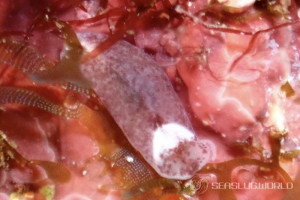

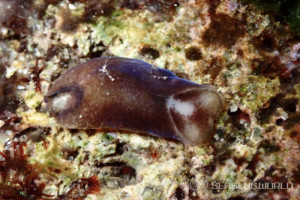

Same Genus Nudibranchs

Similar Colors Nudibranchs
Academic Database
Sea slug observation data is available in international marine biodiversity databases.