Volvatella ayakii Hamatani, 1972
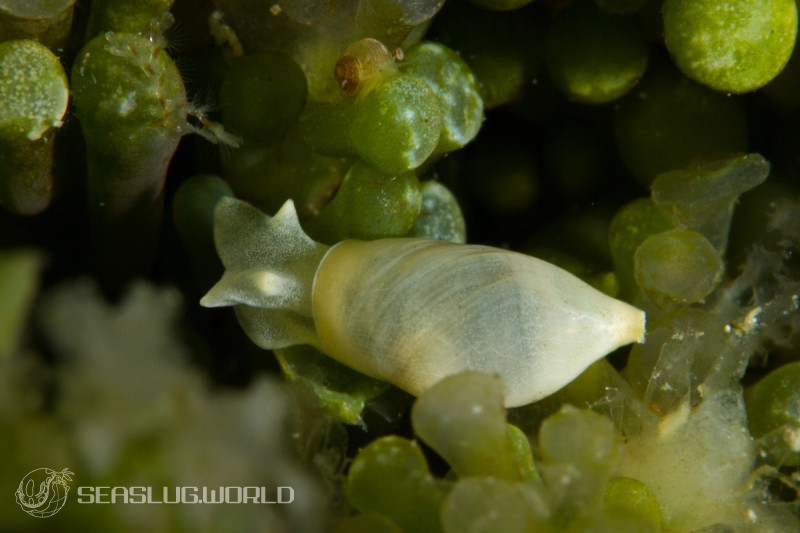
- Location
- Sokodo(Sanmata), Hachijo Island, Tokyo, Japan
- Date
- 2016/07/12
- Length
- 8mm
- Depth
- 4.0m
- Water temperature
- 21.0℃
Description
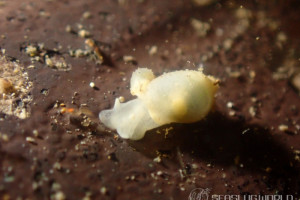
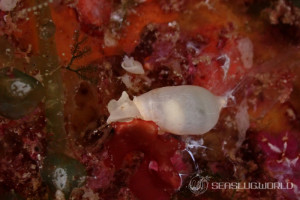
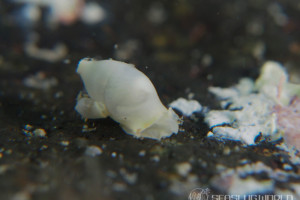
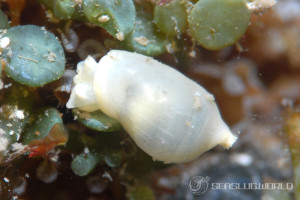
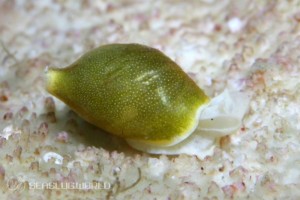
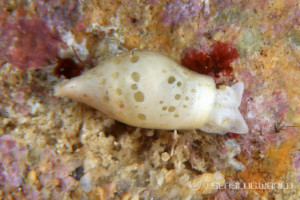
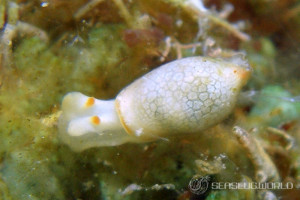
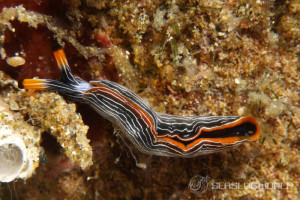
A small shelled sacoglossan, shell length about 6 mm. Living animals are whitish at a glance with a milky white soft body; shells are thin, fragile and ovoid, 3.8-6.2 mm long and 2.0-3.4 mm wide, while extended animals reach up to 7 mm. The soft body can be fully involuted within the shell. A pair of rhinophore-like protuberances rises on the head, with paired pure black eyes visible posterior to their bases. Numerous white opaque dots are scattered over the body, especially densely along the anterior border of the head-shield, on the protuberances, on foot-corners and posterior to the gill-belt; these dots secrete copious white mucus when stimulated. The shell is covered with a membraneous epidermis, with the body whorl rounded and slightly swollen in the middle, contracting near the posterior end into a short spout. Specimens preserved in alcohol turn yellowish orange.Distribution
Lower intertidal zone near Cape Shionomisaki, Kii Peninsula, Middle Japan (Honshu). Prior to the description of Volvatella ayakii, no species of Volvatella had been known from Honshu; only V. vigourouxi (Montrouzier, 1861) had been recorded from the Amami Islands south to Kyushu and Okinawa.Etymology
From the original description:the form represents clearly a new species, which is named ayakii in memory of Mr. Ayaki Y. Nakajima whose aid made the present author collect these specimens.
Notes
The 31 type specimens were collected from colonies of the green alga Caulerpa brachypus Harvey on rocky substratum in the lower intertidal zone, as part of the so-called "caulerpan microfauna", together with Cylindrobulla japonica Hamatani, 1969 and 12 other opisthobranchs. The shell most closely resembles that of Volvatella cumingii (A. Adams, 1855) but has a less swollen body whorl, and is also similar to V. ficula Burn, 1966 from Fiji though lacking the narrow orange band along the anterior mantle margin characteristic of the latter.References
- Volvatella ayakii, Hamatani I. (1972). A new species of Volvatella Pease, 1860, found in the "Caulerpan microfauna" in the province of Kii, Middle Japan (Opisthobranchia: Sacoglossa). Publications of the Seto Marine Biological Laboratory. 21(1): 13-20, pls II-III. https://doi.org/10.5134/175800
- Volvatella ayakii (genus context), Clark K.B. (1982). A new Volvatella (Mollusca: Ascoglossa) from Bermuda, with comments on the genus. Bulletin of Marine Science. 32(1): 112-120.
A Kindle field guide by the site author
Kimoto N. (2026). Sea Slugs of Japan & the Indo-Pacific, 2nd Edition.
Kindle Edition
View on Amazon PR (Amazon Associates)Seasonality
Shooting Locations
Loading shooting locations...
Photos of Volvatella ayakii
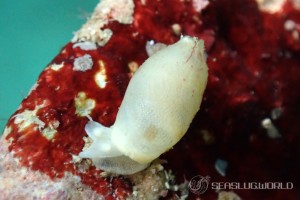

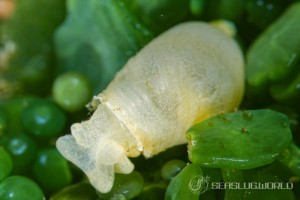





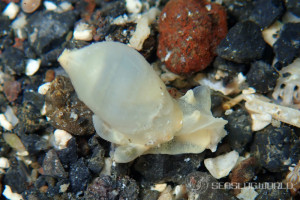
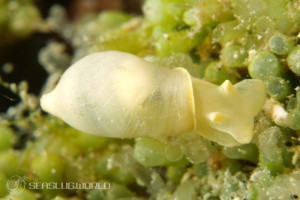

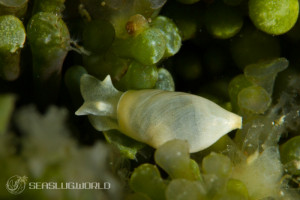

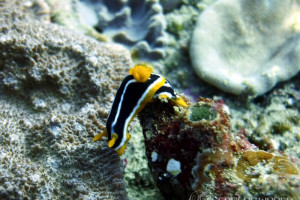
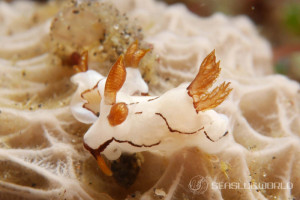
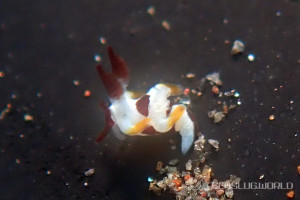
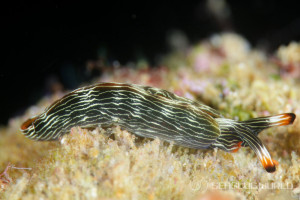
Same Genus Nudibranchs
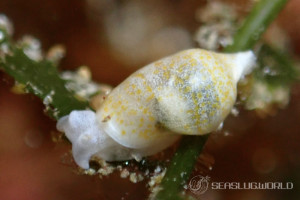
Similar Colors Nudibranchs

Academic Database
Sea slug observation data is available in international marine biodiversity databases.