Is Discodorididae sp.26 a Gargamella?
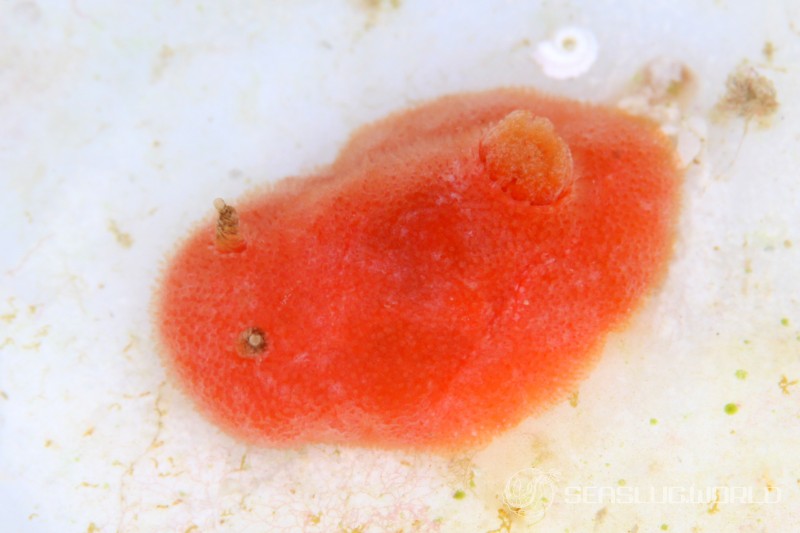
Sea Slugs of Okinawa: An Updated Identification Guide Based on DNA Analysis, 1,089 Species (Imagawa 2026) treats an Okinawan animal (our Discodorididae sp.26) as Gargamella sp. and gives it a new Japanese vernacular name. When its DNA is compared, it comes out closest to the South African Gargamella elandsia. So — is it a Gargamella? The short answer is that, with what we have in hand, it cannot be decided. Here is why.
What the DNA can tell us
COI, 16S and H3 have been obtained from this animal. Against the sequences of Gargamella elandsia (voucher CAS:IZ:176110), the distances are as follows.
| marker | distance to G. elandsia |
|---|---|
| COI | 13.3% |
| 16S | 6.1% |
| H3 | 5.5% |
At first glance COI 13.3% looks like a between-species distance, but the genus Gargamella is very broad inside: the COI distance between G. elandsia and G. immaculata (the type species) is 15.8%. This animal's 13.3% is smaller than that — by the numbers alone, it falls within the genus's internal range. But "a distance that fits inside the genus" and "falling inside the genus" are two different things.
- Cannot say (inside the genus?): whether this animal falls within Gargamella or stands as a separate lineage beside it cannot be decided from distance alone. The figure can be read as within-genus (a 15.8%-wide genus) or as a sister genus.
- Cannot say (outside the genus?): conversely, one cannot declare "it is not Gargamella" either. Since 13.3% is smaller than the within-genus 15.8%, there is no molecular basis for putting it outside.
Distance measures how near or far, but not the shape of the branching — whether the animal sits inside the genus's branch or beside it. That is decided by the tree, and the tree on which Gargamella was defined (Figure 1 of Fernández-Vilert et al. 2024) is built by concatenating four genes: COI, 16S and H3 plus 28S. Fast-evolving genes like COI tell species apart well, but at splits as deep as a genus their variation saturates. That deeper signal is carried by the slowly-evolving 28S, which occupies the longest stretch in that tree (about 910 bp). What we have is COI, 16S and H3 — the 28S that carries signal at this depth is not yet in hand. So what happens if we build a tree from just the three we have?
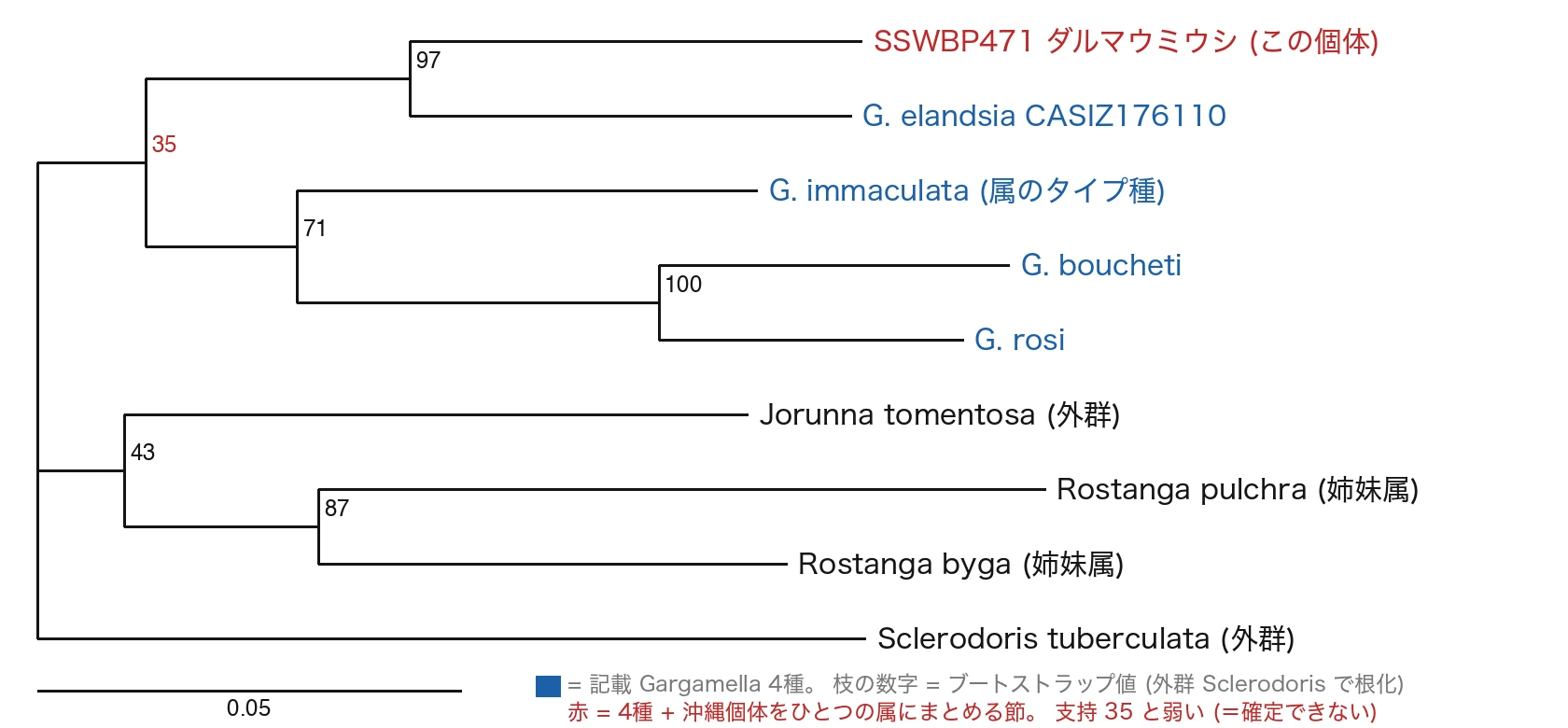
We concatenated COI, 16S and H3 and built a maximum-likelihood tree (below). The animal comes out strongly paired with G. elandsia (support 97), and it falls within the same cluster as all four described Gargamella. On the molecules alone, then, it looks like it could be a Gargamella. But the node that binds those four species plus this animal into one genus has a bootstrap of only 35 (red in the figure) — far from settled. Every genus-level node is weak (35, 43); three genes cannot pin down relationships at this depth. The molecules show "close, probably inside," but confirming the genus needs both the four-gene framework (with 28S) that defined it and the morphological character that separates it.
Its coloration and body shape are quite different from G. elandsia. That is material for suspecting a separate lineage, but on its own it does not settle the genus either. Molecularly and morphologically alike, the genus can at present be neither confirmed nor denied.
The rest of this article is for Premium members
This is one of our in-depth member articles — new species reports, paper walkthroughs, and taxonomy deep-dives. Members read them all. Free for your first month, then USD 3.00/month, cancel anytime.
- New species reports, paper walkthroughs, and taxonomy deep-dives — members only
- No ads (AdSense) across the entire site
- Priority handling of your observations (Premium uploads are identified and published first when the moderation queue is backed up)
- Priority access to the AI identification feature
Already a member? Please log in.
Enjoyed this post? You can tip the author directly —
Tip this post