Is the Okinawan animal really distinct from Dermatobranchus albus? (Can one unpublished sequence overturn a published treatment?)
The book identifies a single Okinawan specimen (SSWBP520) as an undescribed species distinct from Dermatobranchus albus (Eliot, 1904), and assigns it a new Japanese vernacular name. Its basis for treating the animal as a separate species is an observation that the external morphology differs from the known D. albus — a photograph-based identification — and no molecular support is presented in the book.
So we checked the COI sequence the book records as the voucher for this specimen (SSWBP520). Its closest match on GenBank is a single sequence labelled D. albus, MW940348, at about 90% identity (roughly 10% distance, a between-species level). But MW940348 is itself unpublished and has no photograph, so it lacks any basis for its own identification, and that ~90% cannot be read as "the distance to true D. albus." A single sequence is not enough either to confirm a separate species or to reject one. The one published standard, meanwhile, is Gosliner & Fahey 2011, which treats D. albus — Okinawan material included — as a single, broadly variable species.
The book's determination and our check
| Item | Content |
|---|---|
| Specimen | SSWBP520 (Okinawa) |
| Book's name / new vernacular name | Dermatobranchus sp. / a new Japanese vernacular name (judged distinct from D. albus) |
| Basis the book gives for a separate species | Difference in external morphology (photograph-based identification); no molecular data presented |
| Our check | Compared the COI of SSWBP520 against GenBank. Closest sequence is MW940348 (collected in Batangas Bay, Philippines; labelled D. albus), at about 90% identity (~10% distance) |
| Provenance of MW940348 | Deposited on GenBank by Larkin, Donohoo & Gosliner in 2021. The associated paper is unpublished; the specimen (CAS:IZ:217272) has zero photographs on either iDigBio or GBIF |
| Our existing page | D. albus (adopting the broad treatment of Gosliner & Fahey 2011) |
The standard set by Gosliner & Fahey 2011
Gosliner & Fahey 2011 (Zoological Journal of the Linnean Society 161: 245–356) treats D. albus as follows.
- The type locality is Tanzania (Eliot 1904, originally described as Pleuroleura alba)
- The material examined ranges from South Africa to the Philippines and on to Okinawa, and the Okinawan material includes several specimens, such as those from Seragaki
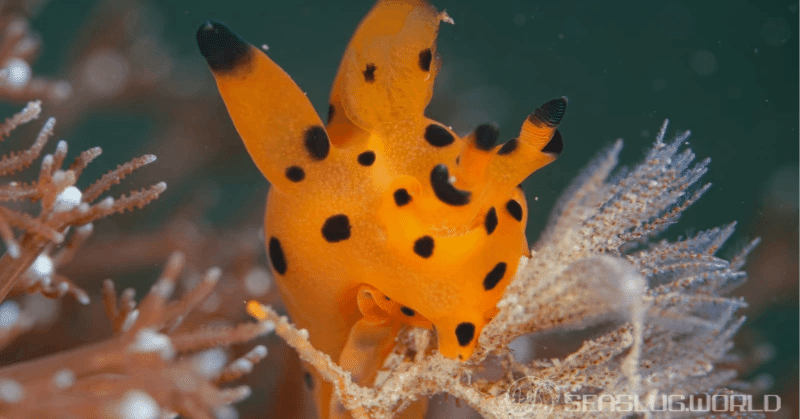
- Dorsal colour ranges from white through grey to black, and the colour of the pits varies widely too — orange, yellow, blue, black
- Even so, the paper states explicitly that all of these specimens share the same radular and reproductive morphology, and, having acknowledged the range of colour, treats them as a single species
In other words, Gosliner & Fahey 2011 placed Okinawan animals squarely within D. albus. This is at present the only published standard for D. albus, and it is the one we follow.
A check alone cannot establish a separate species
To support the book's "separate species" independently with molecules would require at least the following, none of which exists as public data.
- Assurance that MW940348, the closest match in our check, belongs to the same lineage as "true D. albus" (the concept fixed by the Tanzanian type). Right now the only anchor is a depositor's label on an unpublished paper, and a GenBank label is not an identification
- DNA of the Okinawan specimens Gosliner & Fahey 2011 examined (such as the Seragaki animals). No sequences were taken from these, so there is no molecular way to tell whether SSWBP520 is the same lineage as "Gosliner & Fahey's Okinawan D. albus"
- Comparison with fresh material from the type locality, Tanzania
Even to back the book's separate-species call with molecules, the only thing available for the check is a single unpublished sequence. The basis for molecularly replacing the published decision that placed Okinawan animals within D. albus is not yet in place.
Which name points to which lineage
The rest of this article is for Premium members
To read the rest of this article, a Premium membership (USD 3.00/month) is required.
- Unlimited access to all members-only articles, including new species reports and paper introductions
- No ads (AdSense) across the entire site
- Priority handling of your observations (Premium uploads are identified and published first when the moderation queue is backed up)
- Priority access to the AI identification feature
Already a member? Please log in.
Enjoyed this post? You can tip the author directly —
Tip this post