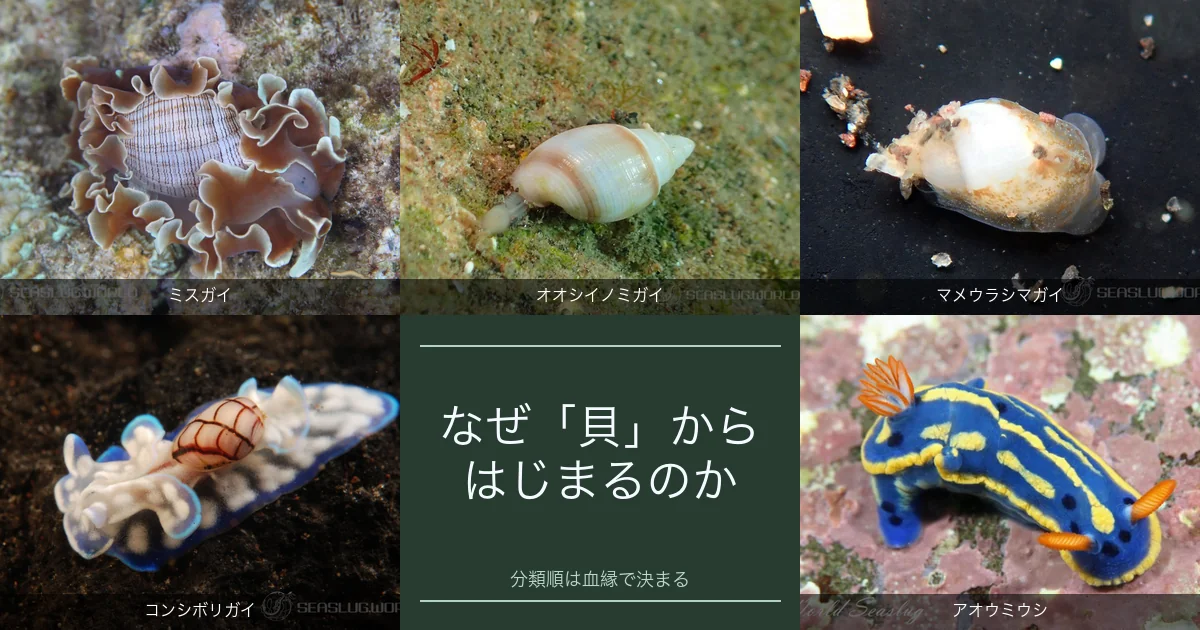
Why does a sea slug catalogue start with snails?
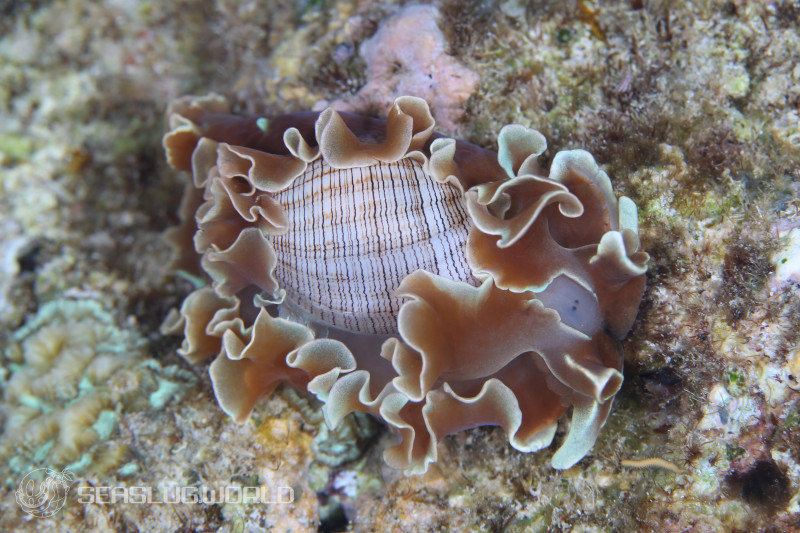
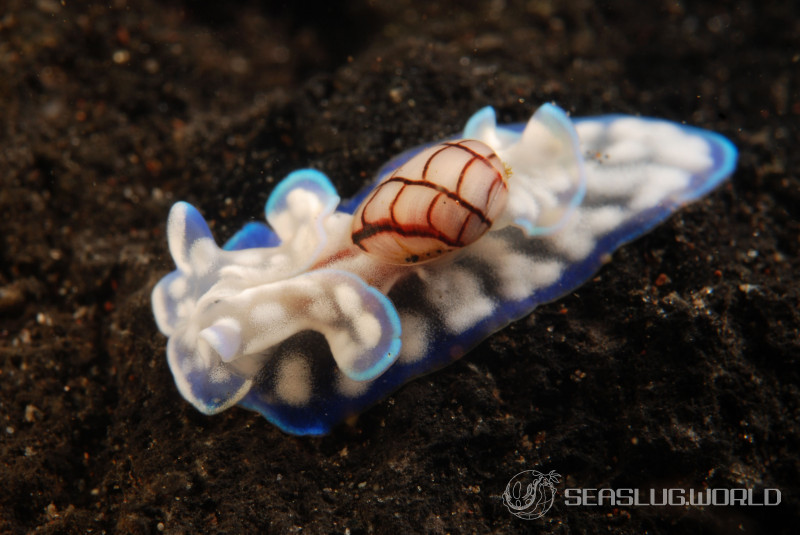
Open a sea slug catalogue in "taxonomic order" and the first species you meet are coiled snails: Hydatina and Acteon. Pleurobranchs and nudibranchs follow, and Umbraculum and the head-shield slugs come near the end. What decides this sequence? The answer is that a catalogue's taxonomic order is a classification tree, flattened into a single line.
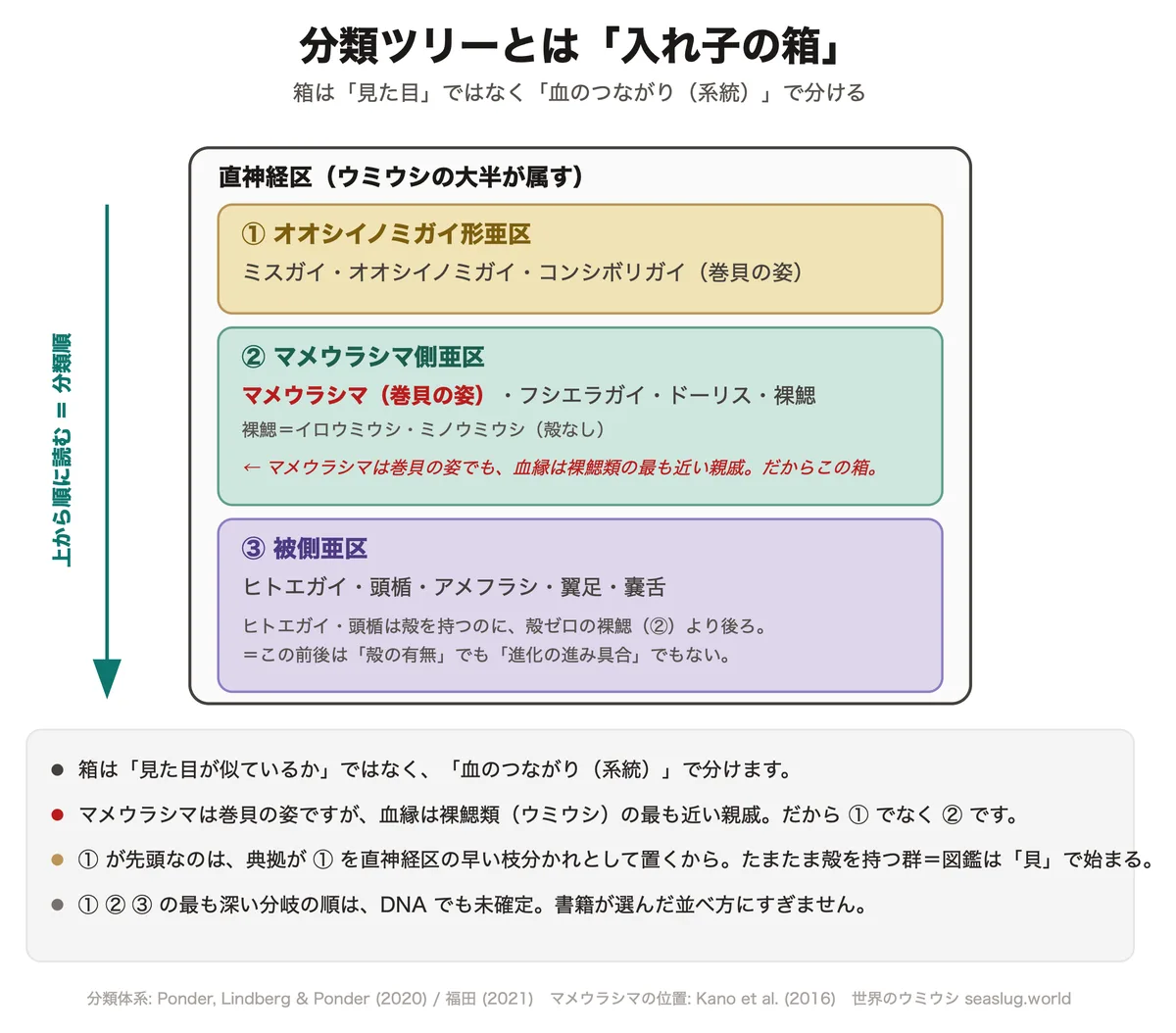
A classification tree is a set of nested boxes
Biological classification is a nesting of boxes inside boxes. A large box holds medium boxes, which hold smaller ones. For sea slugs, a class holds orders, which hold families, then genera, with the species sitting in the innermost box.
This nesting is the branching of evolution turned into boxes. Sharing a box means sharing a close branch. In other words, the nested boxes of classification have the same shape as the tree of life.
A catalogue's "taxonomic order" opens these boxes from the outermost inward, writing out the medium boxes, the small boxes, and finally the species, as one long line. The species look like a single column, but behind them is the nesting of boxes — the tree. Taxonomic order is the tree, read from the top down.
The tree we use
Our taxonomic order follows the molluscan classification set out in Biology and Evolution of the Mollusca (Ponder, Lindberg & Ponder, 2020). The Japanese-name correspondence for that system was worked out by Hiroshi Fukuda in his 2021 review.
In this system, Euthyneura, the branch that holds nearly all sea slugs, first splits into three large boxes:
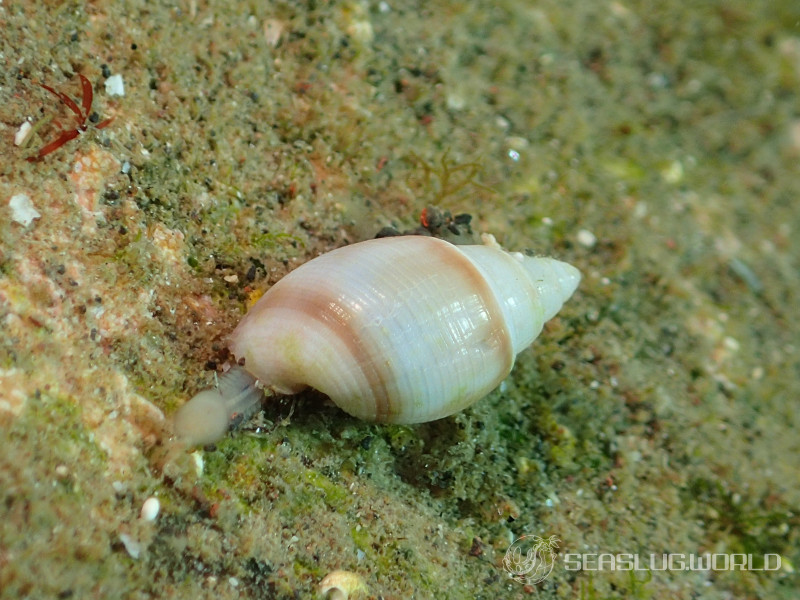
- Hydatina, Acteon and other shell-retaining relatives
- Ringicula, the pleurobranchs, the dorids and the nudibranchs
- Umbraculum, the head-shield slugs, the sea hares, the pteropods and the sacoglossans
The book calls these three, in order, Acteonimorpha, Ringipleura and Tectipleura. The catalogue opens these three boxes in this order, so the contents of the first box — the shelled Hydatina group — stand at the very front.
Boxes are grouped by kinship, not by looks
The key point is that the boxes hold animals grouped by shared ancestry — their branch on the tree — not by resemblance. And resemblance is often misleading.
Take Ringicula, sitting in the second box. Ringicula doliaris is a shell about 3 mm long, by any look a proper little snail, much like Acteon in the first box. Yet careful DNA and morphology place it not with the first box but as the closest relative of the nudibranchs (Kano et al. 2016; confirmed by Brenzinger et al. 2021). So despite its snail shell, it sits in the second box, with the sea slugs. Fittingly, a fully shelled relative like Ringicula turning up next to the shell-less nudibranchs is itself evidence that even the naked sea slugs descend from shelled ancestors (Hirano & Fukuda 2026).
Why it opens with snails
So why does the catalogue start with the shelled Acteonimorpha (box ①)? Not because "snail-looking comes first" — if that were the rule, Ringicula would be at the front too, and it is in box ②.
The reason is simply that the reference system places box ① as an early branch of Euthyneura, and that box happens to be a shelled group. And the order of those deepest splits is itself unsettled: change how the molecular data are analysed and the tree changes — under one analysis the box placed last, Tectipleura (with Umbraculum and the head-shield slugs), comes out as the first of the three to branch off, though the support is weak. "Later in the list" does not mean "branched later."
The order is not a ladder of evolution
The head-shield slugs coming late is likewise not a sign they are "more evolved." The clearest proof: the nudibranchs, which lost the shell entirely, sit ahead of the shell-bearing Umbraculum and head-shield slugs. If "later meant more evolved, with the shell fading away," the order would be reversed. The sequence matches neither the branching order, nor degree of evolution, nor presence of a shell. A different reference system can put it in a different order.
The tree gets redrawn
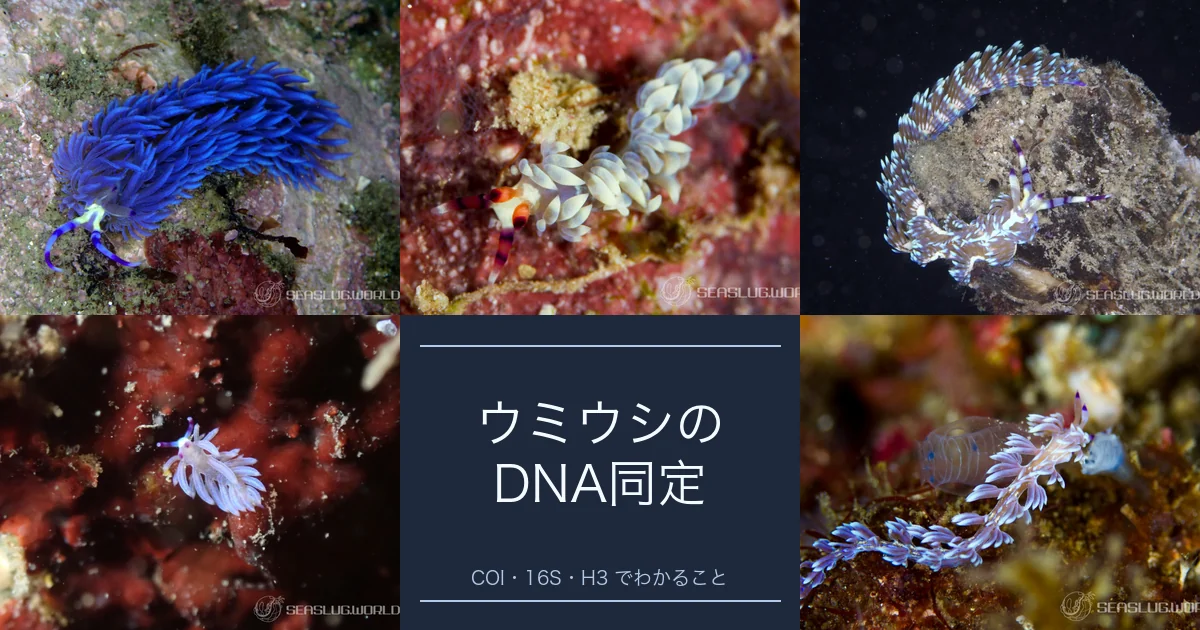
Classification trees are redrawn as research advances, and the driver of the current arrangement was DNA. From the 1990s on, molecular phylogenetics of gastropods showed that "Opisthobranchia" — the old box that lumped the shell-losing groups together — is not a natural grouping.
DNA also turned up relationships no one would guess from anatomy. The sacoglossans (the chloroplast-stealing relatives of Elysia) and the acochlidians turned out to sit closer to land snails than to the other sea slugs — a link no amount of looking at shell shape would reveal. The box called Opisthobranchia was broken up and rebuilt into today's major branches, and DNA settled that much firmly.
What is not settled is only the order of the three deepest splits, seen in the previous section. Those branches are so old, and split in such quick succession, that almost no mutations recording their order survive. The groups themselves are secure; only the oldest branching order stays weakly supported, even with DNA.
A catalogue's order changes too whenever the reference system it follows is updated. The tree a book presents is the best map available at the time. How the scope of the word "sea slug" has shifted over 130 years is laid out in a separate article, What is a Sea Slug? — Nine Orders to Twelve Lineages.
In short
A catalogue's taxonomic order is a classification tree of nested boxes, read from the top. The boxes are grouped by kinship, not by looks, and the snails come first only because the box placed first happens to be a shelled group. The head-shield slugs come later not because they are higher on some ladder. Next time you scroll through the catalogue, picture the nesting of boxes — the tree — behind that single column of species.
Enjoyed this post? You can tip the author directly —
Tip this post