The steps between a DNA match and a new name (Ascobulla, Mourgona, Volvatella)
Sea slug taxonomy has a "vernacular-name problem." Unlike scientific names, Japanese vernacular names sit outside any international code like the ICZN, and proposals have accumulated for decades without an agreed standard for when one is warranted. More recently the field has begun to resist casual coinage, moving toward checking a candidate against existing descriptions, existing vernacular names, and molecular data before it is proposed.
Sea Slugs of Okinawa: An Updated Identification Guide Based on DNA Analysis, 1,089 Species (Imagawa 2026) is the first attempt to tie name proposals to specimens and DNA data, and reads as a real advance on the vernacular-name problem.
The book proposes 81 new Japanese vernacular names for Okinawan sea slugs. This post takes up three of those specimens: the ones it labels Cylindrobulla sp. 1, Mourgona sp. 2, and Volvatella sp. 1 (assigning each a new Japanese vernacular name). All three are Okinawan animals that closely resemble sacoglossans Hamatani originally described from Japan — Ascobulla japonica, Mourgona osumi, and Volvatella viridis respectively — and the book treats each as an undescribed species deserving a new name. From the same entry point (they look alike), the book routes all three uniformly to "undescribed species → new name." But run DNA and morphology through an identification workflow on the same animals and the answer is not uniform. How much can be said, and where does it stop? That line falls in a different place in each case, and the three split three ways. This post does not adjudicate whether the book's conclusions are right; it follows only the procedure — the four steps of (1) homology search, (2) DNA analysis, (3) identification, and (4) name proposal. Whatever identification the book performed, once it flies the banner of "name proposals backed by DNA," the honest move is to actually check that DNA. For each specimen, without entering into the book's own reasoning, I read the same animal's DNA and asked only how far it lets you go. A homology search returns different results depending on the database. Even the same sequence draws different references in GenBank (BLAST) than in BOLD, and a match present in one may be absent from the other. This site re-queried each specimen against GenBank, and then went further, bringing in type material and multiple markers. These three cases are not a lever for doubting the remaining new names wholesale. Where barcoding genuinely helped identification, that is collected in a separate post (16 species whose names DNA confirmed); this post covers the flip side — cases where an incomplete search or comparison lets the conclusion drift.
The three specimens the book renamed, and the similar Hamatani species
The three known species they resemble are:
| Book's label | Similar Hamatani species | Original description, type locality, host |
|---|---|---|
| Cylindrobulla sp. 1 | Ascobulla japonica | Hamatani (1969), Cape Shionomisaki (Kii Peninsula), on Caulerpa brachypus |
| Mourgona sp. 2 | Mourgona osumi | Hamatani (1994), Amami-Ōshima, on Acetabularia |
| Volvatella sp. 1 | Volvatella viridis | Hamatani (1976), Yoron-tō, on Caulerpa racemosa |
All three were described between 1969 and 1994, and given the era no type-derived DNA was obtained. That said, the type specimens of Ascobulla japonica and Volvatella viridis are now held at the Osaka Museum of Natural History (Hamatani's surviving material was recovered), and all three type localities (Shionomisaki / Amami / Yoron-tō) are within Japan. The types are formalin-fixed and unsuitable for DNA extraction (though usable for morphological re-examination), but a molecular baseline can be established from fresh material collected at the type locality. In every case this is a genuinely feasible step.
The scaffolding for molecularly matching these known species is also weak. The nearest sequences in GenBank all lack photo vouchers or evidence specimens and correspond to no type locality or type specimen, so there is no way to independently assess whether a label is genuine. On top of that, COI itself is saturated in this group, so even setting aside reference quality, reading genus or undescribed status off a percent identity has intrinsic limits. These two problems — references not tied to types, and marker saturation — bite differently in each case.
Case 1: the book's Cylindrobulla sp. 1
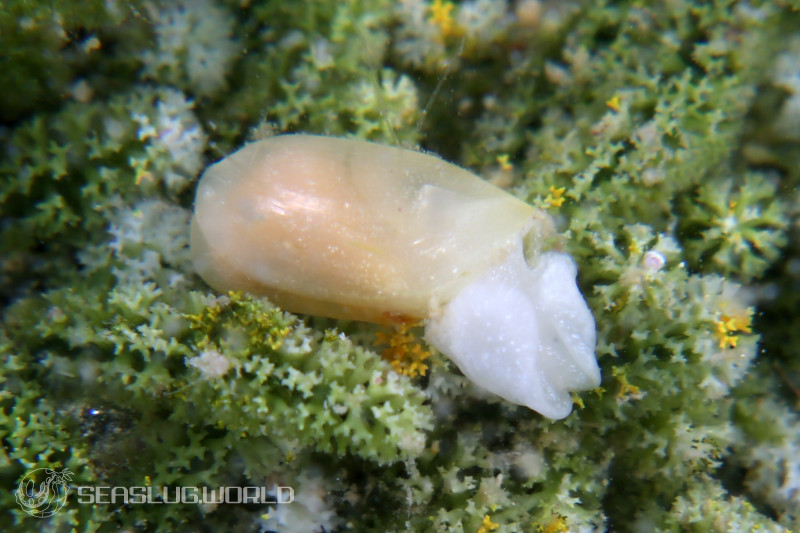
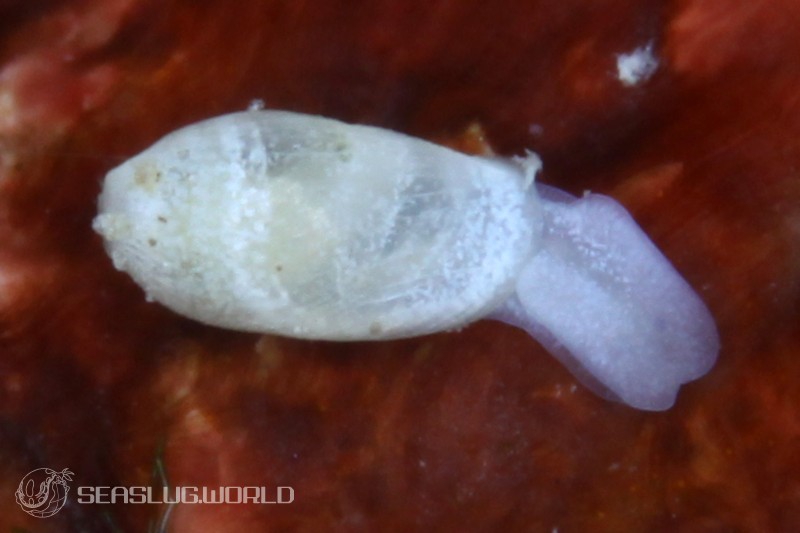
What the book does
The book gives this Okinawan animal a new Japanese vernacular name as Cylindrobulla sp. 1.
What happens when you actually run the DNA
I compared the book's specimen's COI against reference sequences in GenBank.
- Against the GenBank "Ascobulla japonica" sequence (from Chiba, AB501301) it sits 82% (~18% divergence) apart — a between-species distance. But whether that sequence's own "japonica" label is genuine is unverified (see below), so all you can say is "different species from this sequence."
- The only close relative is the unnamed DQ974683 (Ascobulla sp., 96.8%).
- Yet neither genus nor family can be settled. The nucleotides are saturated (all inter-lineage comparisons collapse into an 80–85% band) and the amino acids are too conserved (97–100%). By raw distance this animal is actually slightly closer to Cylindrobulla (~16% divergence) than to Ascobulla japonica (~18% divergence), but that gap is within the noise of a saturated marker and is no basis for assigning a genus. Indeed the two Ascobulla species (japonica and fragilis) share only 83.8%, and Cylindrobulla itself contains splits on the order of 15%.
And if the genus can't be settled, neither can the family. Cylindrobulla is Cylindrobullidae, Ascobulla is Volvatellidae — different families. However alike they look, they belong to different families. So the secure placement of this animal is only superorder Oxynooidea, and writing "Cylindrobulla" asserts not just a genus but a family-level identity.
The reference labels themselves are not tied to types
COI can only answer "is this the same species as the reference," but none of these reference labels carry a firm anchor. DQ974683 is "sp." (unidentified); AB501301 is an identification in a peer-reviewed paper (Maeda et al. 2010) but has no voucher and no photograph, and is from Chiba — not the type locality (Shionomisaki). Establishing a molecular baseline tied to A. japonica would require DNA from a Shionomisaki (type-locality) animal, and that does not exist.
The radula is what separates the genera
The defining character separating these two genera is the radula (quadrangular rasping teeth = Cylindrobulla / needle-like teeth + ascus = Ascobulla). The external proxies you can read from photographs (visibility of the protoconch, the gap between the cephalic shield lobes) cannot be scored from the images on hand. No radular description of this animal is given either.
In short
All COI can tell you is "different species from the GenBank A. japonica sequence." Since that sequence's label is itself uncertain, even the relationship to the type of A. japonica is unsettled. COI is a ruler for species, not for genera. With the third codon position saturated and distances pinned to a floor around 80%, you can say "different species" but cannot measure "how different" (genus? family?). Genus, family, and undescribed status simply do not fall out of this single gene. "Classification by DNA analysis" does not hold for this animal on the data used (COI). The book's conclusion (undescribed) may still turn out to be correct, but COI cannot confirm that either.
If anything, this animal poses a question worth opening. Add 16S and H3 and look at one radula, and it may connect — as an unresolved lineage placeable in neither Cylindrobullidae nor Volvatellidae — to the unnamed GenBank sequence (and if it really is undescribed, that opens the door to a description). If you are going to call it "by DNA analysis," this is exactly where running multiple markers pays off. With COI alone, the question stays shut.
How this site reflects it
This site keeps the book's proposed name for the animal but places it provisionally at Oxynooidea sp. 1 (family and genus undetermined). Malaquias and colleagues place the sole close relative DQ974683 in Ascobulla (on morphology, including the radula). By COI distance, however, both DQ974683 and this animal lean slightly toward Cylindrobulla. Since the morphological label (Ascobulla) and the COI distance (toward Cylindrobulla) disagree, COI cannot fix the genus, and neither the book's Cylindrobulla nor DQ974683's Ascobulla is supported by COI. Settling the genus requires morphological re-examination, including the radula. This site is querying the original describer on that basis — a re-examination of MNHN 42250, the specimen behind DQ974683 — and will update the reflection once an answer comes back.
Case 2: the book's Mourgona sp. 2
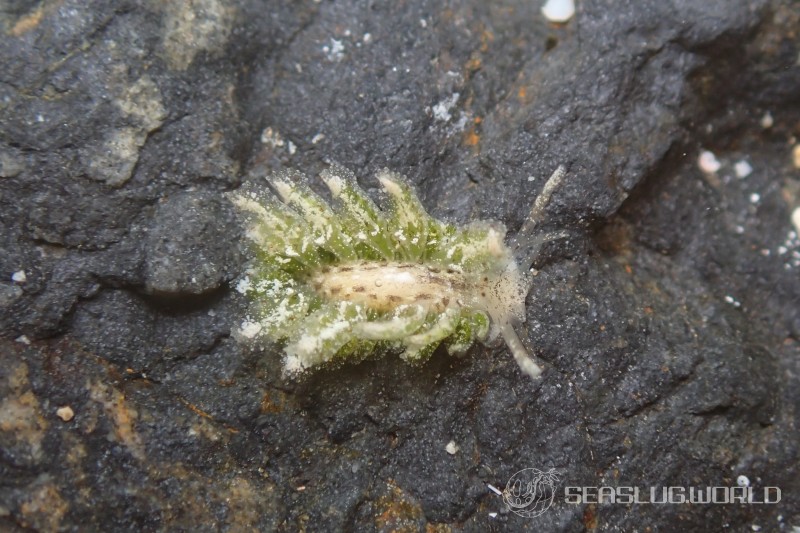
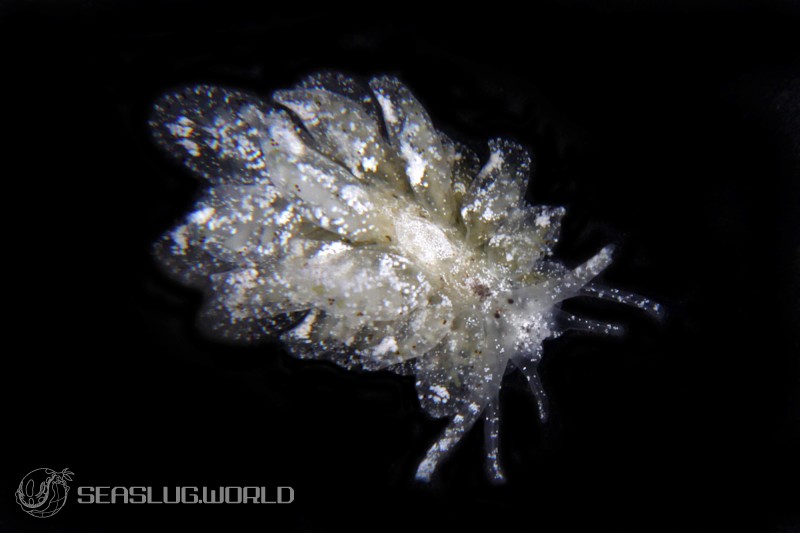
What the book does
The book treats this Okinawan animal as Mourgona sp. 2, gives it a new Japanese vernacular name, and positions it as an undescribed species distinct from the known M. osumi. A BLAST search of the Okinawan animal's COI against GenBank returns these top hits:
| Rank | Accession | Label | Identity |
|---|---|---|---|
| 1 | KF921382.1 | Mourgona germaineae voucher S277 | 88.39% |
| 2 | GQ996667.1 | Mourgona osumi isolate Mo791LIC | 84.07% |
| 3 | KM086409.1 | Hermaea wrangeliae isolate Hwra_10Jap01 | 84.22% |
(Ranks follow BLAST bit score, which does not always match descending identity.) Identity to the M. osumi-labelled Mo791LIC (GQ996667.1) stops at 84.07% — a between-species distance.
The reference standard is unstable
Reading that 84% (~16% divergence) as "not osumi" presupposes that Mo791LIC is genuine M. osumi. But Mo791LIC has no published photo voucher, so there is no way to independently assess whether the source animal really is M. osumi (a label is the submitter's identification claim, not a fact — as covered in a separate post). Worse, the type locality of M. osumi is Amami-Ōshima (Hamatani 1994). Seaslug.world has obtained 16S from an animal at that type locality, and compared against Mo791's 16S (EU140847) it sits about 12% apart and falls on a separate lineage (a sister relationship) in the tree. Mo791 does not match the type-locality animal, and its own "osumi" label is therefore shaky. With no guarantee that the reference Mo791 is genuine osumi, you cannot judge osumi status from the COI distance between the Okinawan animal and Mo791 alone (84%, ~16% divergence).
How this site reflects it
With the basis for a split undefined, this site retains the known name M. osumi. A split might have been possible with 16S from the Okinawan animal, but absent that — and resting only on a COI distance to a shaky reference — a split does not stand as a procedure. Whether the Okinawan animal is osumi proper or something undescribed is decided only by comparing it against COI from a type-locality animal.
Case 3: the book's Volvatella sp. 1
The rest of this article is for Premium members
To read the rest of this article, a Premium membership (USD 3.00/month) is required.
- Unlimited access to all members-only articles, including new species reports and paper introductions
- No ads (AdSense) across the entire site
- Priority handling of your observations (Premium uploads are identified and published first when the moderation queue is backed up)
- Priority access to the AI identification feature
Already a member? Please log in.
Enjoyed this post? You can tip the author directly —
Tip this post