Ascobulla japonica (Hamatani, 1969)
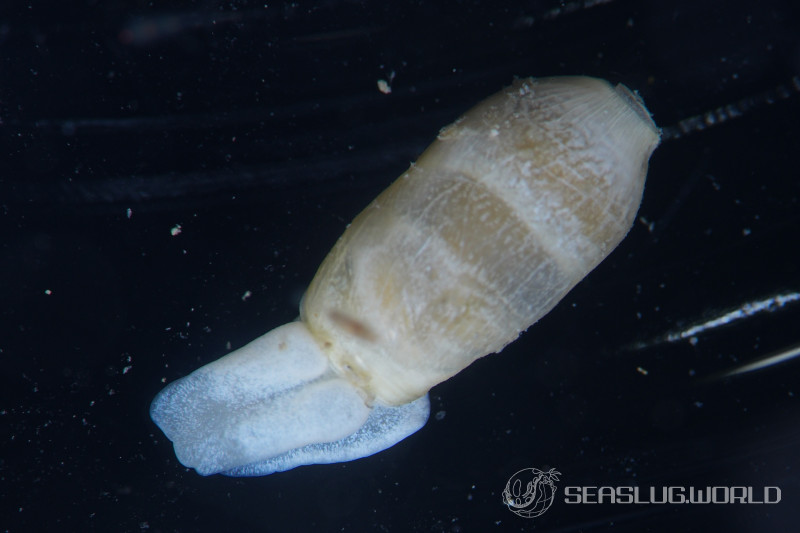
- Location
- Makiminato, Okinawa Island (Chatan and Southern area), Okinawa, Japan
- Date
- 2025/07/12
- Length
- 8mm
- Depth
- 5.0m
- Water temperature
- 29.0℃
Description
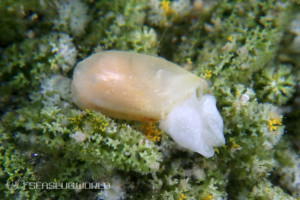
A small shelled sacoglossan with a shell length of about 4 mm. The shell is somewhat elongate cylindrical-bulloid, thin, translucent and smooth, with a translucent white to pale yellowish ground overlaid with irregular reddish-purple blotches — a diagnostic feature of the species. The soft body is white, with fine white spots scattered over the dorsum and along the mantle margin. There are no parapodial flaps (a feature of the genus Ascobulla); the cephalic shield is broad, symmetrical and shallowly notched at the anterior margin.The species is distinguished from members of Cylindrobulla only by internal characters such as the structure of the digestive-gland terminations; externally the two genera are essentially indistinguishable.
Distribution
Type locality: central Honshū, Japan (Seto Marine Biological Laboratory area, Kii Peninsula / Inland Sea region; Hamatani, 1969). Currently known only from the Japanese coast. The species occurs in shallow rocky habitats colonised by its host green algae of the genus Caulerpa.Etymology
The specific epithet japonica is Latin for "of Japan", in reference to the type locality.Remarks
Originally described by Hamatani 1969 from central Honshū as Cylindrobulla japonica. Cylindrobulla P. Fischer, 1857 and Ascobulla Marcus, 1972 are externally near-identical and have long been confused; the species has been treated under Ascobulla since Marcus 1972 erected that genus, and the parentheses in the current author citation reflect this generic transfer. Laetz, Christa, Händeler & Wägele 2014 reviewed both genera using combined morphological and molecular data and provided an identification key.The slug feeds suctorially on the cell contents of Caulerpa species (notably C. brachypus and C. scalpelliformis). The Japanese vernacular name "Iwazuta-budō-gai" combines the host alga (Iwazuta = Caulerpa) with "budō-gai" (the traditional Japanese name for small shelled cephalaspideans bearing a thin globose shell).
References
- Cylindrobulla japonica sp. nov. (Iwazutabudogai n.n.), Hamatani I. (1969). A new species of the rare shelled sacoglossan genus Cylindrobulla from Middle Japan (Opisthobranchiata). Publications of the Seto Marine Biological Laboratory. 17(3): 171-174. https://doi.org/10.5134/175595
- Ascobulla japonica (genus context), Marcus Ev. (1972). On some opisthobranchs from Florida. Bulletin of Marine Science. 22(2): 284-308.
- Ichikawa M. (1993). Saccoglossa (Opisthobranchia) from the Ryukyu Islands. Publications of the Seto Marine Biological Laboratory. 36(3): 119-139. https://doi.org/10.5134/176229
- Ascobulla japonica (Hamatani, 1969), Laetz E.M.J., Christa G., Händeler K. & Wägele H. (2014). The Cylindrobulla / Ascobulla complex—unraveling problems in identification and adding to Cylindrobulla diversity (Gastropoda, Heterobranchia, Sacoglossa) by describing a new species. Zootaxa. 3893(3): 339-362.
Related articles

The steps between a DNA match and a new name (Ascobulla, Mourgona, Volvatella)
A Kindle field guide by the site author
Kimoto N. (2026). Sea Slugs of Japan & the Indo-Pacific, 2nd Edition.
Kindle Edition
View on Amazon PR (Amazon Associates)Seasonality
Shooting Locations
Loading shooting locations...
Photos of Ascobulla japonica



Similar Colors Nudibranchs

Academic Database
Sea slug observation data is available in international marine biodiversity databases.