Aeolidiidae revised — Novaeolidiella janae and a cryptic Aeolidiella avatar
In April 2026, a paper substantially updating the systematics of Aeolidiidae was published.
Carmona, L., Martín-Hervás, M.D.R., Pola, M., Gosliner, T.M. & Cervera, J.L. (2026). Unfinished symphony: updating the systematics of Aeolidiidae (Nudibranchia, Gastropoda), with special focus on Aeolidiella Bergh, 1867. Invertebrate Systematics 40(4): 1–30.
— https://connectsci.au/is/article/40/4/IS24105/271766/Unfinished-symphony-updating-the-systematics-of
The paper erects the new genus Novaeolidiella and places the species long known in Japan as Namidakasumi-mino-umiushi under the new name Novaeolidiella janae.
Back when it was Cerberilla sp.
This species has long been figured in the literature without a formal name. Carmona et al. (2013) treated it as Cerberilla sp. A, Gosliner, Valdés & Behrens (2015) as Cerberilla sp. 7, and the 2018 edition as Cerberilla sp. 8. Each treatment noted that the animal resembles Cerberilla incola Burn, 1974 but differs in the patterning of the cerata.
Ono & Kato (2020), Umiushi (revised edition), figured it as Cerberilla incola and proposed the Japanese vernacular Namidakasumi-mino-umiushi as a new name. The current molecular phylogeny, however, places this species in a clade distinct from both Cerberilla and Aeolidiella, and assigns it to the new genus Novaeolidiella.
The genus Novaeolidiella
The genus name combines Nova (Latin "new") + Aeolidiella. The type species is Novaeolidiella drusilla (Bergh, 1900) comb. nov., distributed in New Zealand and Australia (formerly Aeolidiella drusilla).
Diagnostic features: the radula is bilobed with a prominent central cusp flanked by long, sharp denticles on either side. The reproductive system is diaulic. The penial papilla can bear spines — and this "armed penial papilla" is the first such report in Aeolidiidae and is one of the most distinctive features of N. janae.
The uncorrected COI p-distance between N. janae and N. drusilla is 12.2%, clearly separating them as distinct species.
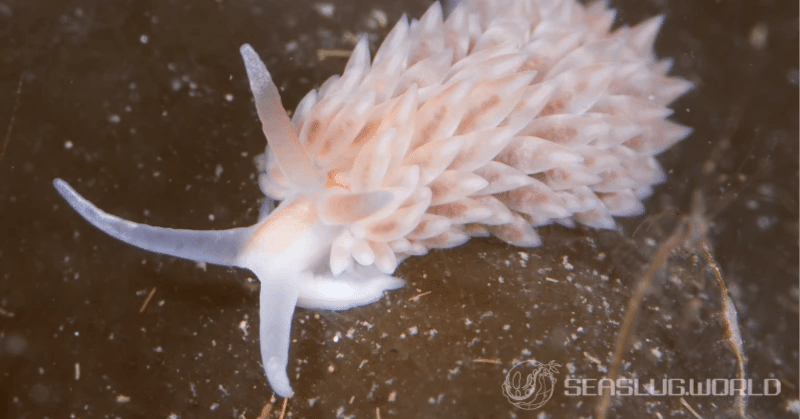
External morphology of Novaeolidiella janae
Type locality: Mabini, Batangas, Luzon, Philippines.
- Body broad and flattened, tapering posteriorly.
- Ground colour translucent white. Pearly white spots and gold to yellow-brown pigment cover the body surface.
- Head and dorsum bear yellow-brown pigment. Near the pericardium, pearly white pigment may overlap.
- Rhinophores conical with a blunt tip, smooth. Base and tip pearly white; the rest covered in gold pigment.
- Oral tentacles longer than the rhinophores. Basal two-thirds pearly white, distal third gold.
- Cerata slender, of even diameter throughout, arranged in densely packed rows. The yellow-brown to dark branches of the digestive gland show through, and the surface is covered with pearly white pigment.
- Cnidosac translucent.
- Nocturnal, with a habit of burying in sandy substrates.
The specific epithet janae honours Jana Callejo Carmona, daughter of the first author Leila Carmona.
Comparison with earlier Japanese descriptions
Ono & Kato (2020) describe "two brown longitudinal lines" on the cerata, whereas the paper describes ceratal colouration as "yellow-brown to dark branches of the digestive gland + pearly white pigment." Similarly, the "orange-yellow band on the anterior edge of the oral tentacles" mentioned in the Japanese guide likely corresponds to the "gold pigment on the distal tip of the oral tentacles" in the paper. How much colour variation exists between Japanese specimens and the Philippine type material is a topic for future verification.
The rest of this article is for Premium members
To read the rest of this article, a Premium membership (USD 3.00/month) is required.
- Unlimited access to all members-only articles, including new species reports and paper introductions
- No ads (AdSense) across the entire site
- Priority handling of your observations (Premium uploads are identified and published first when the moderation queue is backed up)
- Priority access to the AI identification feature
Already a member? Please log in.
Enjoyed this post? You can tip the author directly —
Tip this post