Mourgona osumi Hamatani, 1994
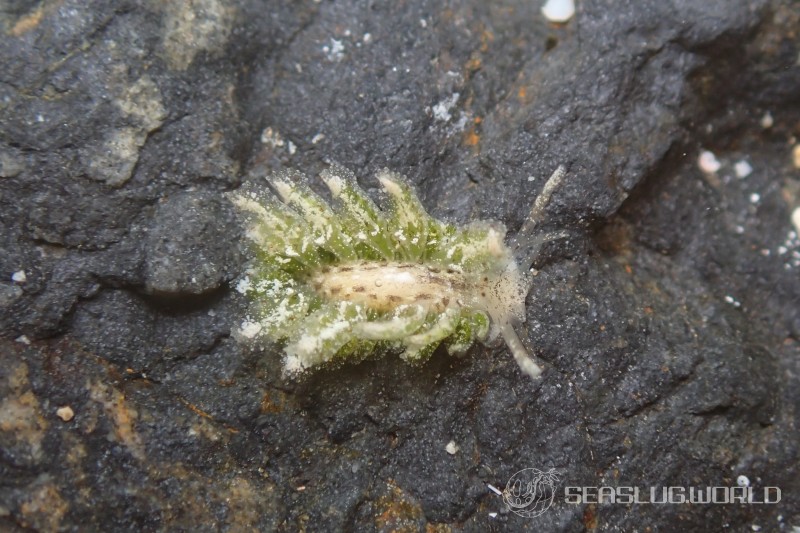
- Location
- Tebiro beach, Amami Oshima, Kagoshima, Japan
- Date
- 2026/04/25
- Length
- 5mm
- Depth
- 0.1m
- Water temperature
- 23.0℃
Description
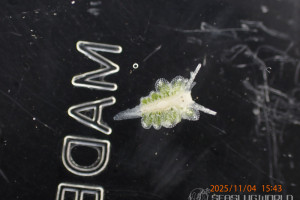
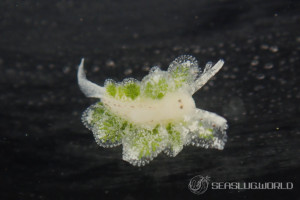
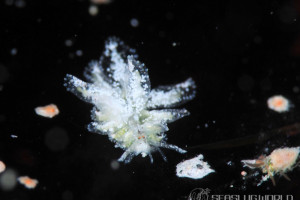
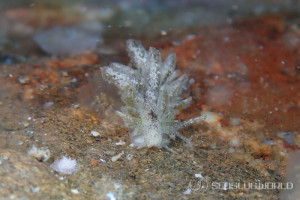
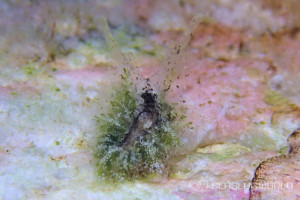
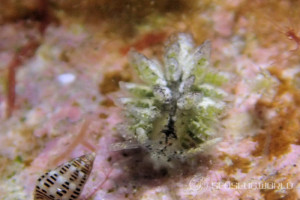
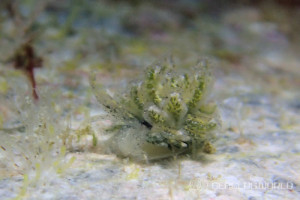
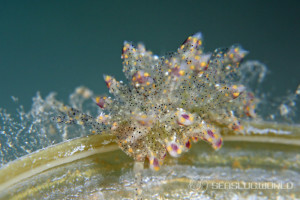
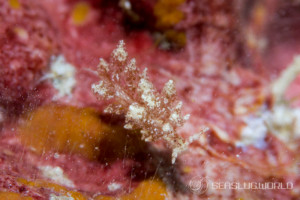
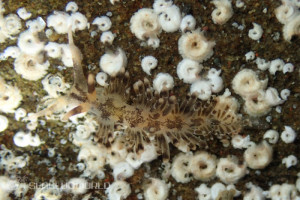
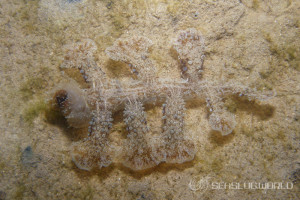
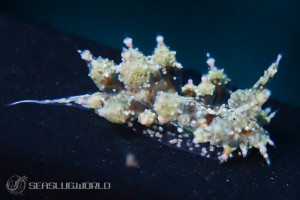
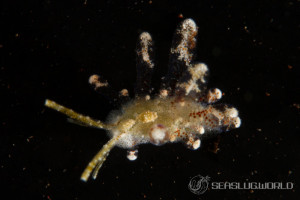
A small sacoglossan reaching about 15 mm in length, with a fragile, semi-translucent body. The ground colour is whitish green, sometimes greyish green or yellowish white tinged with green. The dorsal surface is overlain with irregular small patches of brown to brownish black pigment, which occasionally form two longitudinal middorsal belts. Numerous minute white opaque granules are scattered over the body and cerata, often densest near the distal region of the cerata. The dorsal surface of the cerata bears similar brown pigment, while the lower surfaces of the cerata, the rhinophores and the oral tentacles are largely free of brown pigmentation.The foliated cerata are very numerous (more than 130 in total) and arranged all around the dorsum. Each ceras consists of a short stalk and a spread, leaf-like lamina, the margin of which is repeatedly indented; the convex parts contain conspicuous glistening glandular granules. The hepatic diverticulum within the ceras is pale grass-green and irregularly unipinnate. The cerata are contractile and easily deciduous.
The rhinophores are flagelliform and slightly auriculate ventrally, bifurcate with the upper rami longer than the lower. Long oral tentacles are present. The eyes lie close together between the bases of the rhinophores, visible through the integument. There is no transverse mesopodial groove, and the tail is short.
Distribution
Type locality: Kasari, Amami-Oshima Island, Japan. Also recorded from the southernmost part of Okinawa-Jima Island.Etymology
From the original description (Hamatani, 1994):The new species is here named after Mr. Dai Osumi, a student at the Ryukyu University, who first discovered this new species.The specific epithet honours Mr. Dai Osumi, then a student at the University of the Ryukyus, who first found the species in Acetabularia colonies at Kasari, Amami-Oshima, in March 1990.
Notes
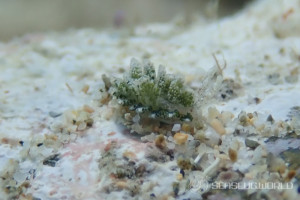
Lives on colonies of the green alga Acetabularia ryukyuensis Okamura and Yamada, 1932, in the intertidal zone near the high water mark, feeding voraciously on the algal cell sap. The Japanese name "Kasanori-tamana-umiushi" derives from its host alga Acetabularia (Japanese: kasanori) and the cabbage-like (tamana) appearance of its foliated cerata. Hamatani allied the species with M. germaineae Marcus & Marcus, 1970 from the western Atlantic but distinguished it anatomically. Originally placed in the family Caliphyllidae; under the current classification the genus is referred to Polybranchiidae.References
- Mourgona osumi n. sp. (New Japanese name: Kasanori-tamanaumiushi), 濱谷巌. (1994). 奄美大島産カサノリ群落に生息するMourgona属嚢舌後鰓類の1新種. 貝類学雑誌. 53(1): 21-27. https://doi.org/10.18941/venusjjm.53.1_21
- カサノリタマナウミウシ, 大隅大. (2020). エッセイ 濱谷巖先生. うみうし通信. 108.
- オウジマタマナウミウシ(新称), 今川郁. (2026). 沖縄のウミウシ: DNA解析による最新の分類図鑑1089種. 誠文堂新光社.
Related articles

The steps between a DNA match and a new name (Ascobulla, Mourgona, Volvatella)
A Kindle field guide by the site author
Kimoto N. (2026). Sea Slugs of Japan & the Indo-Pacific, 2nd Edition.
Kindle Edition
View on Amazon PR (Amazon Associates)Seasonality
Shooting Locations
Loading shooting locations...
Photos of Mourgona osumi







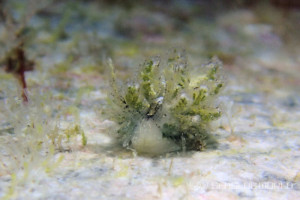
Specimen & DNA
| Observation | Database | COI | 16S | H3 |
|---|---|---|---|---|
| #54006 | BOLD Systems | SSWBP166-25 |
Same Genus Nudibranchs
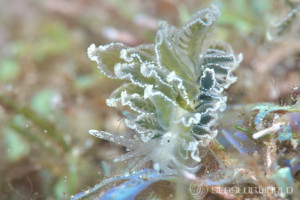
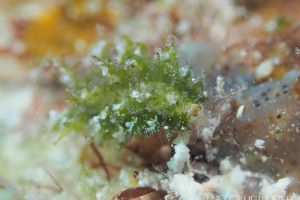
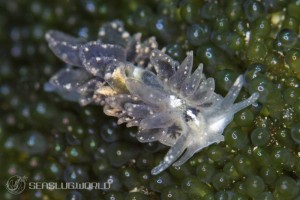
Similar Colors Nudibranchs


Academic Database
Sea slug observation data is available in international marine biodiversity databases.