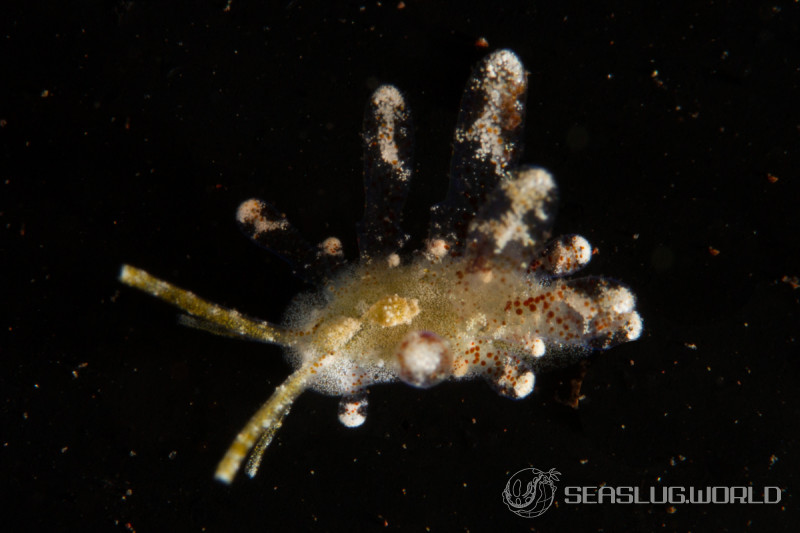
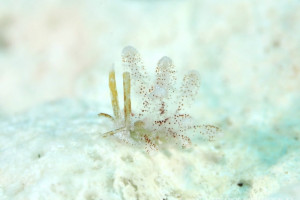
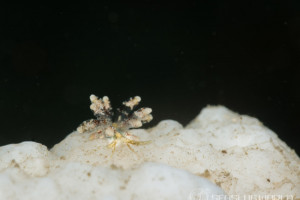
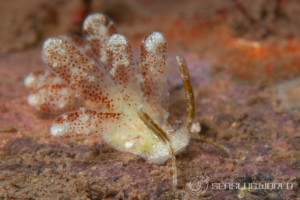
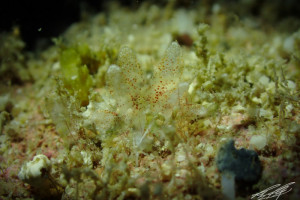
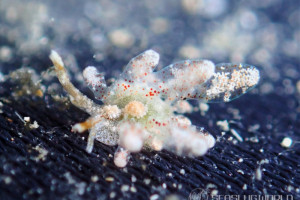
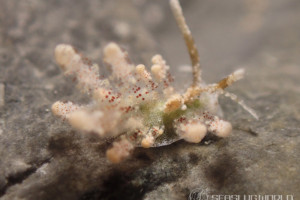
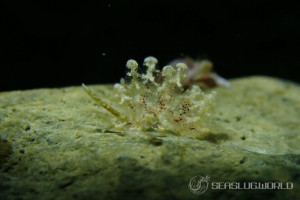
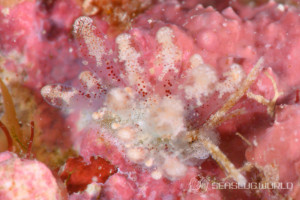
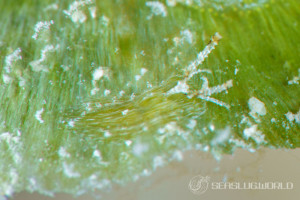
Sohgenia palauensis Hamatani, 1991
- Location
- Batu Niti, Tulamben, Pulau Bali, Indonesia
- Date
- 2018/01/12
- Length
- 10mm
- Depth
- 16.0m
- Water temperature
- 28.0℃
Description
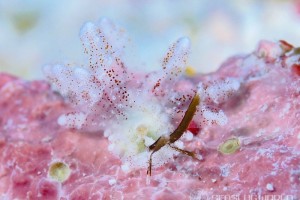
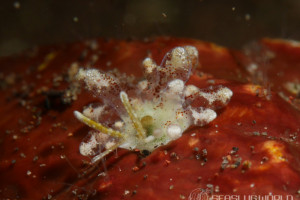
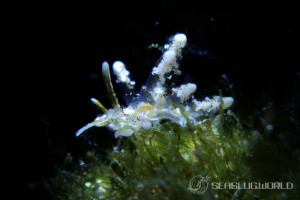
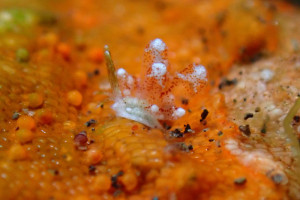
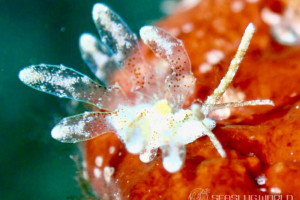
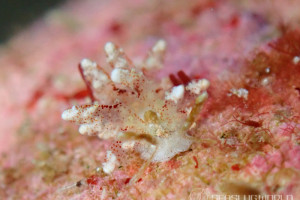
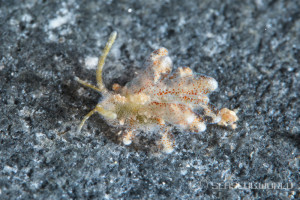
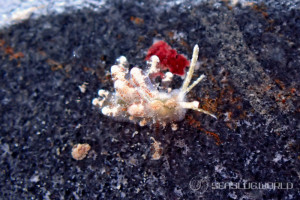
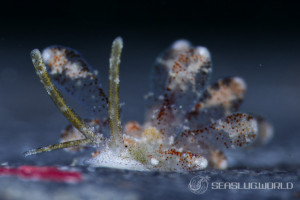
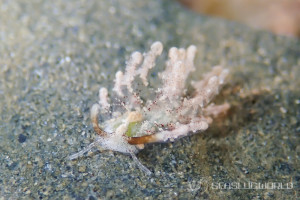
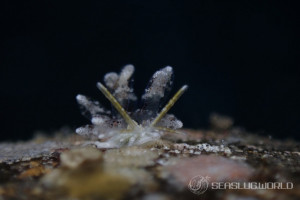
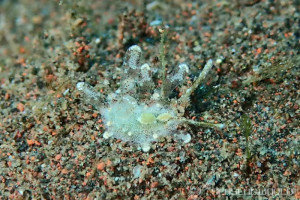
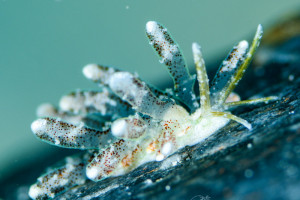
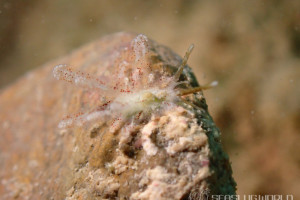
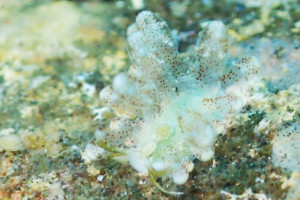
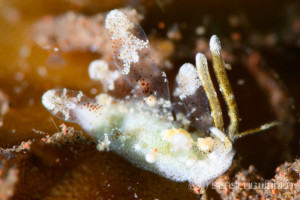
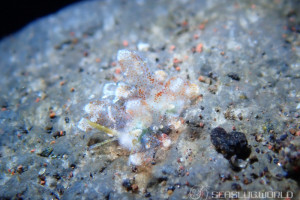
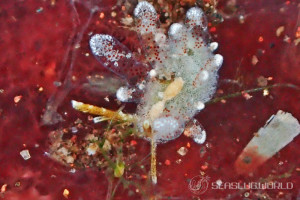
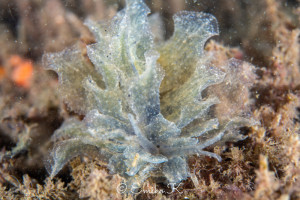
Body leaf-shaped and extremely thin, generally elongated oval in outline, measuring about 4.5 mm in total length, 2.0 mm in breadth and only 0.3 mm in thickness in the living animal. The undivided foot occupies the whole ventral surface. The general body colour is grass green, the green pigments arranged in an irregular meshwork and presumably derived from chlorophyll in the food; preserved specimens fade rapidly to yellowish white. The body margin is colourless and translucent. The pure black eyes are situated behind the rhinophores. The rhinophores rise close together from a common base, are bifurcate near the base, and each branch bears a longitudinal groove along its entire length; the front branch is shorter than the rear branch, the upper half of which is faintly tinged with brown while the front branch is colourless. Oral tentacles are absent. The cerata are stick-shaped with a spherical swelling at the top, wholly transparent and colourless; the stalk is 0.5–1.5 mm long and 0.1–0.2 mm thick, sometimes bearing a few minute conical protuberances, and the spherical apex is 0.2–0.5 mm in diameter and contains a few refractive granules presumed to be defensive glands. In the holotype six cerata on the left and seven on the right are arranged in a single row on each side. No hepatic diverticulum penetrates into any ceras. The anal papilla lies latero-dorsally on the right just in front of the pericardial prominence. The penis is situated just behind and below the base of the right rhinophore and is unarmed.Distribution
Type locality: intertidal zone of Carp Island, Palau Islands. The two type specimens were collected on 19 August 1990 from among the thalli of the green algae Halimeda macroloba or Udotea sp.; the actual host alga could not be determined.Etymology
Hamatani 1991 wrote: "The new genus is here named after the research vessel of M.B.I., Sohgen-Maru. The specific name palauensis refers to the type locality of this new species." The genus name Sohgenia thus commemorates the R/V Sohgen-Maru of the Marine Biotechnology Institute, which collected the type material, while the species epithet palauensis refers to the Palau Islands.Remarks
This is the type species of the genus Sohgenia, erected by Hamatani 1991 within the family Caliphyllidae. The combination of stick-shaped cerata with a swollen apex, the absence of hepatic diverticula entering the cerata, the unarmed penis and the lack of oral tentacles distinguishes Sohgenia from the related caliphyllid genera Cyerce Bergh, 1871, Mourgona Marcus & Marcus, 1970 and Caliphylla Costa, 1867.References
A Kindle field guide by the site author
Kimoto N. (2026). Sea Slugs of Japan & the Indo-Pacific, 2nd Edition.
Kindle Edition
View on Amazon PR (Amazon Associates)Seasonality
Shooting Locations
Loading shooting locations...
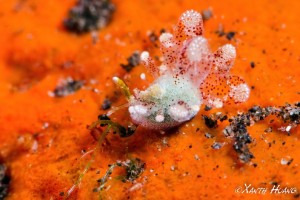
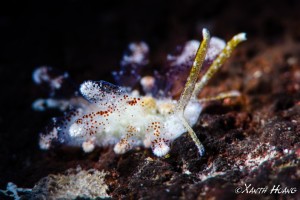
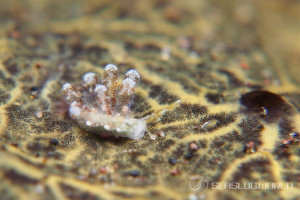
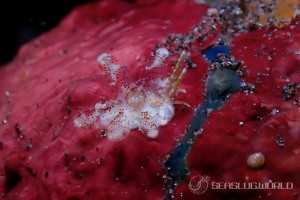
Photos of Sohgenia palauensis





















Same Genus Nudibranchs
Similar Colors Nudibranchs
Academic Database
Sea slug observation data is available in international marine biodiversity databases.