Melibe viridis (Kelaart, 1858)
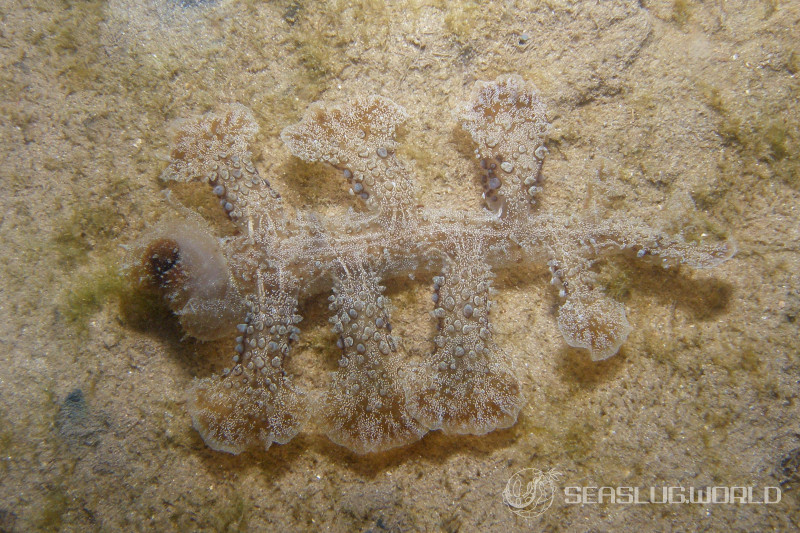
- Location
- Futami, Okinawa Island (Oura Bay), Okinawa, Japan
- Date
- 2011/01/09
- Length
- 150mm
- Depth
- 5.0m
- Water temperature
- 21.0℃
Description
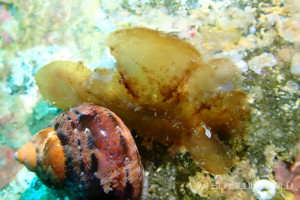
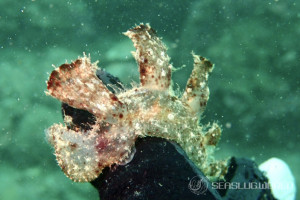
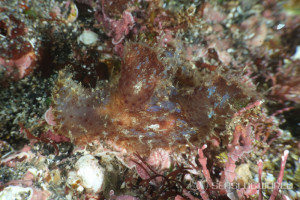
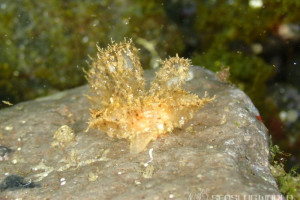
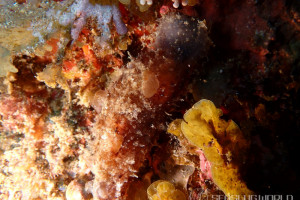
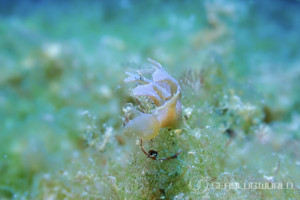
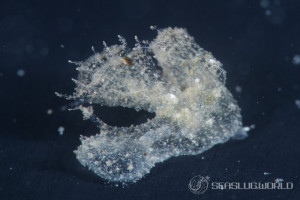
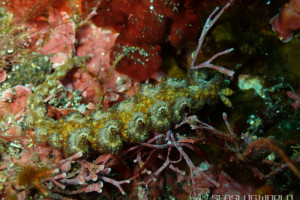
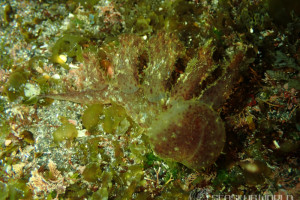
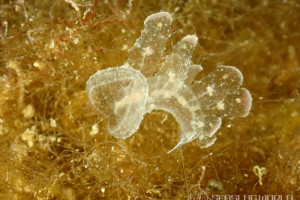
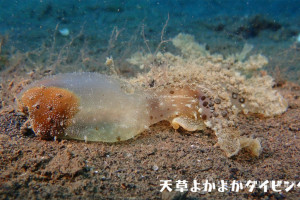
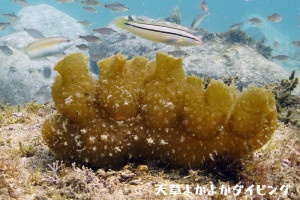
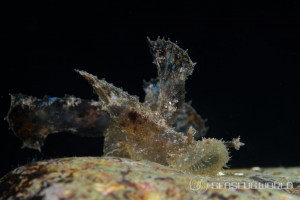
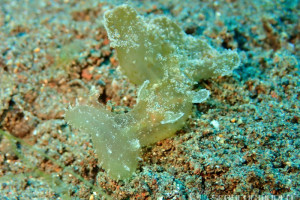
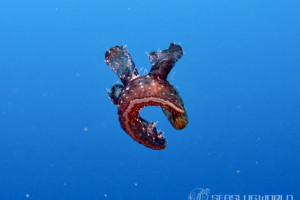
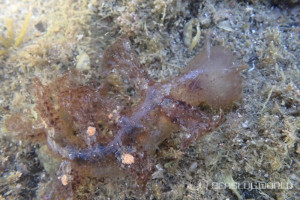
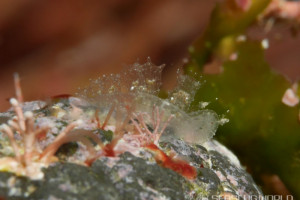
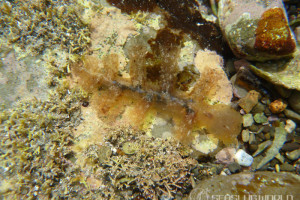
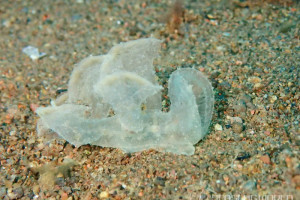
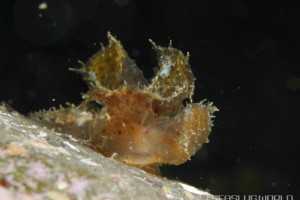
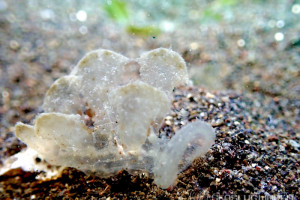
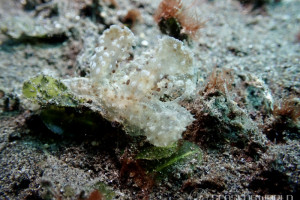
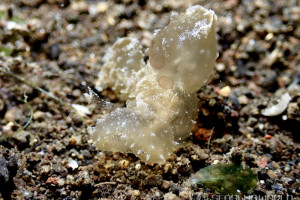
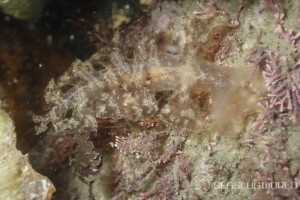
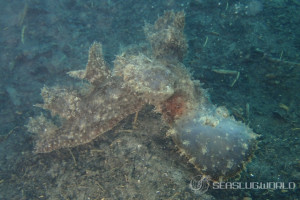
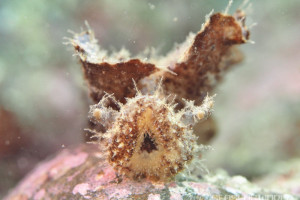
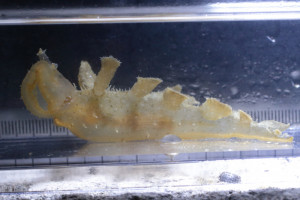
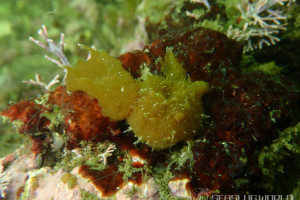
A large melibid reaching about 130 mm in length. The living animal has a tan ground color, with brown blotches present on the notum and cerata, along with dispersed patterns of tiny white flecks or glandular dots. The animal is translucent to transparent, and portions of the internal organs and the substratum can be seen through the body.The body is elongate, limaciform, somewhat compressed anterolaterally, with a dorsally elevated hump in the cardiac region tapering gradually to a slender posterior portion of the foot. Rounded tubercles are present on the notum and cerata — a key character distinguishing this species from Melibe bucephala and other relatives. The opaque, narrow, linear foot has a rounded, entire anterior margin becoming somewhat undulate on the lateral portions.
The large oral hood has a circular, entire margin that produces two to five rows of cylindrical papillae, which taper to conical points, with the innermost row being the longest. There are scattered papillae or tubercles on the surface of the oral hood. The well-separated, perfoliate rhinophores have 5–7 lamellae and arise from the surface of the oral hood within cylindrical sheaths bearing low tubercles. A posterior sail is absent from the rhinophore sheath, but a simple papilla is commonly present on the posterior side of the sheath in most of the animals examined.
There are five to nine cerata per side, somewhat flattened, saccate, oval to cylindrical with tubercular and papillate surfaces, whose dark blotches persist in preservation. The presence of tubercles on the ceratal surface is an important character distinguishing the species from M. papillosa and M. pilosa.
The buccal mass is wide and muscular, devoid of a radula but containing a pair of thick, chitinous jaws with a smooth (not denticulate) masticatory border, an important difference from M. papillosa. The posterior stomach contains 23 triangular chitinous plates with thickened, eccentric apices arranged in an alternating manner of large and small. The reproductive system has more than 50 compound, spherical, congested ovotestis bodies arranged in compound clumps of 2–4 bodies.
Distribution
Originally described from Sri Lanka (then Ceylon) by Kelaart 1858. The species is widely distributed in the Indian and western Pacific Oceans, with records from Mozambique, Zanzibar, Sri Lanka, India, Vietnam, Japan, Okinawa, the Philippines and Australia. The species has also been found in the Mediterranean Sea off Greece and has probably migrated there through the Suez Canal (Thompson & Crampton, 1984).Etymology
The specific epithet viridis is Latin for "green".Remarks
The species was originally described as Meliboea viridis Kelaart, 1858, but Kelaart's name was largely ignored by subsequent authors. The species was variously confused with Melibe fimbriata Alder & Hancock, 1864, M. vexillifera Bergh, 1880 and Propomelibe mirifica Allan, 1932. A 2003 revision treated all three names as junior synonyms of M. viridis, applying the oldest available name.The sister species is Melibe bucephala. The two species share a coarsely papillate inner surface of the oral hood and a wide foot. M. viridis is distinguished from M. bucephala by the presence of ceratal tubercles and a smooth (non-papillate) inner buccal mass.
M. viridis is a crustacean predator capable of swallowing entire crabs and hermit crabs. The stomach of one Philippine specimen contained the carapace of a crab 13 mm across, and the 11 cm specimen from Mozambique contained the carapace of a crab and a hermit crab in a snail shell 2 mm in height. Specimens have also been observed feeding on mysid shrimp at night under a diver's light, although this is interpreted as an opportunistic feeding event rather than typical behavior under natural conditions.
References
- むかでめりべ(新稱), 内田清之助ほか. (1927). 日本動物圖鑑. 北隆館.
- ムカデメリベ, Baba K. (1949). Opisthobranchia of Sagami Bay collected by His Majesty the Emperor of Japan (相模湾産後鰓類図譜). Iwanami Shoten, Tokyo. 4+2+194+7 pp., pls. 1-50.
- メリベウミウシ, 益田一. (1999). 海洋生物ガイドブック. 東海大学出版会.
- メリベウミウシ, 鈴木敬宇. (2000). ウミウシガイドブック〈2〉. TBSブリタニカ.
- 高岡生物研究会. (2002). 日本海のウミウシ. 第2版.
- メリベウミウシ, 殿塚孝昌. (2003). ウミウシガイドブック〈3〉. TBSブリタニカ.
- Melibe viridis (Kelaart, 1858), Gosliner, T. M.; Smith, V. G. (2003). Systematic review and phylogenetic analysis of the nudibranch genus Melibe (Opisthobranchia: Dendronotacea) with descriptions of three new species. Proceedings of the California Academy of Sciences. 4(54): 302-356.
- ムカデメリベ, 中野理枝. (2004). 本州のウミウシ. ラトルズ.
A Kindle field guide by the site author
Kimoto N. (2026). Sea Slugs of Japan & the Indo-Pacific, 2nd Edition.
Kindle Edition
View on Amazon PR (Amazon Associates)Seasonality
Shooting Locations
Loading shooting locations...
Photos of Melibe viridis
Tag:



















Same Genus Nudibranchs


Similar Colors Nudibranchs

Academic Database
Sea slug observation data is available in international marine biodiversity databases.