Melibe megaceras Gosliner, 1987
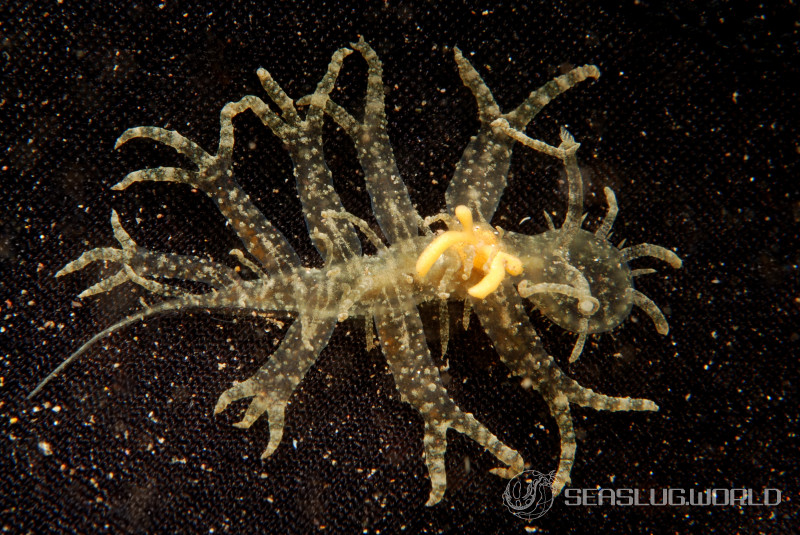
- Location
- Pulau Flores, Indonesia
- Date
- 2011/06/20
- Length
- 45mm
- Depth
- 18.0m
- Water temperature
- 27.0℃
Description
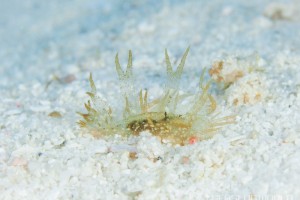
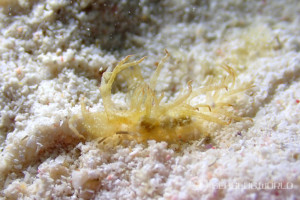
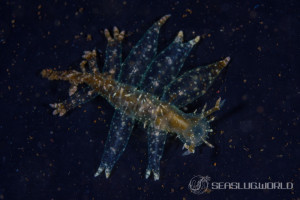
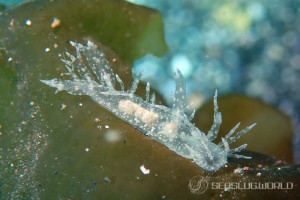
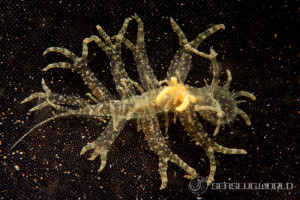
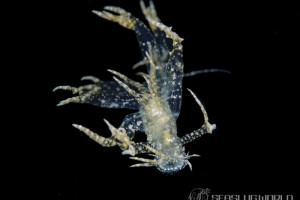
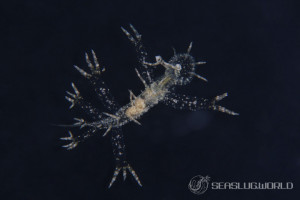
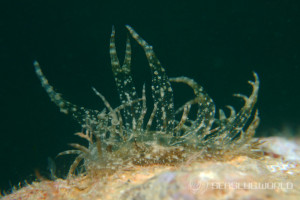
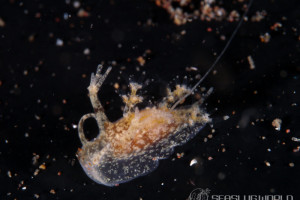
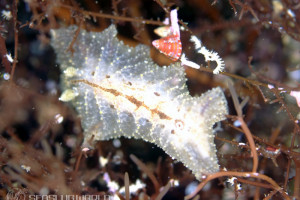
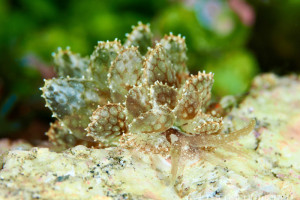
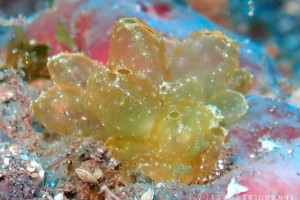
A melibid reaching about 40 mm in length, distinctive in that the body is uniformly covered with scattered, elongate papillae, giving a shaggy appearance.The smooth, elongate cerata are inflated and bear 2–4 elongate apical branches, the most diagnostic feature of the species. Ceratal tubercles are absent. The cerata and body appear to lack zooxanthellae, and the ground color of the living animal is variable, ranging from translucent gray to translucent brown.
The rhinophore sheaths bear a single elongate papilla on the posterior surface, a useful character for distinguishing the species. The oral hood is small (about 7 mm in diameter) and bears two rows of tentacles along the anterior margin. The outer row consists of uniformly elongate tentacles, while the inner row has tentacles of alternating large and small sizes. Papillae are absent from the anterior border of the wide foot.
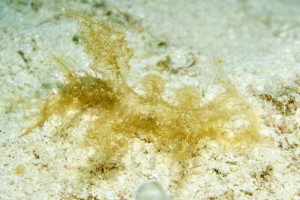
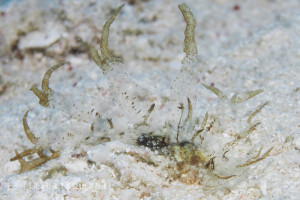
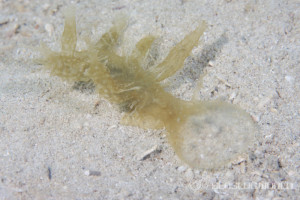
Irregularly spaced patches of opaque white pigment are present on the body and cerata, and alternating bands of brown and opaque white pigment are present on the rhinophores, cerata and the elongate papillae of the head, notum and sides of the body. The translucent brownish color with opaque white spots makes the animal virtually invisible on a sandy substratum.
The buccal mass is wide and muscular, devoid of jaws or radula. A small, compact, globular salivary gland lies on either side of the muscular portion of the buccal mass. The posterior stomach contains 20–24 thin triangular plates with eccentric apices. The majority of the plates are nearly equal in size and aligned in a regular fashion. Three to four smaller plates are found in some specimens, but these do not alternate with the larger ones in a regular manner. The digestive gland is diffuse and surrounds the stomach; the posterior digestive branch is not well developed and does not extend into the posterior cerata.
The penis is flattened and paddle-shaped, distinctive within the genus.
Distribution
The type locality is Coconut Island, Kaneohe Bay, Oahu, Hawaii (Gosliner, 1987). A 2003 revision added records from Dubai, Indonesia and Malaysia, indicating that the species is widely distributed throughout the Indo-Pacific.Etymology
The specific epithet megaceras derives from Greek megas (large) and keras (horn), meaning "large-horned". The original description (Gosliner, 1987) states that the epithet "refers to the large cerata, which may be almost as long as the body proper."Remarks
The type locality is the west side of a sand bar in Kaneohe Bay, Oahu, Hawaii, at 3 m depth. The holotype is CASIZ 061507, collected on 12 February 1986 by T. M. Gosliner. In Kaneohe Bay specimens were found sympatrically with Melibe pilosa. When actively crawling, the cerata are held horizontally and the animal is exceedingly flat, providing camouflage on sandy substrata. When disturbed, animals swim by rapid lateral flexure of the body. The white egg mass is a broad, coiled ribbon attached to the sand substratum by a mucous thread, with 1–3 eggs per capsule (zygotes 72 µm in diameter). At 24–26 °C, hatching to type-1 planktotrophic veliger larvae (shell length 128 µm) occurs in 3 days (Gosliner, 1987).The phylogenetic analysis of a 2003 revision indicates that Melibe megaceras is the sister species of a large clade containing seven Indo-Pacific taxa. All members of this clade share several synapomorphies: papillae on the surface of the oral hood, papillae on the rhinophore sheaths (secondarily lost in M. viridis), a papillate body surface (secondarily modified in M. digitata and M. tuberculata), and the presence of either an external or internal nodular vaginal gland.
M. megaceras is most easily distinguished from other members of this clade and from other members of the genus by its elongate cerata with 2–4 elongate branches, a posterior digestive gland branch that does not enter any of the cerata, and a flattened, paddle-shaped penis. As in M. digitata and M. tuberculata, ceratal tubercles are absent.
References
- Melibe megaceras Gosliner, sp. nov., Gosliner, T. M. (1987). Review of the nudibranch genus Melibe (Opisthobranchia: Dendronotacea) with descriptions of two new species. The Veliger. 29(4): 400-414.
- Melibe megaceras Gosliner, 1987, Gosliner, T. M.; Smith, V. G. (2003). Systematic review and phylogenetic analysis of the nudibranch genus Melibe (Opisthobranchia: Dendronotacea) with descriptions of three new species. Proceedings of the California Academy of Sciences. 4(54): 302-356.
- Melibe megaceras, Terrence Gosliner, Ángel Valdés and David Behrens. (2015). Nudibranch and Sea Slug Identification Indo-Pacific. New World Pubns Inc.
- オオウラメリベ(新称), 中野理枝. (2018). 日本のウミウシ. 文一総合出版.
Featured in this book
Terrence Gosliner, Ángel Valdés and David Behrens. (2018). Nudibranch and Sea Slug Identification Indo-Pacific 2nd Edition. New World Pubns Inc.
New World Publications
This species, Melibe megaceras, is included in the book.
View on Amazon PR (Amazon Associates)Seasonality
Shooting Locations
Loading shooting locations...
Photos of Melibe megaceras







Same Genus Nudibranchs


Similar Colors Nudibranchs
Academic Database
Sea slug observation data is available in international marine biodiversity databases.