Melibe japonica Eliot, 1913
Description
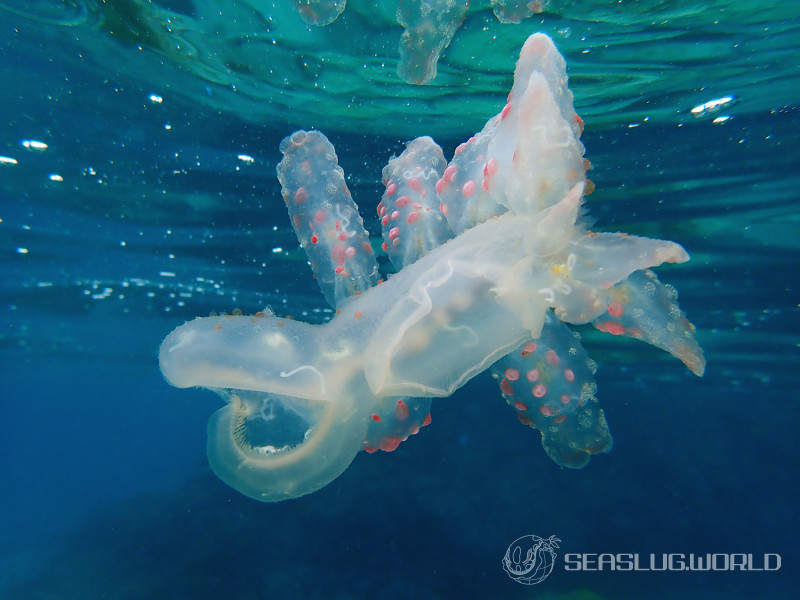
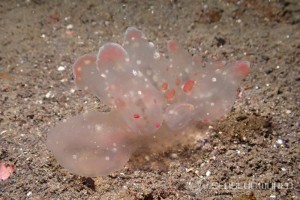
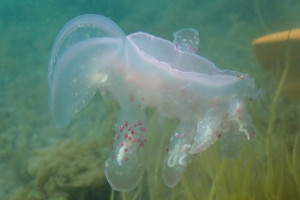
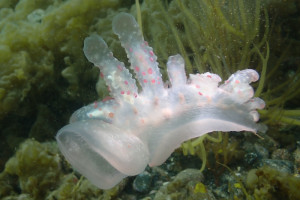
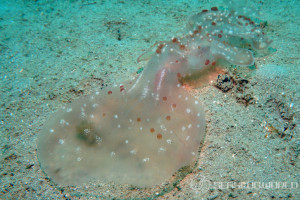
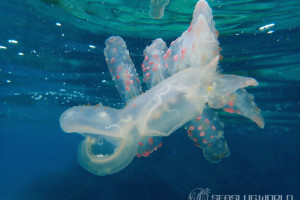
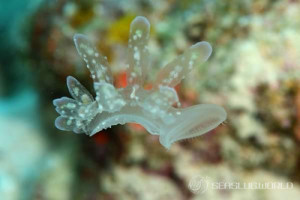
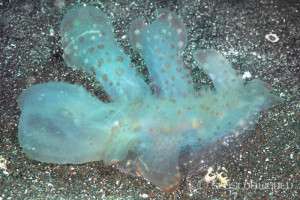
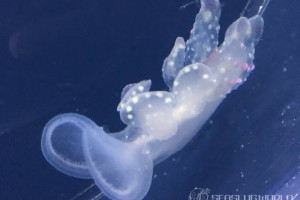
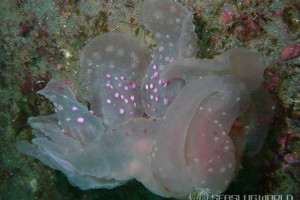
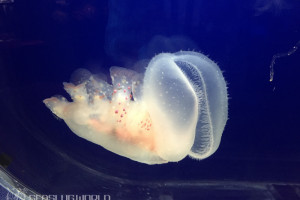
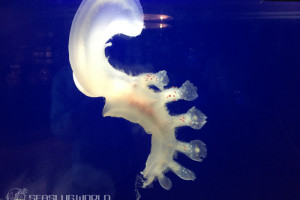
A large dendronotacean nudibranch reaching up to 70 cm in body length. The body is translucent pinkish-white, scattered all over with reddish to pink tubercles. The cerata are typically arranged in 6–7 pairs (up to 10 pairs in some individuals), rounded and saccate, and densely covered with red-tipped tubercles.The head is modified into a large oral hood with sensory papillae arranged in two bands along its margin. The hood is cast forward like a net to capture small crustaceans.
The rhinophores are small, each with a posterior tubercular process. Dendritic papillae are irregularly arranged along the dorsal midline between the cerata, particularly in larger specimens.
This species does not swim actively by twisting its body; rather, it floats in the mid-water and occasionally descends to the seabed to feed.
The cerata are readily autotomised but regenerate.
Distribution
Indo-West Pacific, recorded from Japan (Pacific coast of Honshu through Kyushu, including Tsushima and the Oki Islands), Korea, Pakistan, and Queensland (Australia). The type locality is the sea off Numazu, Shizuoka Prefecture, Japan.Etymology
The specific epithet japonica is Latin for "of Japan," referring to the type locality (Numazu, Japan). The name was coined by Eliot 1913.Remarks
The original description by Eliot 1913 was based on a single specimen from Numazu held by the Department of Zoology, Tokyo Imperial University. The type specimen, now deposited in the University Museum, the University of Tokyo, has dried and solidified to the extent that neither morphological re-examination nor DNA extraction is feasible.A 2003 revision suggested that this taxon might be a junior synonym of Melibe viridis, and WoRMS 2024 listed it as an uncertain synonym of M. viridis. Nakano, Tokuda & Yorifuji 2024 re-examined red-spotted Melibe specimens collected from various sites in Japan and confirmed, on the basis of external morphology (oral hood shape, number and coloration of cerata, presence of dendritic papillae), internal anatomy (stomach plates, jaw plate, reproductive system), and molecular phylogenetic analyses (COI, 16S, and H3), that M. japonica is a valid species distinct from M. viridis. They designated a specimen from off Enoshima Island, Kanagawa (NSMT-Mo 79324, 70 mm in length) as the provisional neotype.
Aquarium observations indicate that this species feeds on small crustaceans, including brine shrimp (Artemia) larvae.
References
- ヤマトメリベ, Baba K. (1949). Opisthobranchia of Sagami Bay collected by His Majesty the Emperor of Japan (相模湾産後鰓類図譜). Iwanami Shoten, Tokyo. 4+2+194+7 pp., pls. 1-50.
- ヤマトメリベ Melibe japonica Eliot, 1913, 馬場菊太郎 (1984). ヤマトメリベ Melibe japonica Eliot, 1913 の解剖(予報). 南紀生物 26(1): 67.
- Gosliner, T. M.; Smith, V. G. (2003). Systematic review and phylogenetic analysis of the nudibranch genus Melibe (Opisthobranchia: Dendronotacea) with descriptions of three new species. Proceedings of the California Academy of Sciences. 4(54): 302-356.
- ヤマトメリベ, 中野理枝. (2004). 本州のウミウシ. ラトルズ.
- ヤマトメリベ, 小野篤司. (2004). 沖縄のウミウシ. ラトルズ.
- Melibe japonica, Nakano R., Tokuda G. & Yorifuji M. (2024). Redescription of Melibe japonica (Nudibranchia: Dendronotoidea: Tethydidae) and its phylogenetic relationship in the genus. Molluscan Research. 44(3): 267-277. https://doi.org/10.1080/13235818.2024.2367267
A Kindle field guide by the site author
Kimoto N. (2026). Sea Slugs of Japan & the Indo-Pacific, 2nd Edition.
Kindle Edition
View on Amazon PR (Amazon Associates)Seasonality
Shooting Locations
Loading shooting locations...
Photos of Melibe japonica
Tag:









Same Genus Nudibranchs


Similar Colors Nudibranchs

Academic Database
Sea slug observation data is available in international marine biodiversity databases.