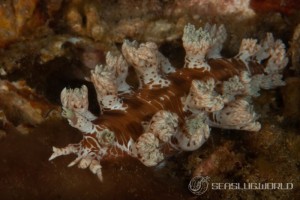
Melibe digitata Gosliner & V. G. Smith, 2003
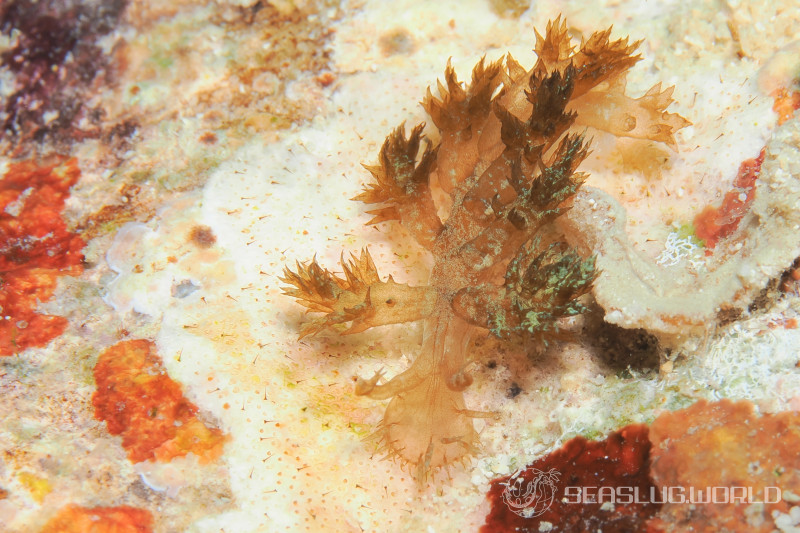
- Location
- Romblon Island, Philippines
- Date
- 2024/06/23
- Length
- 30mm
- Depth
- 8.0m
- Water temperature
- 30.0℃
Description
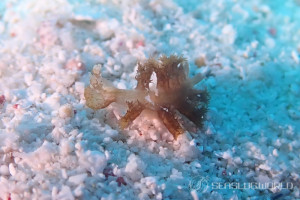
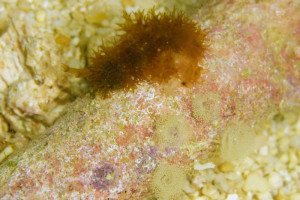
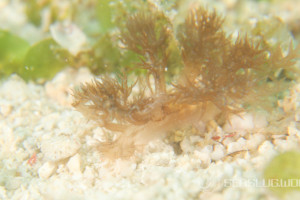
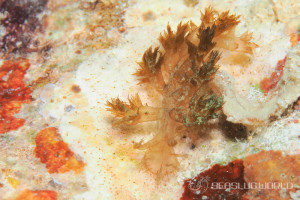
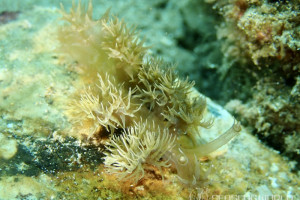
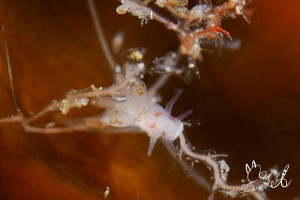
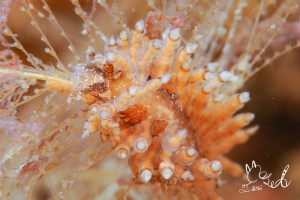
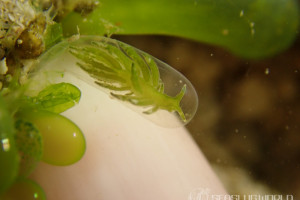
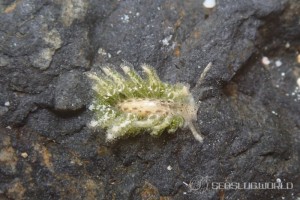
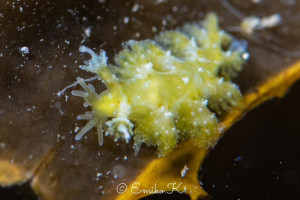
A medium-sized melibid reaching about 25 mm in length. The body is creamy white to greenish brown, with darker green pigmentation toward the distal ends of the cerata. The animal is translucent and the viscera are visible through the body wall. The body is elongate and laterally compressed, with a dorsal hump in the cardiac region.The most distinctive feature is the highly ramified, arborescent cerata. The basal two-thirds of each ceras is unbranched or has only simple branches, while the distal third divides repeatedly into multifid, acutely tapering apices. There are 4–7 cerata per side. In living animals the cerata exhibit a pronounced greenish-brown coloration, probably indicating the presence of zooxanthellae.
The oral hood is small relative to the body (up to 6 mm in diameter in the largest specimen) and bears inner and outer rows of tentacular papillae. The rhinophores are inserted close together and bear 5–7 lamellae. The posterior stomach contains about 17 thin triangular chitinous plates, and the jaws have a smooth masticatory margin.
Distribution
The type locality is Devil's Point, Maricaban Island, Batangas Province, Luzon, Philippines, at 10 m depth. Specimens have been collected only in the vicinity of Maricaban Island and Hamilo Bay in the Philippines.Etymology
The specific epithet digitata is Latin for "finger-like", referring to the highly digitate branching of the cerata.Remarks
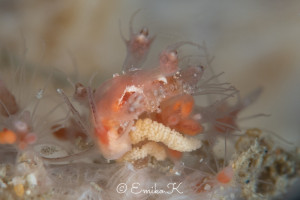
Specimens have been found in 1–12 m of water, generally on or under the surface of rounded basaltic stones, sometimes co-occurring with Melibe tuberculata. The egg ribbon is a flatly coiled, three-tiered spiral whorl, with capsules approximately 0.12 mm in diameter, each containing a single opaque white egg.M. digitata is the sister species of M. tuberculata. The two share numerous synapomorphies including a secondarily smooth body, smooth jaws and the absence of a rhinophoral sail, but M. digitata is distinguished by acutely pointed ceratal papillae (vs. rounded in M. tuberculata), a pyriform bursa copulatrix, closely set ovotestis follicles, an elongate buccal mass, elongate salivary glands and largely fused pleural ganglia.
References
- Melibe digitata Gosliner and Smith, sp. nov., Gosliner, T. M.; Smith, V. G. (2003). Systematic review and phylogenetic analysis of the nudibranch genus Melibe (Opisthobranchia: Dendronotacea) with descriptions of three new species. Proceedings of the California Academy of Sciences. 4(54): 302-356.
- Melibe digitata, Terrence Gosliner, Ángel Valdés and David Behrens. (2018). Nudibranch and Sea Slug Identification Indo-Pacific 2nd Edition. New World Pubns Inc.
Featured in this book
Terrence Gosliner, Ángel Valdés and David Behrens. (2018). Nudibranch and Sea Slug Identification Indo-Pacific 2nd Edition. New World Pubns Inc.
New World Publications
This species, Melibe digitata, is included in the book.
View on Amazon PR (Amazon Associates)Seasonality
Shooting Locations
Loading shooting locations...
Photos of Melibe digitata
Tag:






Same Genus Nudibranchs


Similar Colors Nudibranchs

Academic Database
Sea slug observation data is available in international marine biodiversity databases.