Ercolania kencolesi Grzymbowski, Stemmer & Wagele, 2007
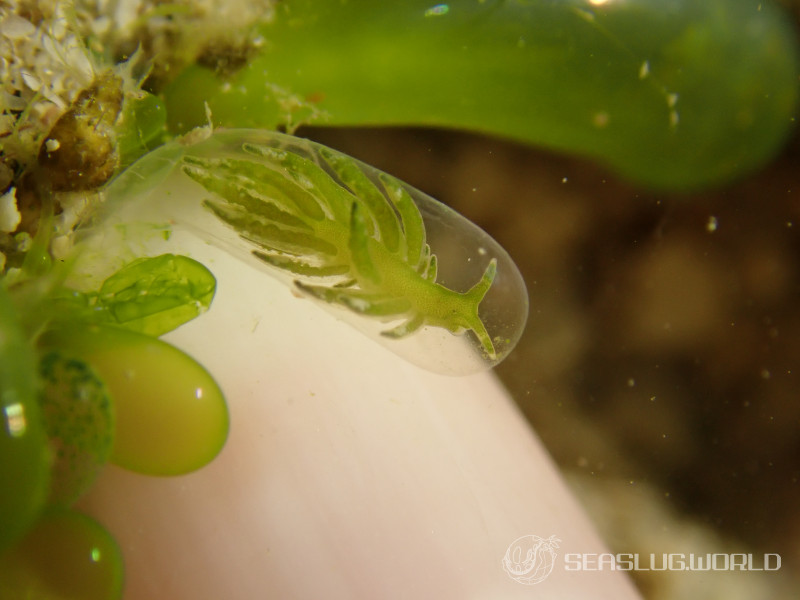
- Location
- Houbihu Outlet, Kenting, Taiwan
- Date
- 2021/02/28
- Length
- 3mm
- Depth
- 0.1m
- Water temperature
- 28.0℃
Description
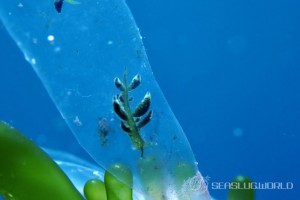
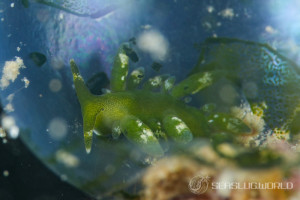
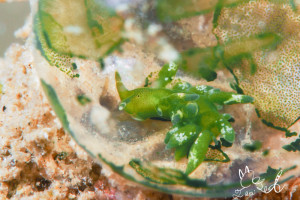
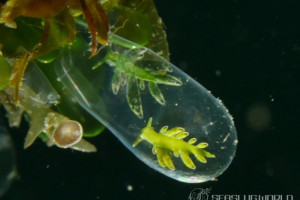
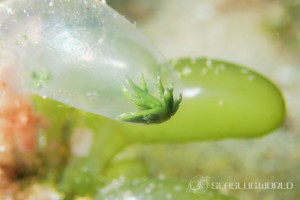
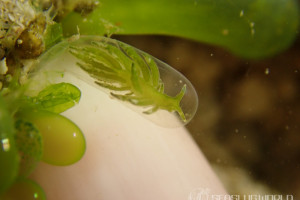
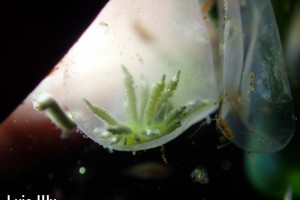
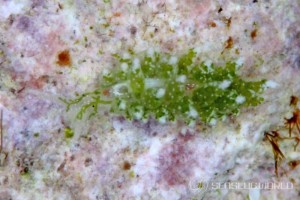
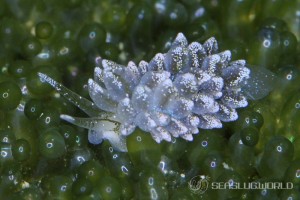
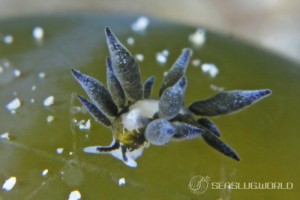
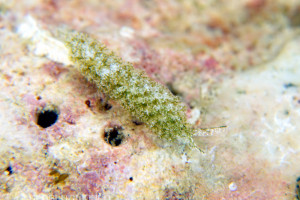
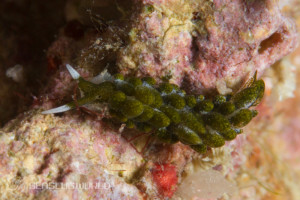
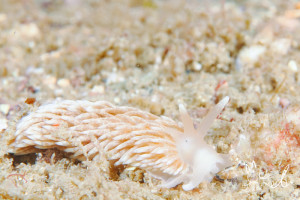
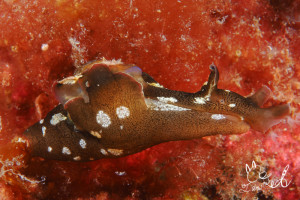
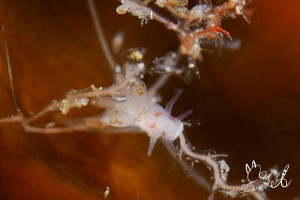
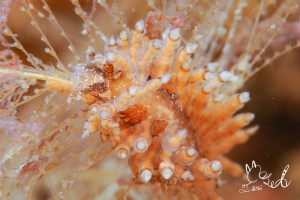
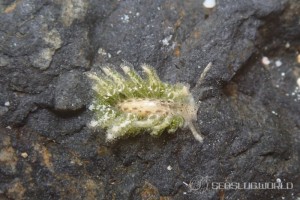
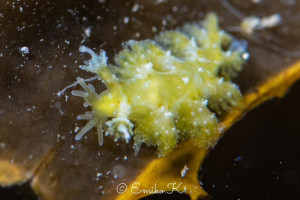
A very small sacoglossan; living animals 4-6 mm long, contracting to about 3 mm when starved. Preserved specimens measure only 2.1-2.3 mm. The body is elongate with the foot tapering posteriorly; the anterior foot lacks both a notch and propodial tentacles. Rhinophores are long, solid and digitiform with smooth surfaces. The eyes lie behind the rhinophores on the lateral sides of the head. The renopericardial prominence is inconspicuous. Cerata are club- to sausage-shaped, arranged in one or two rows along the dorsum, with smaller cerata interspersed laterally and similar-sized cerata typically opposite each other.Living animals are bright green, the colour deriving from chloroplasts of Boergesenia forbesii sequestered along the digestive-gland branches. Rhinophores are green with white tips and a white blotch encircling them about midway. The head is entirely green and the eyes are hardly visible. The anterior foot margin is pale green to whitish. Cerata are a darker green, darkest apically, with subapical white blotches forming an incomplete ring. After two to three days of starvation the body becomes brownish and the eyes more conspicuous.
Distribution
Type locality: Casuarina Beach, Lizard Island, North Queensland, Australia (intertidal flat in front of the Lizard Island Research Station, in shallow water to about 1 m depth). The species has also been reported from Hope Island, North Queensland (Loch, 1989) and from Guam (Carlson & Hoff, 2003), giving it a tropical western Pacific range.Etymology
The specific epithet kencolesi honours Ken Coles, a long-time Australian sponsor of the Lizard Island Research Station (LIRS), whose donations have supported many researchers working at the station.Remarks
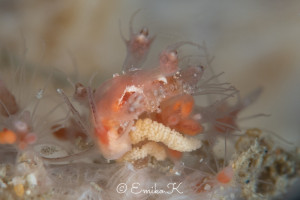
The species lives endophytically inside the giant unicellular tubular green alga Boergesenia forbesii. The slug pierces the algal cell wall with its radula and pushes its head into the cell. Once inside, it sucks the chloroplast layer along the inner wall, then consumes the cytoplasm; after a host cell is exhausted, the slug deposits one or two egg masses within the empty alga and moves on to the next algal cell. Each egg mass is a tubular coil 4-5 mm in diameter, wound anticlockwise in about 2.5 planar whorls and containing roughly 500 capsules; each capsule encloses a single white egg about 100 µm in diameter. Development is planktotrophic.A comparable endophytic life-history is known from Ercolania endophytophaga Jensen, 1999, which lives inside Struvea plumosa; the two species may be closely related. The Japanese vernacular name "Magatamamo-umiushi" refers to the host alga (Magatamamo = Boergesenia forbesii).
References
- Ercolania kencolesi sp. nov., Grzymbowski Y., Stemmer K. & Wägele H. (2007). On a new Ercolania Trinchese, 1872 (Opisthobranchia, Sacoglossa, Limapontiidae) living within Boergesenia Feldmann, 1950 (Cladophorales), with notes on anatomy, histology and biology. Zootaxa. 1577: 3-16.
- マガタマモウミウシ(新称), 西田和記. (2024). ウミウシの生態観察図鑑. 誠文堂新光社.
Featured in this book
西田和記. (2024). ウミウシの生態観察図鑑. 誠文堂新光社.
誠文堂新光社
This species, Ercolania kencolesi, is included in the book.
View on Amazon PR (Amazon Associates)Seasonality
Shooting Locations
Loading shooting locations...
Photos of Ercolania kencolesi
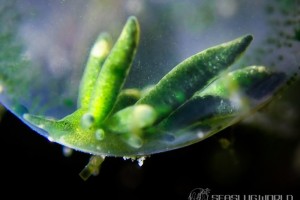

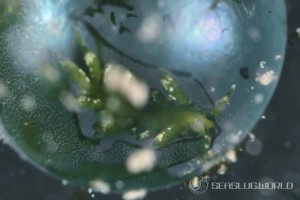







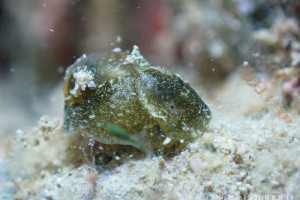
Same Genus Nudibranchs
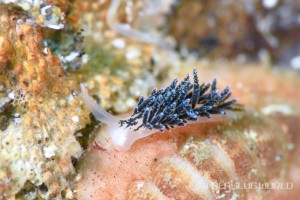
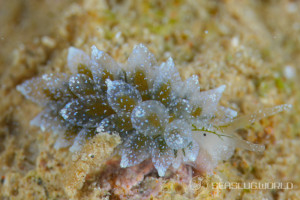
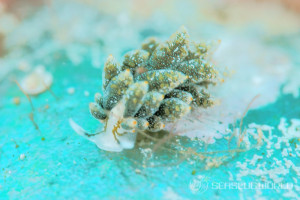

Similar Colors Nudibranchs


Academic Database
Sea slug observation data is available in international marine biodiversity databases.