Ercolania annelyleorum Wägele, Stemmer, Burghardt & Händeler, 2010
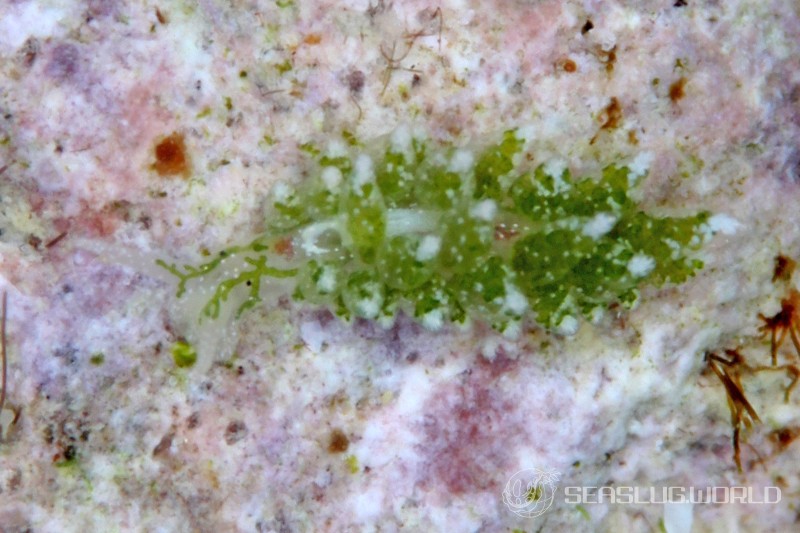
- Location
- Gorilla Chop, Okinawa Island (Motobu and Northern area), Okinawa, Japan
- Date
- 2024/12/18
- Length
- 3mm
- Depth
- 3.0m
- Water temperature
- 23.0℃
Description
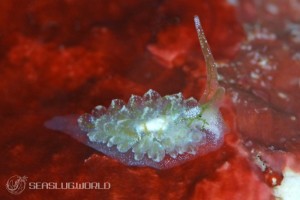
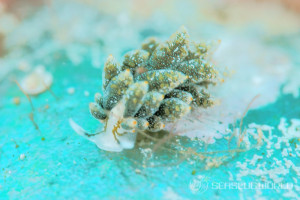
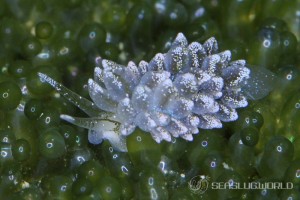
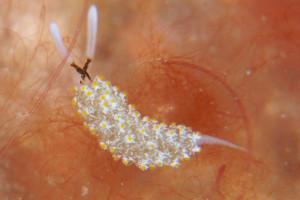
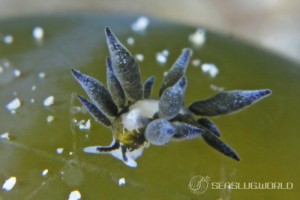
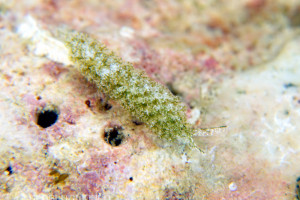
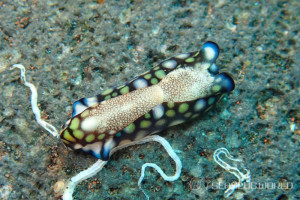
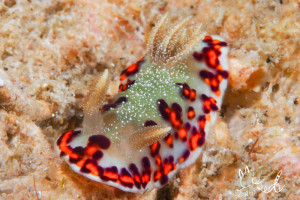
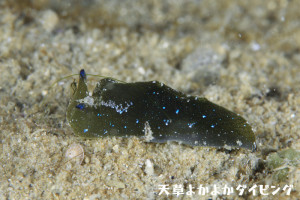
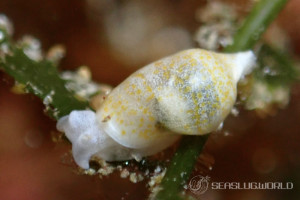
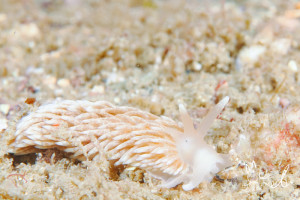
A very small sacoglossan sea slug, only about 4-5 mm long. The body is elongate and translucent to whitish, with the green branches of the digestive gland — coloured by ingested chloroplasts — showing through the body wall, especially in the cerata and along the margins. Two green lines run forward from the rear of the back to the bases of the rhinophores. Its most distinctive feature is a pair of irregular red patches on the dorsal surface, one in the anterior third and one in the posterior third, lying between the two green lines. The cerata are club-shaped to elongate and arranged in two or three rows, smaller towards the outside, leaving the centre of the back bare; scattered white dots cover the body and become denser on the tips of the cerata and the long, finger-shaped rhinophores. Starved animals lose the green tint and turn pale, whitish to slightly pinkish.Distribution
At the time of description, the species was known from its type locality at Casuarina Beach, Lizard Island (Great Barrier Reef, Queensland, Australia), in shallow water down to about 1 m, and from the Mariana Islands.Etymology
The specific epithet annelyleorum honours Dr. Anne Hoggett and Dr. Lyle Vail, directors of the Lizard Island Research Station, in recognition of their long-standing support of the research project; the ending -orum is the plural genitive used when a species is dedicated to more than one person.Remarks
It lives among tufts of the green alga Boodlea, piercing the algal cell walls with its teeth and sucking out the contents. Unlike many sacoglossans, it digests the ingested chloroplasts almost at once and does not retain functional kleptoplasts. The closely related Ercolania boodleae, which feeds on the same alga, is distinguished by lacking the two dorsal red patches.References
- Ercolania annelyleorum sp. nov., Wägele H., Stemmer K., Burghardt I. & Händeler K. (2010). Two new sacoglossan sea slug species (Opisthobranchia, Gastropoda): Ercolania annelyleorum sp. nov. (Limapontioidea) and Elysia asbecki sp. nov. (Plakobranchoidea), with notes on anatomy, histology and biology. Zootaxa. 2676: 1-28.
- ニライカナイウミウシ(新称), 今川郁. (2026). 沖縄のウミウシ: DNA解析による最新の分類図鑑1089種. 誠文堂新光社.
Related articles
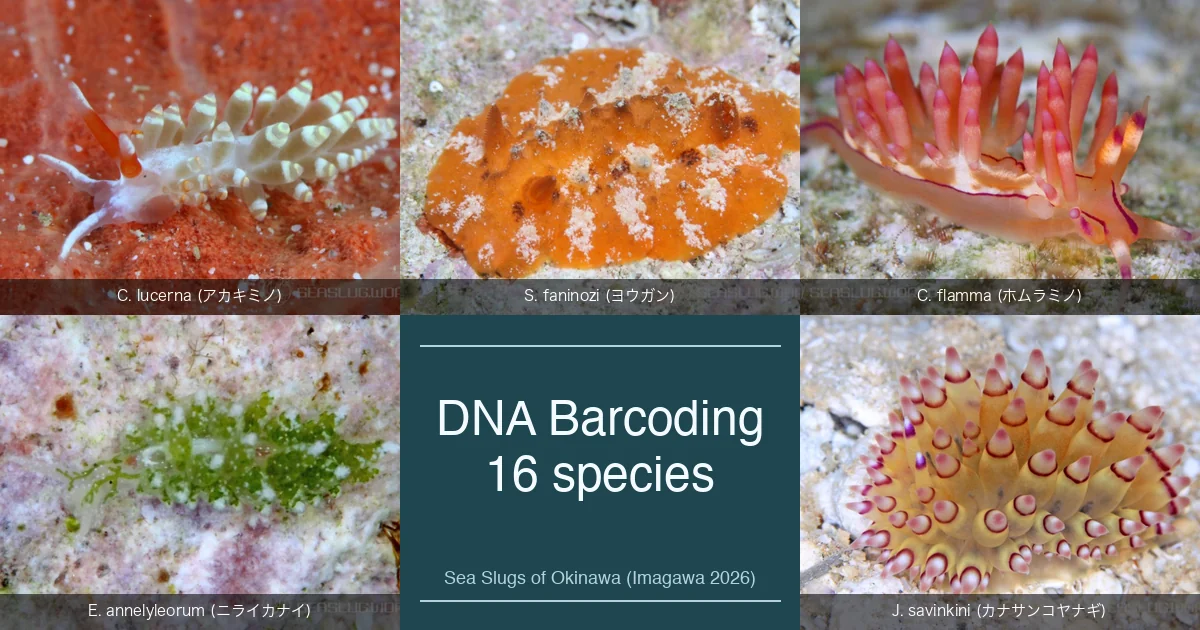
Sea Slugs of Okinawa (Imagawa 2026): 16 species with DNA-confirmed identity
A Kindle field guide by the site author
Kimoto N. (2026). Sea Slugs of Japan & the Indo-Pacific, 2nd Edition.
Kindle Edition
View on Amazon PR (Amazon Associates)Seasonality
Shooting Locations
Loading shooting locations...
Photos of Ercolania annelyleorum

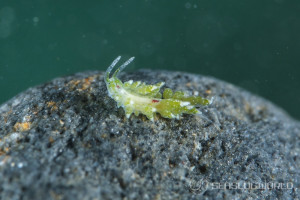

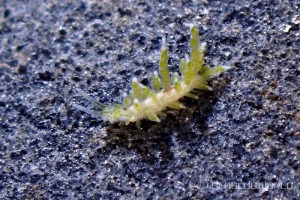

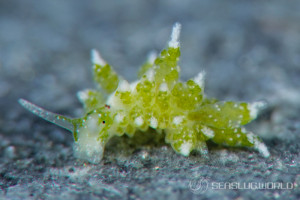

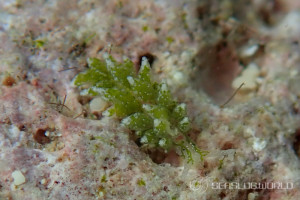

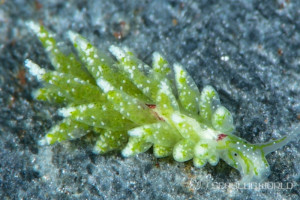
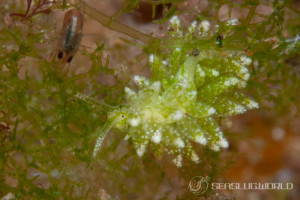

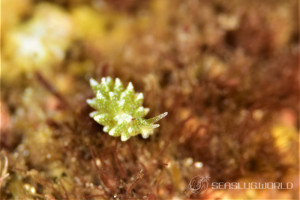

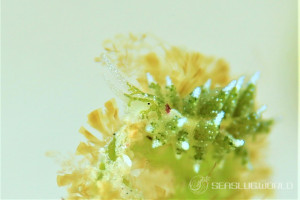

Specimen & DNA
| Observation | Database | COI | 16S | H3 |
|---|---|---|---|---|
| #54009 | BOLD Systems | SSWBP564-25 |
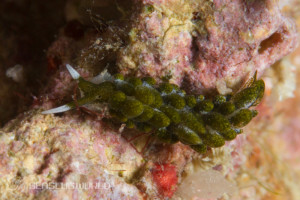
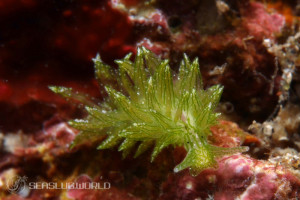
Same Genus Nudibranchs

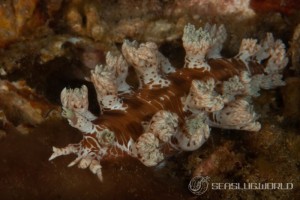
Similar Colors Nudibranchs

Academic Database
Sea slug observation data is available in international marine biodiversity databases.