Hancockia burni T. E. Thompson, 1972
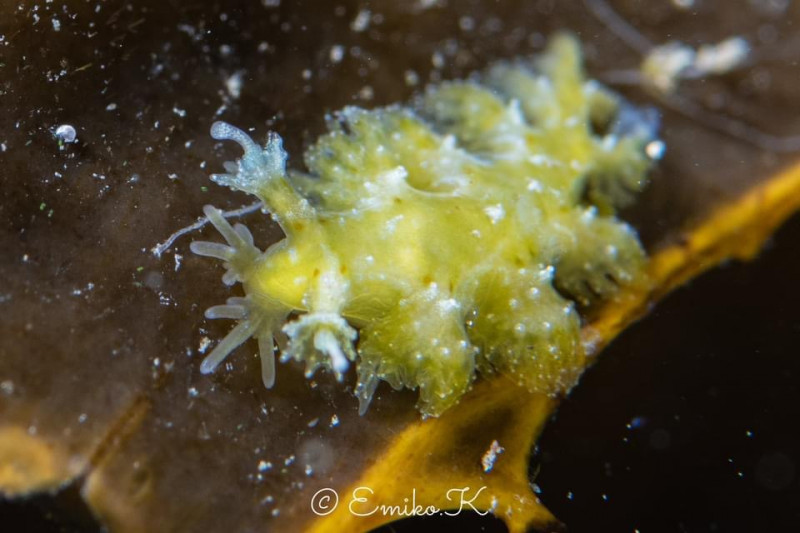
- Location
- Chowder Bay, New South Wales, Australia
- Date
- 2021/10/28
- Length
- 5mm
- Depth
- 3.0m
- Water temperature
- 20.0℃
Description
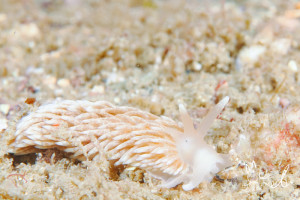
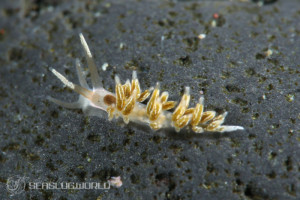
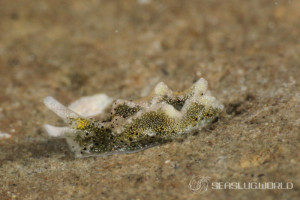
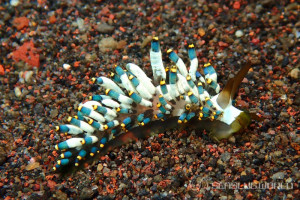
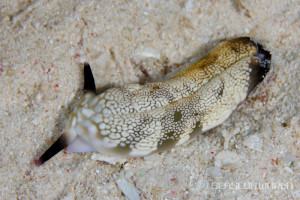
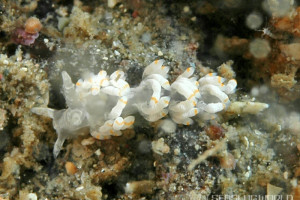
A small Hancockia, reaching about 10 mm in extended length. Body translucent white with a fine irregular pattern of reticulate brown markings and opaque white specks, giving a marbled appearance; a few specks bear a faint green iridescent sheen. The oral veil is bilobed, each lobe carrying four (rarely five) digitate processes that surround the mouth like the petals of a flower. The flattened foot ends posteriorly in a bluntly rounded metapodium. A pulsating pallial prominence (corresponding to the heart) lies about one-third of the body length back from the head, with a low ridge running posteriorly along the dorsal blood vessel. The rhinophore sheaths are trumpet-shaped with frilled rims bearing 9-10 digitate processes and a particularly large spur-like mesial tubercle; each rhinophore has 10-11 longitudinal ridges, a white tip, and is fully retractile. Cerata are arranged in two rows of five (rarely six) per side; anterior cerata are large with 10-11 finger-like processes and posterior ones are smaller with 2-3 processes, with the relaxed cerata typically held in a half-clenched "hand-like" attitude. Each ceras bears a chalk-white spur-like mesial tubercle near its base. Cnidosacs are abundant in the surface tubercles of the cerata and rhinophore sheaths; when disturbed, large numbers of nematocysts (12-15 μm long) are discharged from these sacs.Distribution
The type locality is Point Lookout, North Stradbroke Island, Queensland, Australia, where specimens were taken from calyptoblastic hydroids on the undersides of boulders at LWST. The original description reports this as the first record of the family Hancockiidae from the western Pacific.Etymology
The specific epithet burni honours Robert Burn of Geelong, Victoria, Australia, in recognition of his long-standing contribution to Australian opisthobranch taxonomy.Remarks
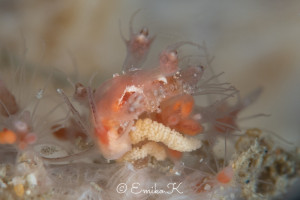
Hancockia is the only genus within the superfamily Dendronotoidea known to possess cnidosacs, which it carries in the surface tubercles of both the cerata and the rhinophore sheaths. The holotype (a 10 mm specimen) is deposited in the Natural History Museum, London (Reg. No. 19702W). The white spawn band is attached to the substratum along one crinkled edge and contains single eggs of about 82 μm in diameter; embryonic development takes about seven days at 20 ℃, yielding planktotrophic veliger larvae.References
A Kindle field guide by the site author

Kimoto N. (2026). Sea Slugs of Japan & the Indo-Pacific, 2nd Edition.
Kindle Edition
View on Amazon PR (Amazon Associates)Seasonality
Shooting Locations
Loading shooting locations...
Photos of Hancockia burni

Same Genus Nudibranchs
Similar Colors Nudibranchs


Academic Database
Sea slug observation data is available in international marine biodiversity databases.