Two Japanese vernacular names for one cryptic species (Phyllodesmium sp. 8)
The new Japanese vernacular name the book proposes is the second one given to the same cryptic species (Phyllodesmium sp. 8) that Nakano (2018) had already named. One and the same animal now carries two vernacular names.
This cryptic pair — Phyllodesmium poindimiei and a closely similar undescribed species — splits into two lineages in the COI tree of Moore & Gosliner 2011, and Okinawan specimens show the same split. The split itself is not in dispute. What differs is how far one checks existing vernacular names before coining a new one: we assign the pre-existing name to P. sp. 8, while the book coins a new vernacular name of its own.
The two species
Phyllodesmium poindimiei (Risbec, 1928) and the closely similar Phyllodesmium sp. 8 (undescribed) are distinct but near-identical species — a cryptic pair.
| Item | P. poindimiei | P. sp. 8 |
|---|---|---|
| Scientific name | Phyllodesmium poindimiei (Risbec, 1928) | Phyllodesmium sp. 8 (undescribed) |
| Japanese vernacular name | pre-existing (Ono 2004) | coined by Nakano 2018 |
| Lineage in Moore & Gosliner 2011 | poindimiei1 | poindimiei2 |
The true appearance of poindimiei is anchored by the specimen Risbec described in 1928 and re-illustrated in 1953 (yellow ground with white dots, sulphur-yellow ceratal tips). P. sp. 8 belongs to the same lineage that the Hawaiian guide site seaslugsofhawaii.com has treated separately as "sp. 1," and it was recognized as a distinct animal early on in Hawaii as well.
Telling them apart
Both are translucent and delicately built, and are easily confused in photographs.
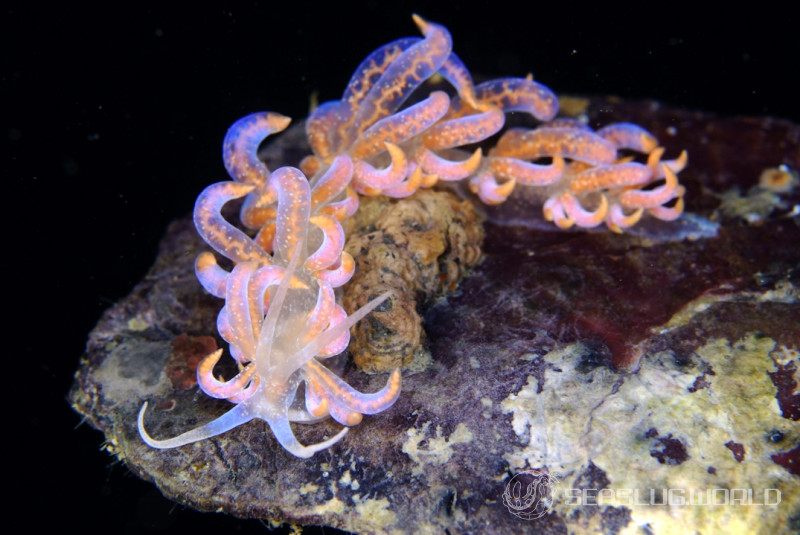
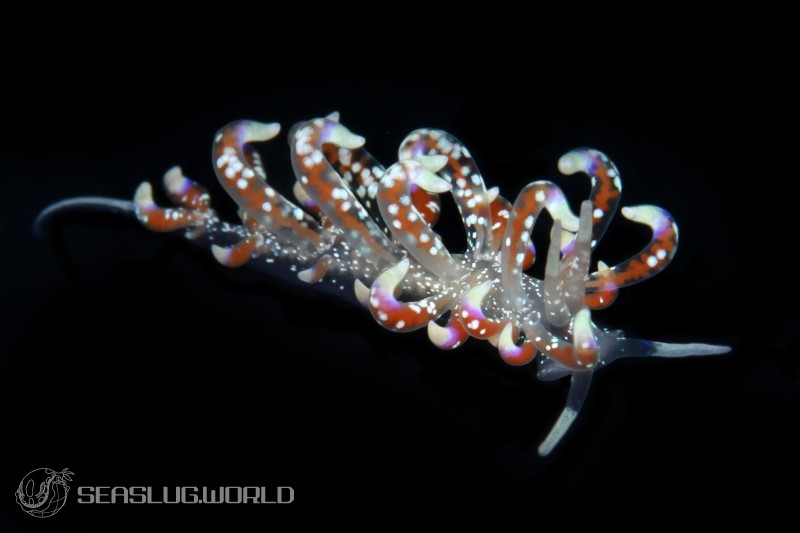
But they can be separated on the following points (based on observations of both species at the Hawaiian site seaslugsofhawaii.com).
| Character | P. poindimiei | P. sp. 8 |
|---|---|---|
| Maximum length | ~50 mm | ~25 mm |
| Build | slender, translucent | even more slender, translucent |
| Ceratal tips | smooth, curved | usually straight, coiling into a spiral when disturbed |
| Digestive gland in the cerata | orange along the whole length, yellow at the tip | short side branches, dark brown, appearing as spots |
| White spots | occasional cloudy white patches | distinct scattered white spots, cerata tips also white |
| Blue sheen (below the tips) | on cerata, rhinophores, and oral tentacles | on the cerata only |
| Host | genus Carijoa (octocorals) | an unidentified small octocoral |
| Habitat | 6–20 m, dark and sheltered spots | intertidal to very shallow rubble, also entering crevices between stones |
| Egg mass | white spiral, hatching in 5–6 days | folded white spiral (~5–6 mm across), hatching in ~4 days |
The way the cerata move when disturbed (staying curved vs coiling into a spiral), body size, host, and habitat all allow field identification. The colour of the digestive gland inside the cerata (orange vs dark brown) is a clue even in a still photograph.
The molecular evidence
When Moore & Gosliner 2011 built a COI tree of 18 Phyllodesmium species, they noticed that sequences labelled P. poindimiei fell into two lineages, which they wrote out as "poindimiei1" and "poindimiei2." The two lineages are about 10% apart in COI, and the authors presented them as separate lineages rather than lumping them.
The rest of this article is for Premium members
This is one of our in-depth member articles — new species reports, paper walkthroughs, and taxonomy deep-dives. Members read them all. Free for your first month, then USD 3.00/month, cancel anytime.
- New species reports, paper walkthroughs, and taxonomy deep-dives — members only
- No ads (AdSense) across the entire site
- Priority handling of your observations (Premium uploads are identified and published first when the moderation queue is backed up)
- Priority access to the AI identification feature
Already a member? Please log in.
Enjoyed this post? You can tip the author directly —
Tip this post