Is the Okinawan animal Coryphellina pseudolotos?
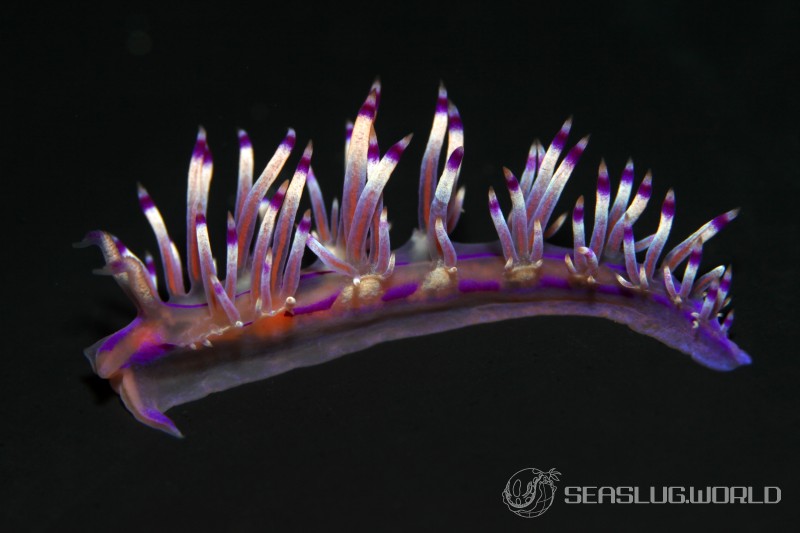
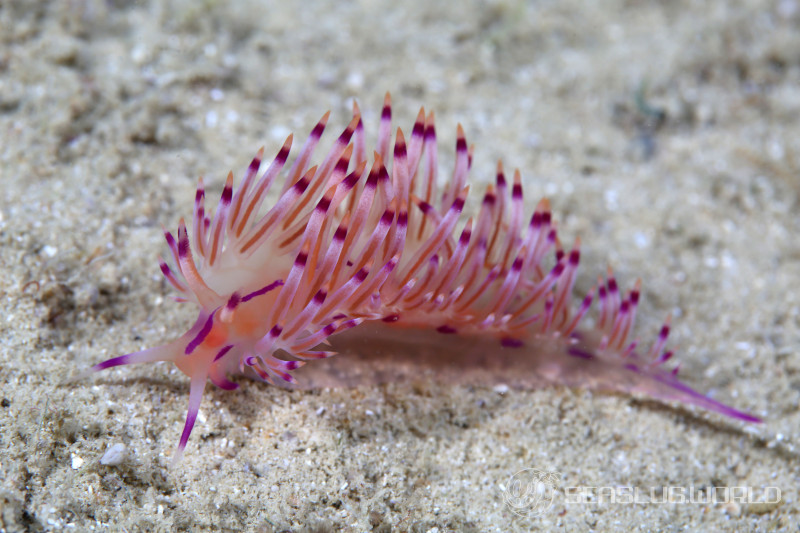
Sea Slugs of Okinawa: An Updated Identification Guide Based on DNA Analysis, 1,089 Species (Imagawa 2026) gives an Okinawan animal (SSWBP188/189) a new Japanese vernacular name and, in a column, states that it is "genetically divergent, confirmed as a separate species," treating it as Coryphellina sp. This site has listed the same population as C. pseudolotos. So — does the DNA really point to a separate species? We checked, with the three genes in hand (COI, 16S, and the nuclear H3).
What the DNA can tell us
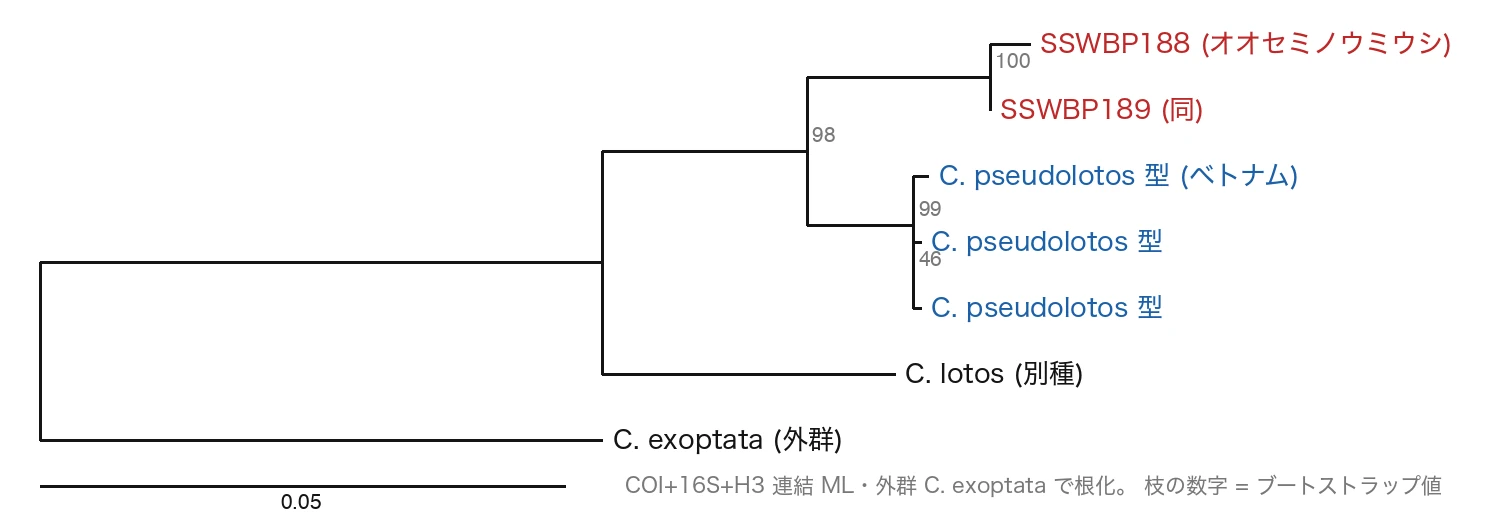
SSWBP188 and 189 are two Okinawan individuals with COI, 16S and nuclear H3 all obtained; their COI differs by only 0.63%, so they are the same lineage. Compared against the Vietnamese reference series used in the description of pseudolotos (Ekimova et al. 2022; hereafter "the type series"), the distances are as follows.
| gene | distance to the type series |
|---|---|
| COI (mitochondrial) | 4.21–4.74% |
| 16S (mitochondrial) | 2.27–2.50% |
| H3 (nuclear) | 0.31–0.36% |
Reading the distances with the describer's own ruler
Where to draw the species boundary is something the authors who described this group (the rubrolineata complex), Ekimova et al. 2022, set out in numbers. According to the paper, within-species COI variation does not exceed 4.2%, and between-species distances range from 9.38% to 16.79%. Between 4.2% and 9.38% there is a clear gap (a barcode gap).
The COI 4.21–4.74% by which SSWBP188/189 differ from the type series only just exceeds that 4.2%, and comes nowhere near the 9.38% of a between-species distance. Indeed, the nearest other species, C. lotos, is 9.71% from pseudolotos in COI — that is what "between species" looks like. SSWBP is less than half that far.
The band the describer herself left undecided
The rest of this article is for Premium members
This is one of our in-depth member articles — new species reports, paper walkthroughs, and taxonomy deep-dives. Members read them all. Free for your first month, then USD 3.00/month, cancel anytime.
- New species reports, paper walkthroughs, and taxonomy deep-dives — members only
- No ads (AdSense) across the entire site
- Priority handling of your observations (Premium uploads are identified and published first when the moderation queue is backed up)
- Priority access to the AI identification feature
Already a member? Please log in.
Enjoyed this post? You can tip the author directly —
Tip this post