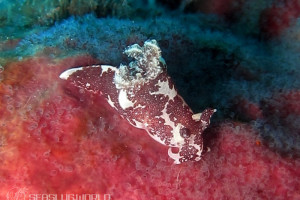
Aliculastrum cylindricum (Helbling, 1779)
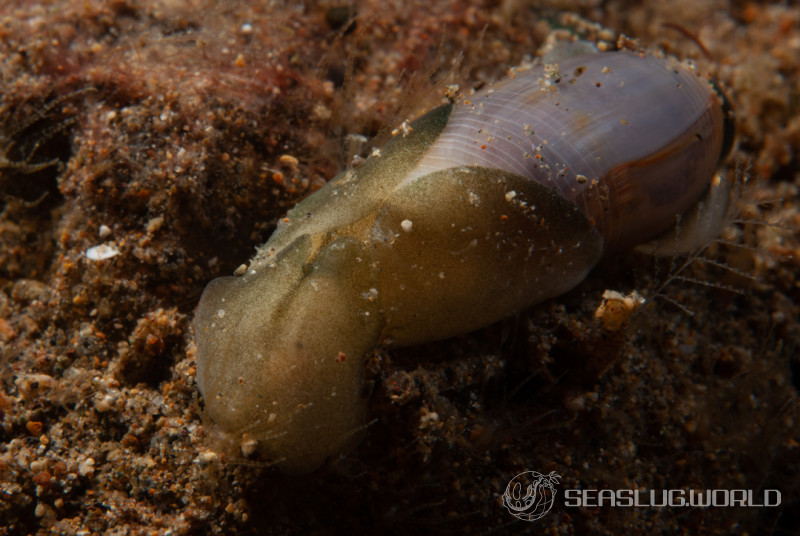
- Location
- Philippines
- Date
- 2006/01/05
- Length
- 30mm
- Depth
- 9.0m
- Water temperature
- 25.0℃
Description
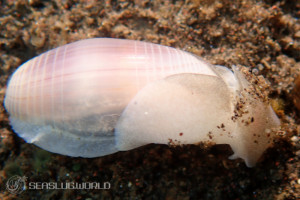
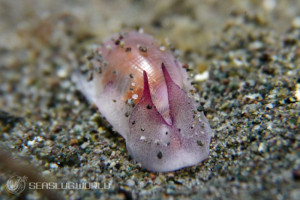
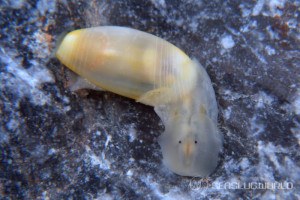
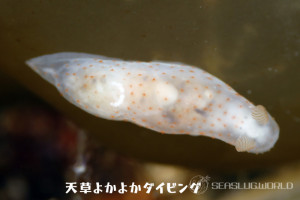
A small haminoeid snail about 25 mm in shell length. The shell is thick, lustrous, and white, with spiral grooves restricted to the apical and basal regions and a smooth middle section. The upper inner lip is weakly twisted and the columella lacks a fold. The living animal is translucent yellowish-white, and some individuals carry white or greenish blotches. The species burrows in sand.Distribution
According to Okutani (ed.) 2000 (Marine Mollusks in Japan), recorded from Kii Peninsula on the Pacific coast and the Tajima coast on the Japan Sea coast southward to the tropical Indo-West Pacific, on sand bottoms in 5–30 m depth. Broadly distributed across the Indo-Pacific, with observation records from Tanzania, Madagascar, New Caledonia, Papua New Guinea, the Philippines, and Japan.Etymology
The specific epithet cylindricum is a Latin adjective meaning "cylindrical", referring to the elongate-ovate, nearly cylindrical shape of the shell.References
- Bulla cylindrica n. sp., Helbling G.S. (1779). Beyträge zur Kenntniß neuer und seltener Konchylien. Aus einigen Wienerischen Sammlungen. Abhandlungen einer Privatgesellschaft in Böhmen, zur Aufnahme der Mathematik, der vaterländischen Geschichte, und der Naturgeschichte. 4: 102-131, pls. 1-3.
- カイコガイ Aliculastrum cylindricum (Helbling, 1779), 奥谷喬司. (2000). 日本近海産貝類図鑑. 東海大学出版会.
- Oskars T.R., Too C.C., Rees D., Mikkelsen P.M., Willassen E. & Malaquias M.A.E. (2019). A molecular phylogeny of the gastropod family Haminoeidae sensu lato (Heterobranchia: Cephalaspidea): a generic revision. Invertebrate Systematics 33(3): 426-472.
A Kindle field guide by the site author
Kimoto N. (2026). Sea Slugs of Japan & the Indo-Pacific, 2nd Edition.
Kindle Edition
View on Amazon PR (Amazon Associates)Seasonality
Shooting Locations
Loading shooting locations...
Photos of Aliculastrum cylindricum





Same Genus Nudibranchs
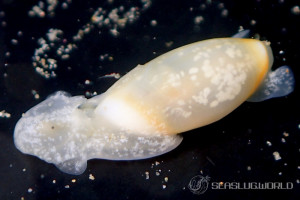
Similar Colors Nudibranchs

Academic Database
Sea slug observation data is available in international marine biodiversity databases.