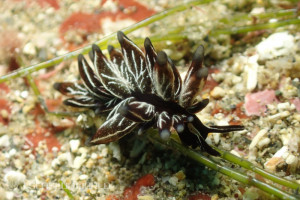
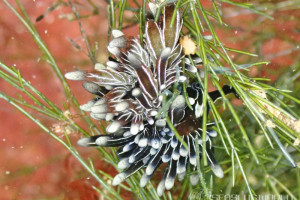
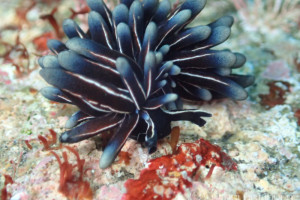
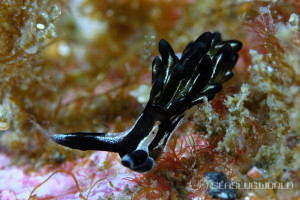
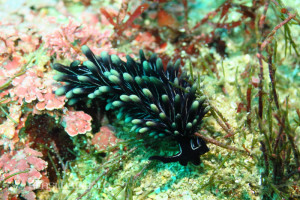
Aplysiopsis nigra (Baba, 1949)
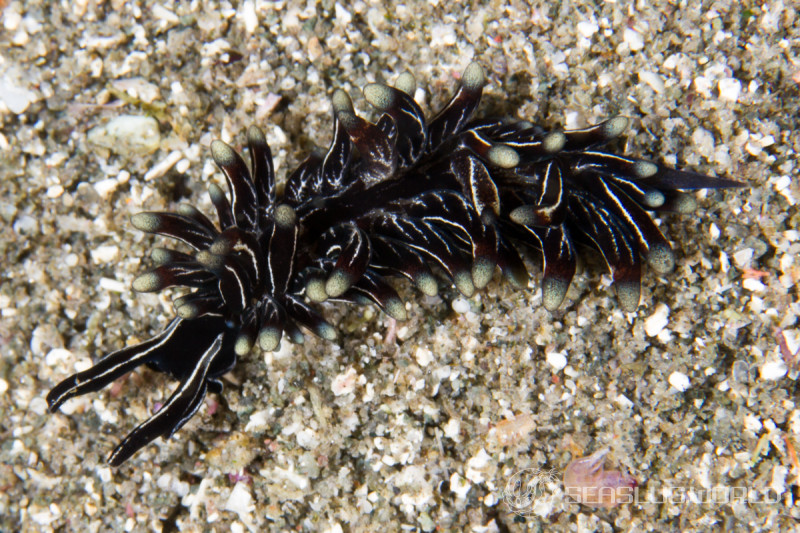
- Location
- Futou beach, Tago, Futou, Dougashima, Shizuoka, Japan
- Date
- 2017/12/21
- Length
- 30mm
- Depth
- 8.0m
- Water temperature
- 16.0℃
Description
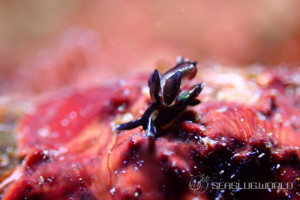
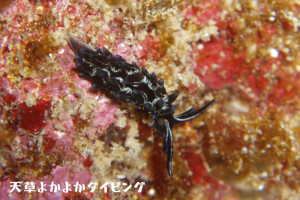
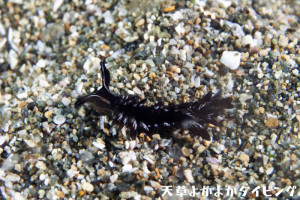
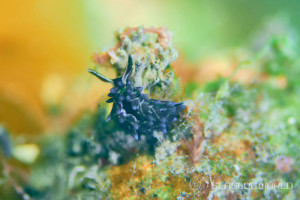
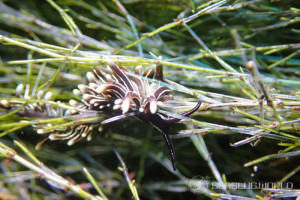
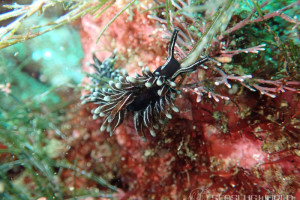
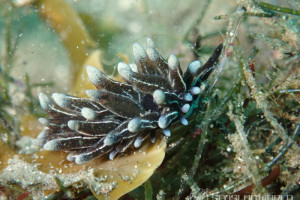
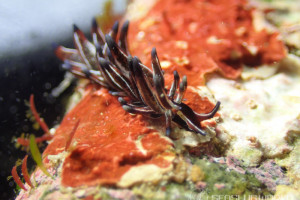
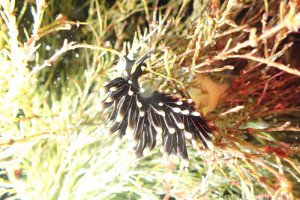
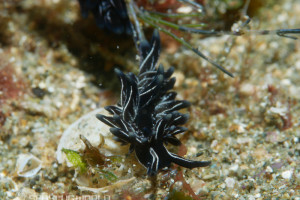
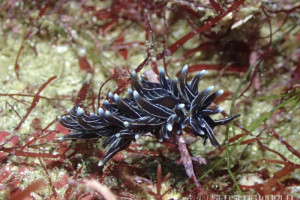
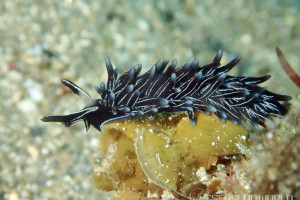
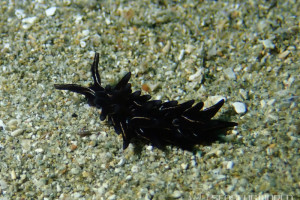
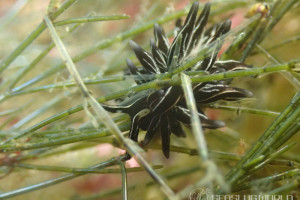
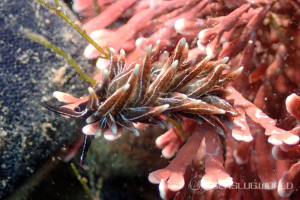
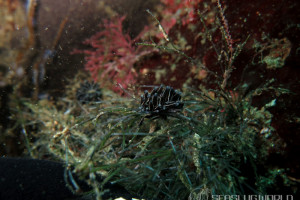
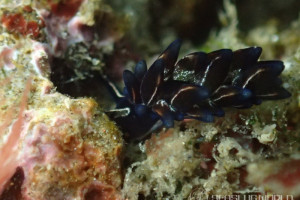
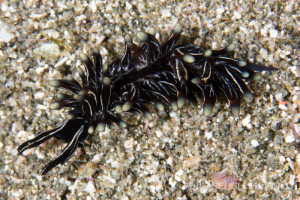
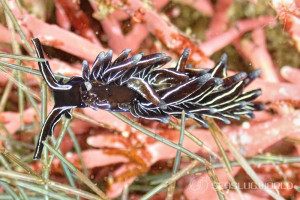
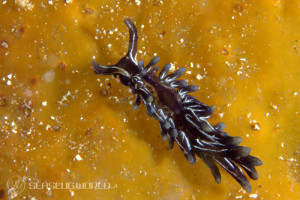
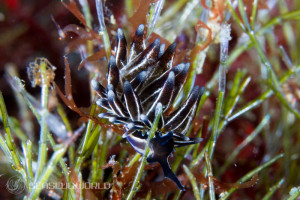
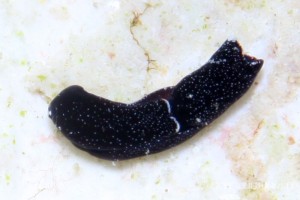
An entirely black sacoglossan, body length 12-30 mm, with a body shape similar to that of the sympatric Aplysiopsis orientalis. The cerata are circular in cross-section, with few indistinct lamellate ridges on the inner face and a smooth outer face; arranged in about 25 oblique rows per side, each row of 3-4 cerata, with branching liver diverticula. The body is black overall, with a black-brown rhizome. A small white area surrounds each eye, from which a narrow same-colour zone extends upward to the rhinophore tip; the rhinophores, oral tentacles, and foot margins are also fringed white. The cerata are black with a white dorsal vein. Radular ascending row 5 teeth, descending row about 40 teeth, with the distal end of the descending row markedly coiled.Distribution
Type locality is off Nishi-no-saki, Sagami Bay (500 m offshore, 10 m depth, April 1941, 3 specimens). The original description (Baba, 1949) records the species only from Sagami Bay.Etymology
The specific epithet nigra is Latin for black. The original description does not give an explicit etymology paragraph; the descriptive sense reflects the uniformly black body colour.Remarks
Originally described as Hermaeina (Hermaeina) nigra and later transferred to Aplysiopsis. The sister species Aplysiopsis orientalis (yellow-white ground with brown longitudinal stripes) is readily separable from the uniformly black ground with white facial markings of this species.References
- Aplysiopsis nigra (Baba, 1949), Baba K. (1949). Opisthobranchia of Sagami Bay collected by His Majesty the Emperor of Japan (相模湾産後鰓類図譜). Iwanami Shoten, Tokyo. 4+2+194+7 pp., pls. 1-50.
- Hermaeina (Hermaeina) nigra BABA, 1949. Kuro-moumiushi., Baba K. (1959). THE FAMILY STILIGERIDAE FROM JAPAN (OPISTHOBRANCHIA-SACOGLOSSA). Publications of the Seto Marine Biological Laboratory. 7(3): 327-334. https://doi.org/10.5134/174635
- クロモウミウシ, 高岡高等学校生物研究会(編). (1964). 富山湾産後鰓類図譜.
- 高岡生物研究会. (2002). 日本海のウミウシ. 第2版.
- Trowbridge C.D., Hirano Y.M., Hirano Y.J., Nishida K. & Sudo K. (2011). North-west Pacific sacoglossan guild associated with filamentous green algae (Family Cladophoraceae and Family Boodleaceae). Marine Biodiversity Records. 4: e67. https://doi.org/10.1017/S1755267211000170
A Kindle field guide by the site author
Kimoto N. (2026). Sea Slugs of Japan & the Indo-Pacific, 2nd Edition.
Kindle Edition
View on Amazon PR (Amazon Associates)Seasonality
Shooting Locations
Loading shooting locations...
Photos of Aplysiopsis nigra
Tag:






















Same Genus Nudibranchs
Similar Colors Nudibranchs

Academic Database
Sea slug observation data is available in international marine biodiversity databases.