Aplysiopsis orientalis (Baba, 1949)
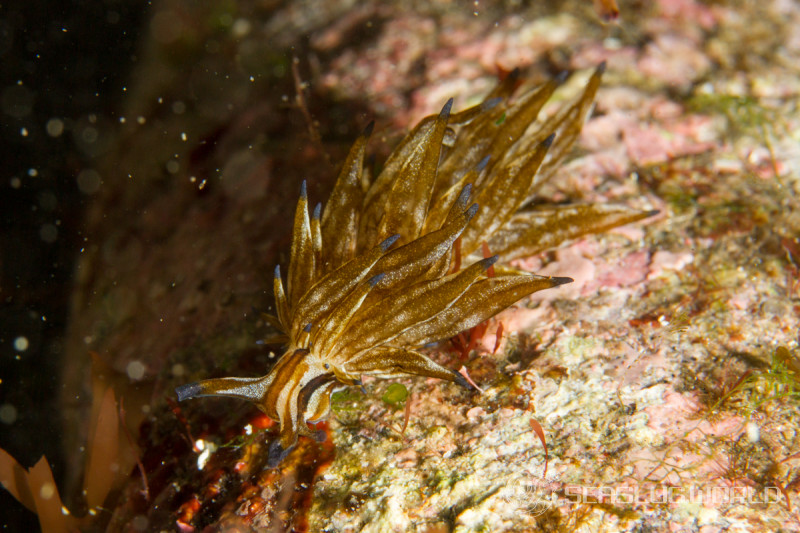
- Location
- Futou beach, Tago, Futou, Dougashima, Shizuoka, Japan
- Date
- 2017/12/21
- Length
- 30mm
- Depth
- 10.0m
- Water temperature
- 16.0℃
Description
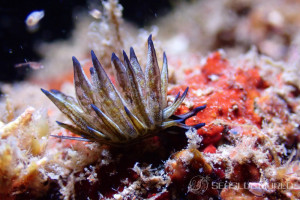
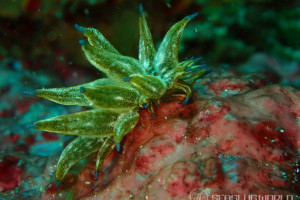
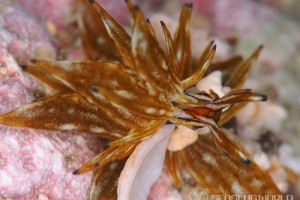
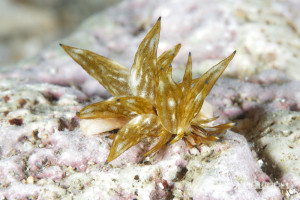
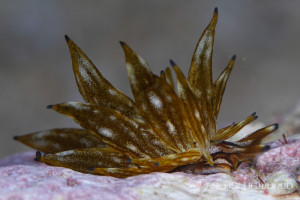
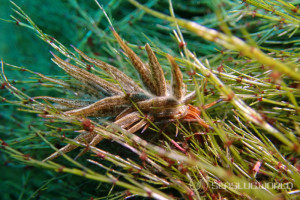
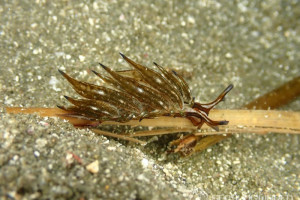
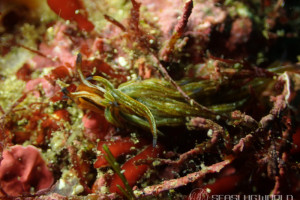
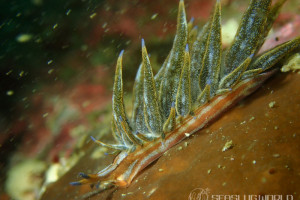
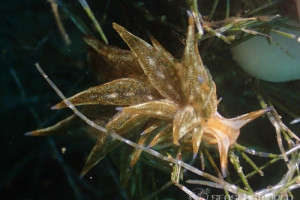
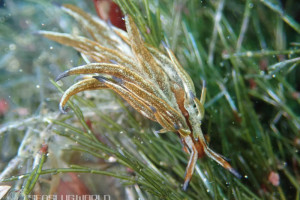
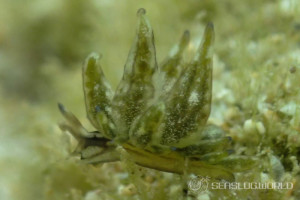
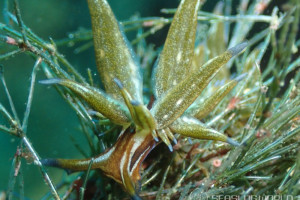
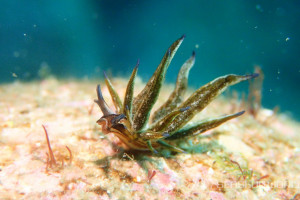
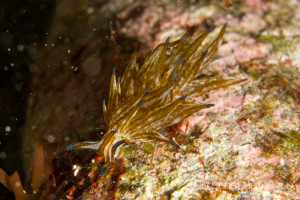
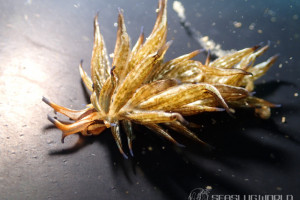
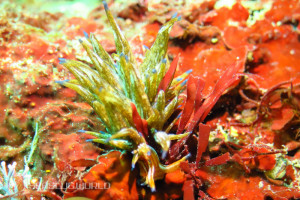
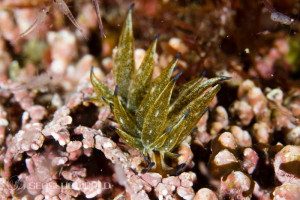
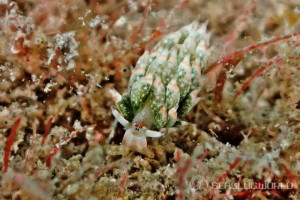
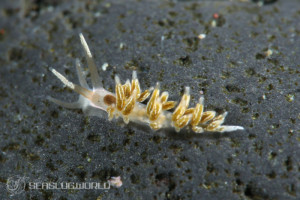
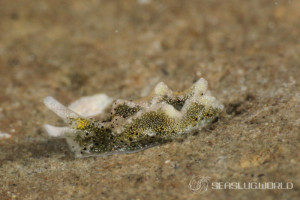
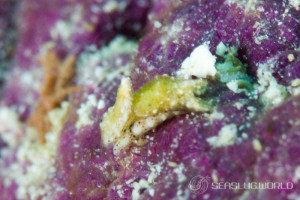
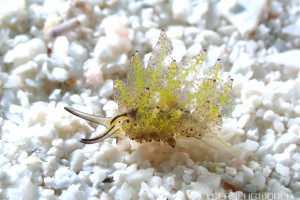
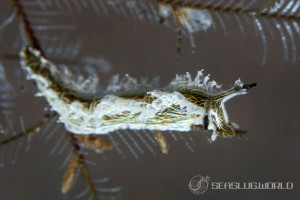
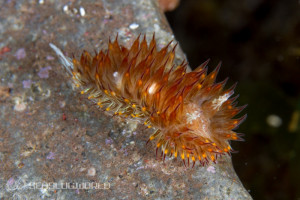
An aeolid-like sacoglossan, body length about 20 mm. The rhinophores are rather large and ear-shaped with an outer groove, and the tips are bifid. A pair of leaf-shaped oral tentacles is present. The cerata are long fusiform, slightly compressed, with a conspicuous lamellate vein on the inner face and a slight median groove on the outer face; arranged in about 20 oblique rows per side, each row of 2-4 cerata, with branching liver diverticula. The genital orifice lies just behind and below the right rhinophoral angle; the anus on the dorsal midline, slightly to the right, opens at the anterior end of the pericardium. Anterior foot corner rounded. The body ground colour is yellow-white, with the rhinophore tips and oral-tentacle edges blackish, a broad brown longitudinal band running along the dorsal midline from front to tail, and two brown longitudinal bands on the foot. The cerata are blue-green, with only the tips blackish. Lays milky-white egg masses (August 1939).Distribution
Type locality is Kameshiro-iso, Sagami Bay (11 m depth, August 1940) and off Kurosaki, Sagami Bay (600 m offshore, 15 m depth, August 1939). The original description records the species from Sagami Bay and Okitsu (additional specimen collected by I. Horikoshi, August 1942).Etymology
The specific epithet orientalis is Latin for of the East. The original description does not give an explicit etymology paragraph; the descriptive sense reflects the eastern (Japanese) provenance.Remarks
Originally described as Hermaeina (Hermaeina) orientalis and later transferred to Aplysiopsis. Distinguished from the uniformly black sister species Aplysiopsis nigra by the yellow-white ground with brown longitudinal stripes and blue-green cerata.References
- Aplysiopsis orientalis (Baba, 1949), Baba K. (1949). Opisthobranchia of Sagami Bay collected by His Majesty the Emperor of Japan (相模湾産後鰓類図譜). Iwanami Shoten, Tokyo. 4+2+194+7 pp., pls. 1-50.
- Hermaeina2 ) (Hermaeina) orientalis BABA, 1949. T6y6-moumiushi., Baba K. (1959). THE FAMILY STILIGERIDAE FROM JAPAN (OPISTHOBRANCHIA-SACOGLOSSA). Publications of the Seto Marine Biological Laboratory. 7(3): 327-334. https://doi.org/10.5134/174635
- Trowbridge C.D., Hirano Y.M., Hirano Y.J., Nishida K. & Sudo K. (2011). North-west Pacific sacoglossan guild associated with filamentous green algae (Family Cladophoraceae and Family Boodleaceae). Marine Biodiversity Records. 4: e67. https://doi.org/10.1017/S1755267211000170
A Kindle field guide by the site author
Kimoto N. (2026). Sea Slugs of Japan & the Indo-Pacific, 2nd Edition.
Kindle Edition
View on Amazon PR (Amazon Associates)Seasonality
Shooting Locations
Loading shooting locations...
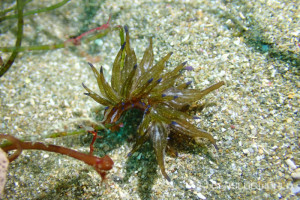
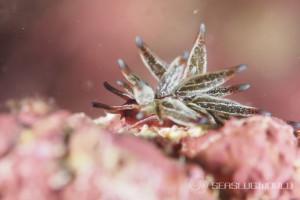
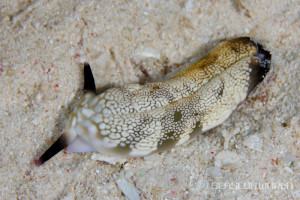
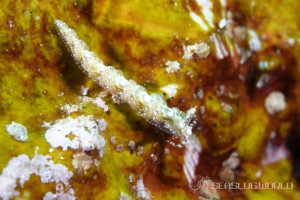
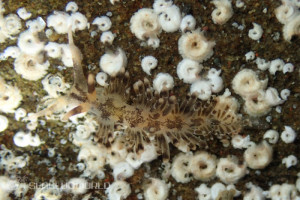
Photos of Aplysiopsis orientalis



















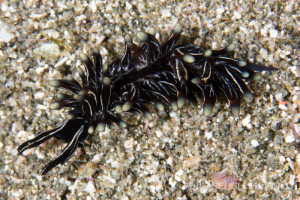
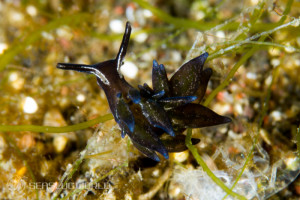
Same Genus Nudibranchs
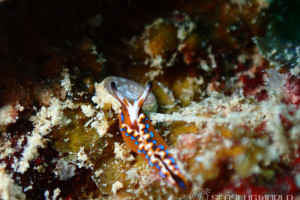
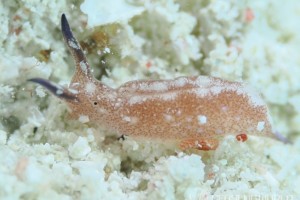
Similar Colors Nudibranchs
Academic Database
Sea slug observation data is available in international marine biodiversity databases.