Calliopaea pusilla (Baba, 1968)
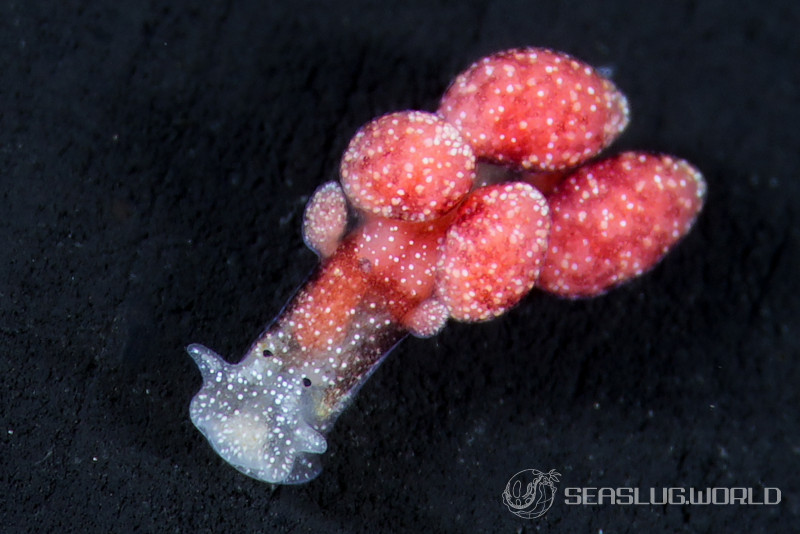
- Location
- Tate Beach, Amakusa, Kumamoto, Japan
- Date
- 2026/01/25
- Length
- 2mm
- Depth
- 8.0m
- Water temperature
- 16.0℃
Description
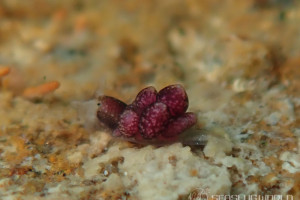
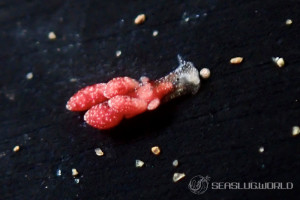
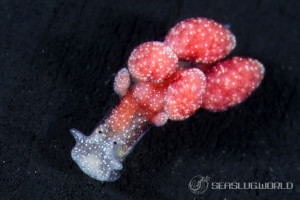
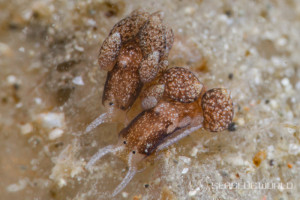
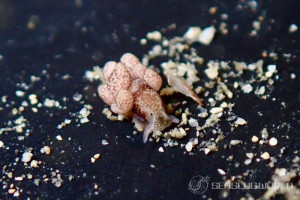
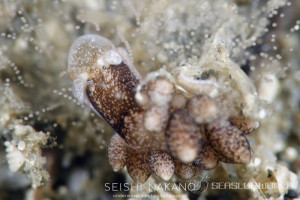
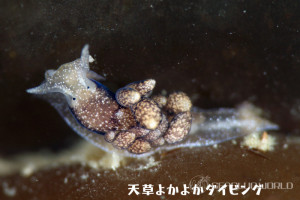
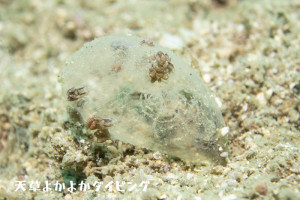
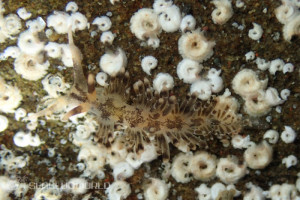
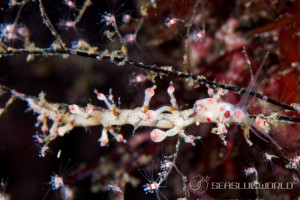
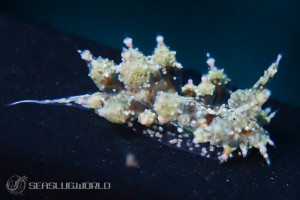
A very small sacoglossan, about 1 mm in total length. Highly distinctive in form and coloration. The rhinophores are very short and stout, without an outer longitudinal groove. Foot corners are rounded. The cerata are always three on each side — the first smallest, the third largest, all inflated and fusiform. Ground colour translucent whitish, with chocolate-brown spots on the cerata. The anterior half of the trunk is chocolate-brown; the sole is whitish. The liver diverticula in the cerata are yellowish-brown. Minute opaque-white dots are scattered over the dorsal and ventral surfaces.Distribution
Type locality: sandy bottom off Tannowa, Osaka Bay, Japan. Subsequent records in Japan are sporadic, mostly from sandy intertidal and sublittoral habitats around Osaka Bay.Etymology
The specific epithet pusillus is general Latin vocabulary meaning "very small, tiny", consistent with the 1 mm body length.Remarks
Originally placed in Stiliger and later transferred to Calliopaea. The Brazilian congener Stiliger talis agrees in having only three cerata per side, but differs in colour and other details.References
- Stiliger (Stiliger) pusillus BABA, n. sp. Kotsubu-moumiushi (n. n.)., Baba K. (1959). THE FAMILY STILIGERIDAE FROM JAPAN (OPISTHOBRANCHIA-SACOGLOSSA). Publications of the Seto Marine Biological Laboratory. 7(3): 327-334. https://doi.org/10.5134/174635
- コツブモウミウシ, 柏尾翔. (2019). 大阪湾の干潟域にすむウミウシ類: 希少種とその保全について. うみうし通信. 105: 2-4.
A Kindle field guide by the site author
Kimoto N. (2026). Sea Slugs of Japan & the Indo-Pacific, 2nd Edition.
Kindle Edition
View on Amazon PR (Amazon Associates)Seasonality
Shooting Locations
Loading shooting locations...
Photos of Calliopaea pusilla
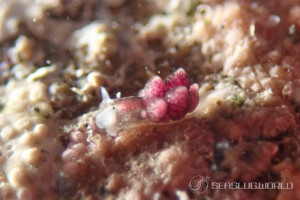

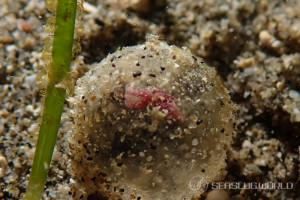




Similar Colors Nudibranchs

Academic Database
Sea slug observation data is available in international marine biodiversity databases.