Elysia maoria A. W. B. Powell, 1937
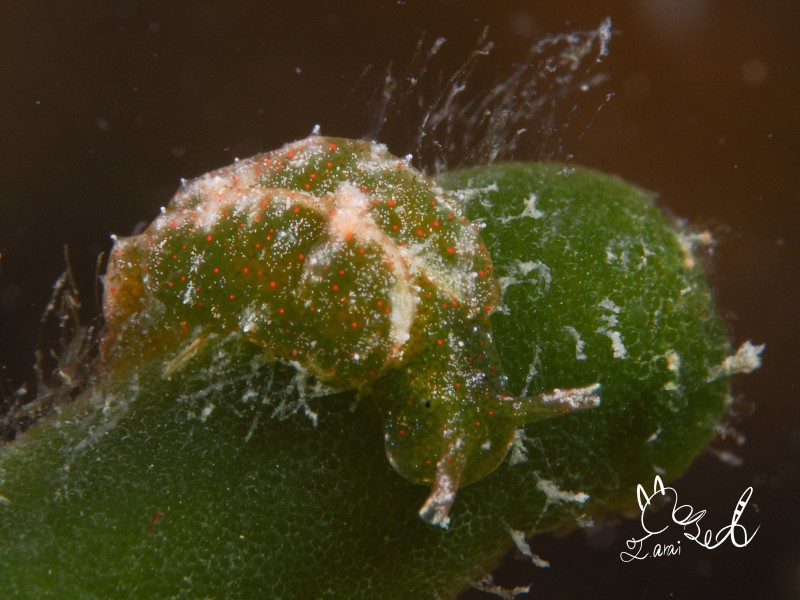
- Location
- Flypoint, Nelson Bay, New South Wales, Australia
- Date
- 2026/04/28
- Length
- 8mm
- Depth
- 8.0m
- Water temperature
- 20.0℃
Description
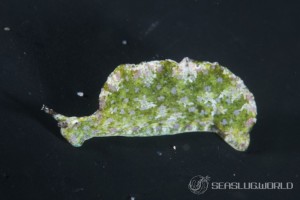
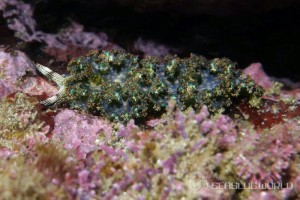
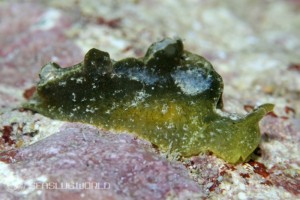
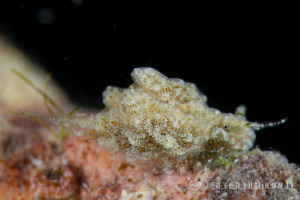
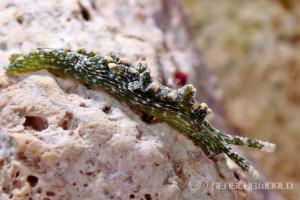
A small to mid-sized sacoglossan reaching about 22 mm in body length. The body is ovate-oblong with a short pointed tail. In life the two mantle lobes curve upwards and towards each other, giving the animal an almost cylindrical appearance. The head bears two stout, somewhat involute tentacles.The ground colour is pale moss-green densely speckled with dark green, with a second series of minute black dots each encircled by a narrow brick-red margin. White flecks are concentrated along the mantle edges and over scattered small tubercles. The underside of the mantle flaps shows beautiful bright green veining on a dark green ground, overlaid with brick-red and metallic-blue specks. The elevated region over the heart is pale yellowish-green flecked with brick-red. The tentacles match the dorsal colour but become whitish towards the tips. The animal blends almost perfectly with its food alga Codium, making it extremely difficult to spot on the host.
Distribution
Type locality: Takapuna Reef, Auckland, New Zealand, on Codium. At the time of the original description, the species was known from rocky shores around the Hauraki Gulf, including Rangitoto Island and Hobson Point.Etymology
The specific epithet maoria is a Latinised adjectival form referring to the Māori people, the indigenous people of New Zealand.Remarks
Externally very similar to the British Elysia viridis (Montagu), but E. viridis bears a conspicuous white patch around each eye, a feature lacking in E. maoria. Both species are obligately associated with green algae of the genus Codium and show striking protective resemblance to their host.References
A Kindle field guide by the site author
Kimoto N. (2026). Sea Slugs of Japan & the Indo-Pacific, 2nd Edition.
Kindle Edition
View on Amazon PR (Amazon Associates)Seasonality
Shooting Locations
Loading shooting locations...
Photos of Elysia maoria


Same Genus Nudibranchs
Similar Colors Nudibranchs


Academic Database
Sea slug observation data is available in international marine biodiversity databases.