Felimida sphoni Ev. Marcus, 1971
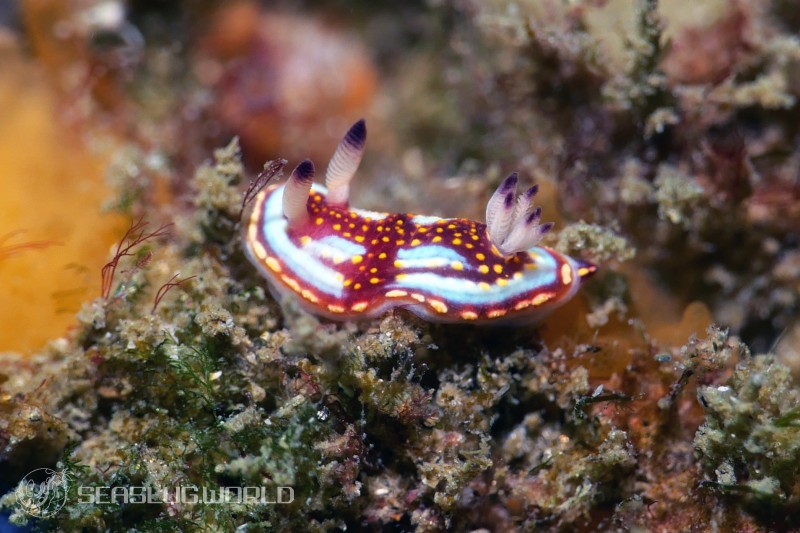
What is Sphon's chromodorid?
Sphon's chromodorid (Felimida sphoni) is a small cream-yellow dorid nudibranch of the tropical eastern Pacific, marked with a red cross on the back. It is the type species of the genus Felimida.Description
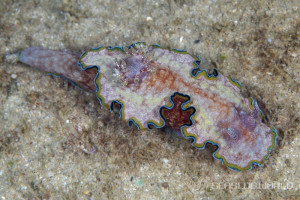
The mantle is cream-yellow, crossed by red bands that form the pattern the species is known for: a red band running lengthwise between the rhinophores and the gills meets a red bar that runs right across the mantle from edge to edge, making a cross. A further red band runs lengthwise along each side of the mantle, and a red band borders the mantle edge. The red markings are picked out and rimmed by rows of small whitish dots. The gills and rhinophores are white at the base and pink to red towards the tip. In small animals the lengthwise side bands appear only near the transverse bar and extend forward and back as the animal grows. Preserved animals in the original description measured 8-18 mm; living animals are usually 10-20 mm and reach 30-40 mm.Distribution
Tropical eastern Pacific. As of the 1978 revision the species was known only from the mainland Pacific coast of Mexico and Central America, from the Mazatlán area to Bahía de Panamá; it has since been recorded from the Galápagos Islands and Ecuador. No type locality was designated in the original description: the original material came from two places about 300 km apart, in the Mexican states of Nayarit and Colima.Etymology
The specific epithet sphoni honours the American malacologist Gale Sphon, who collected the animals off Mexico and sent them to the describer; she worked them up in São Paulo and described the species as new.Remarks
This is the type species of Felimida, a genus erected in the same 1971 paper.The red cross on the back is the quickest way to recognise the species, though in small animals the lengthwise arm of the cross is still short and only the transverse bar stands out.
References
- Felimida sphoni n. sp., Marcus Ev. (1971). On some euthyneuran gastropods from the Indian and Pacific Oceans. Proceedings of the Malacological Society of London. 39(5): 355-369.
- Felimida sphoni, Bertsch H. (1976). A new species of Chromodoris (Opisthobranchia: Nudibranchia) from tropical west America. The Veliger. 19(2): 156-158.
- Chromodoris sphoni (Marcus, 1971), comb. nov., Bertsch H. (1978). The Chromodoridinae nudibranchs from the Pacific coast of America. Part II. The genus Chromodoris. The Veliger. 20(4): 307-327.
- Felimida sphoni, Johnson R.F. & Gosliner T.M. (2012). Traditional taxonomic groupings mask evolutionary history: a molecular phylogeny and new classification of the chromodorid nudibranchs. PLoS ONE 7(4): e33479.
A Kindle field guide by the site author

Kimoto N. (2026). Sea Slugs of Japan & the Indo-Pacific, 2nd Edition.
Kindle Edition
View on Amazon PR (Amazon Associates)Seasonality
Shooting Locations
Loading shooting locations...
Photos of Felimida sphoni

Same Genus Nudibranchs
Similar Colors Nudibranchs


Academic Database
Sea slug observation data is available in international marine biodiversity databases.