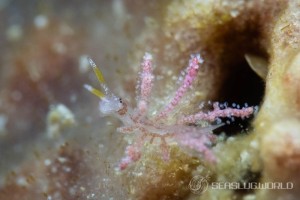
Goniodoridella geminae Paz-Sedano, Ekimova, Smirnoff, Gosliner & Pola, 2023
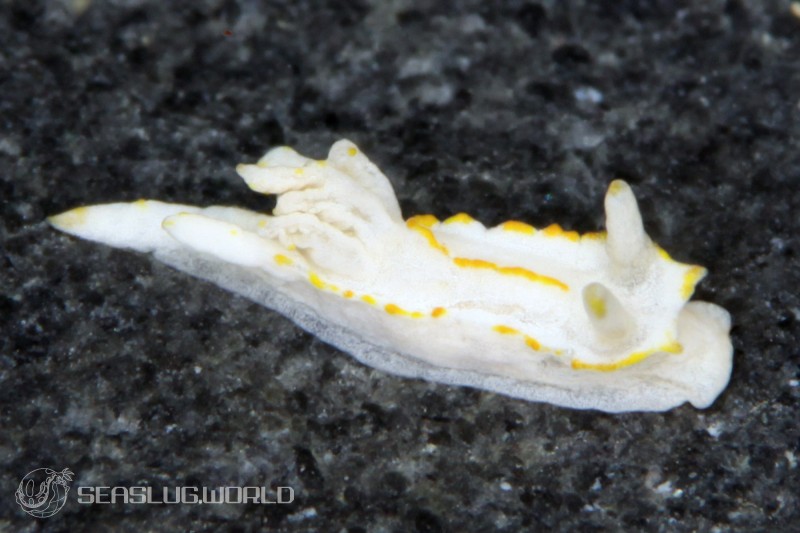
- Location
- Gorilla Chop, Okinawa Island (Motobu and Northern area), Okinawa, Japan
- Date
- 2025/01/21
- Length
- 6mm
- Depth
- 2.0m
- Water temperature
- 21.0℃
Description
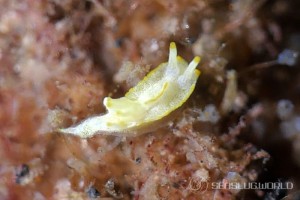
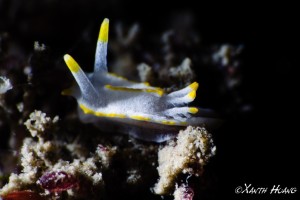
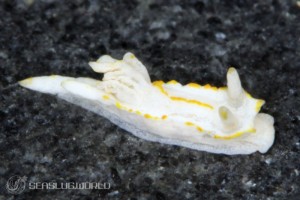
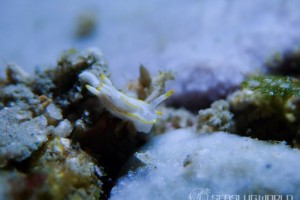
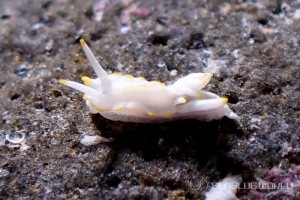
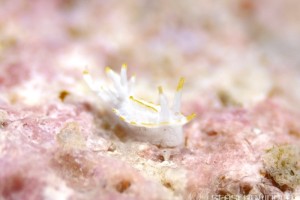
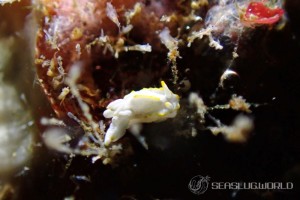
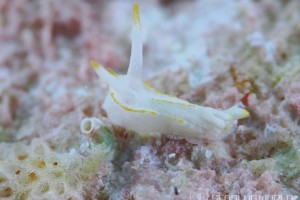
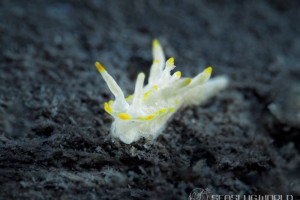
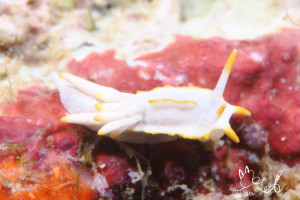
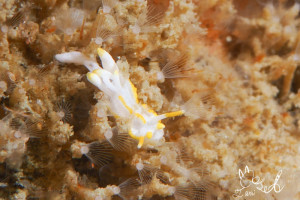
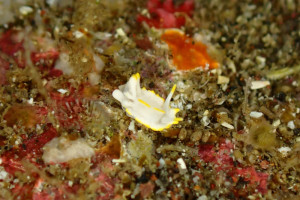
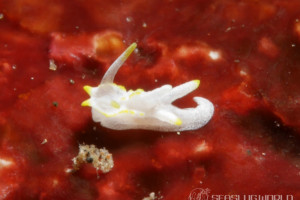
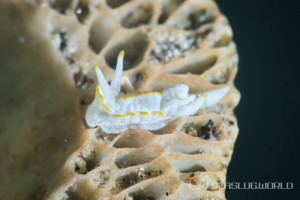
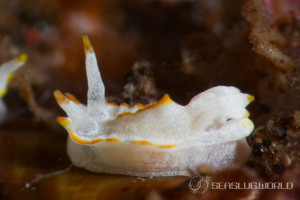
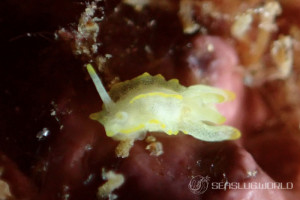
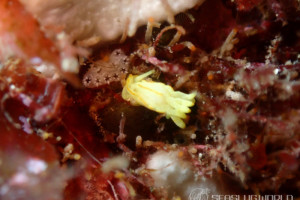
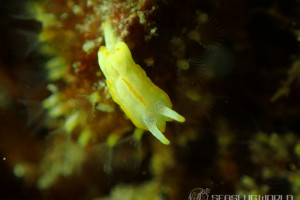
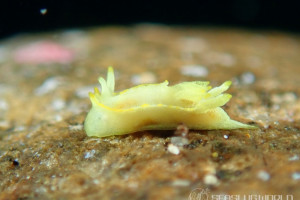
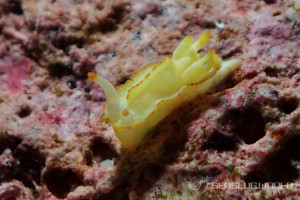
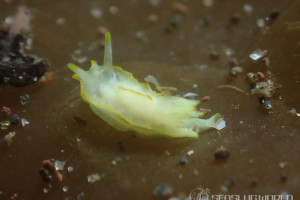
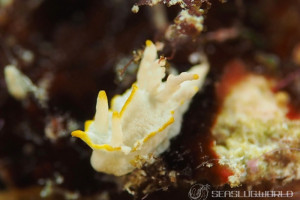
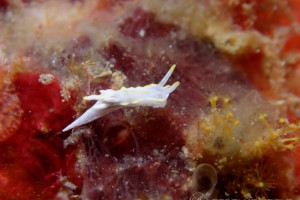
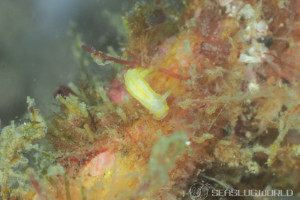
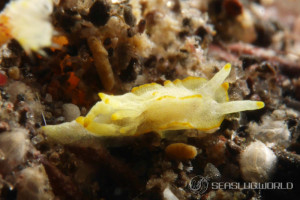
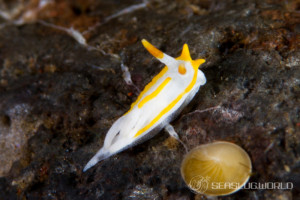
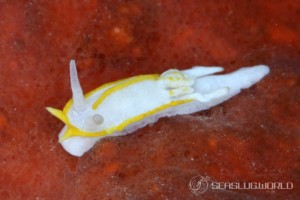
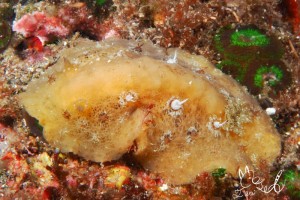
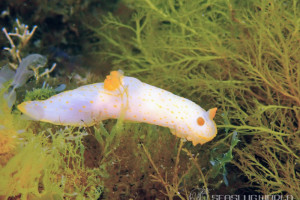
A small nudibranch reaching 2–3 mm in length. Body elongated, terminating in a pointed posterior end of the foot. Ground color opaque white, with the mantle edge, tips of the papillae, rhinophores and gill branches marked in yellow; the posterior tip of the foot may also be yellow. A single yellow mid-dorsal crest runs along the back.The mantle edge is short and bears small, pointed protuberances supported by spicules. Two small, conical papillae lie on the anterior part of the body in front of the rhinophores, and two wider, pointed papillae are present on the posterior part of the mantle edge behind the gill. The rhinophores are smooth, slender and non-retractile. The gill is composed of four simple branches arranged in a semicircle around the anus; the branches are about as thick as the posterior papillae.
Distribution
Australia (Mooloolah River, Queensland) and the Philippines (Romblon Province; Maricaban Island, Batangas Province). Type locality: La Balsa Park, Mooloolah River, Queensland, Australia, at 6 m depth.Etymology
The specific epithet geminae is derived from the Latin word for "twins", referring to the strong resemblance of this species to other members of the genus Goniodoridella—particularly Goniodoridella savignyi—and to its membership in a complex of pseudocryptic species.Remarks
Most similar to Goniodoridella savignyi, from which it can be distinguished externally by its more opaque white body (translucent and hyaline in G. savignyi), a single yellow mid-dorsal crest (three yellow dorsal rows in G. savignyi) and gill branches that are about as thick as the posterior papillae (thinner in G. savignyi). Molecular analyses support its distinctness: the COI uncorrected p-distance to Goniodoridella borealis is 13.7 %, and the H3 p-distance to G. savignyi is 10.3 %.References
- Goniodoridella geminae n. sp., Paz-Sedano S., Ekimova I., Smirnoff D., Gosliner T.M. & Pola M. (2023). Shedding light on a species complex within the genus Goniodoridella Pruvot-Fol, 1933 (Nudibranchia: Goniodorididae), with the description of three new species. Journal of Molluscan Studies. 89(4): eyad020. https://doi.org/10.1093/mollus/eyad020
- Paz-Sedano S., Moles J., Smirnoff D., Gosliner T.M. & Pola M. (2024). A combined phylogenetic strategy illuminates the evolution of Goniodorididae nudibranchs (Mollusca, Gastropoda, Heterobranchia). Molecular Phylogenetics and Evolution. 192: 107990. https://doi.org/10.1016/j.ympev.2023.107990
- マリカコトヒメウミウシ(新称), 今川郁. (2026). 沖縄のウミウシ: DNA解析による最新の分類図鑑1089種. 誠文堂新光社.
A Kindle field guide by the site author
Kimoto N. (2026). Sea Slugs of Japan & the Indo-Pacific, 2nd Edition.
Kindle Edition
View on Amazon PR (Amazon Associates)Seasonality
Shooting Locations
Loading shooting locations...
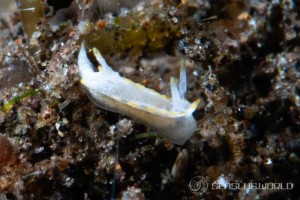
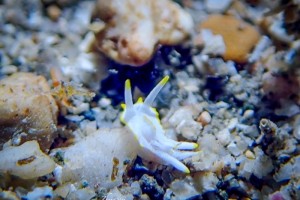
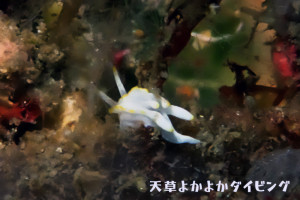
Photos of Goniodoridella geminae




















Specimen & DNA
| Observation | Database | COI | 16S | H3 |
|---|---|---|---|---|
| #53936 | BOLD Systems | SSWBP483-25 |
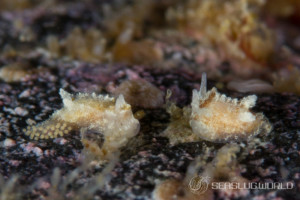
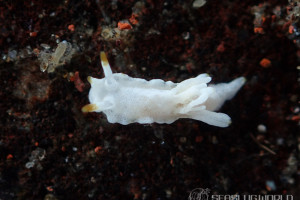
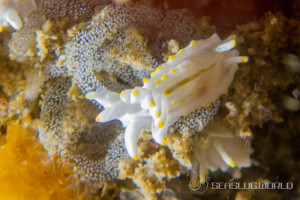
Same Genus Nudibranchs

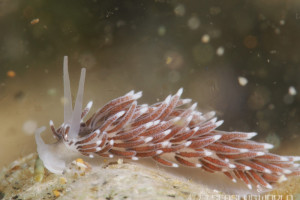
Similar Colors Nudibranchs
Academic Database
Sea slug observation data is available in international marine biodiversity databases.