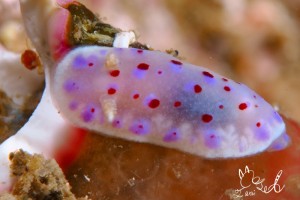
Goniodoridella borealis Martynov, Sanamyan & Korshunova, 2015
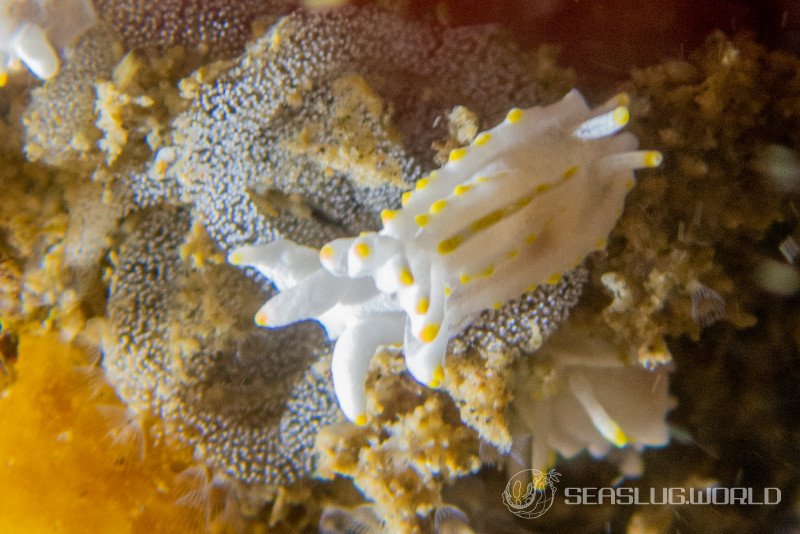
- Location
- HIsui Beach, Etchumiyazaki, Toyama, Japan
- Date
- 2022/04/23
- Length
- 15mm
- Depth
- 8.0m
- Water temperature
- 13.0℃
Description
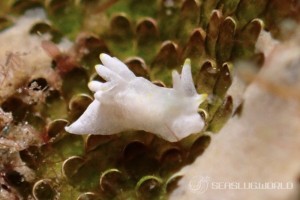
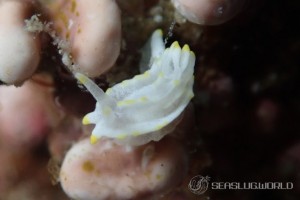
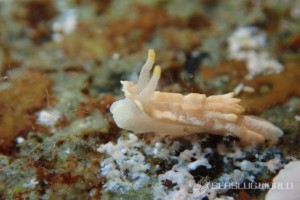
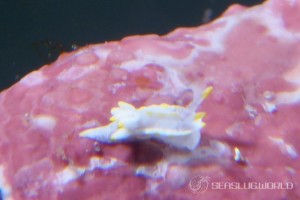
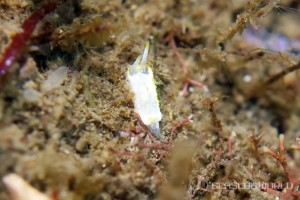
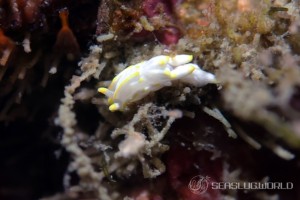
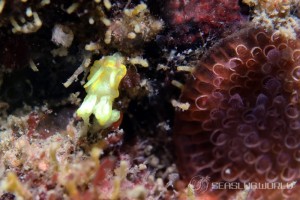
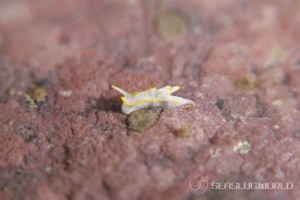
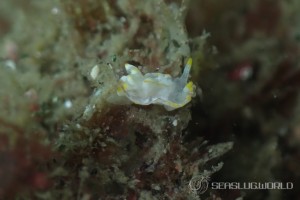
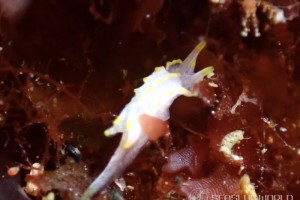
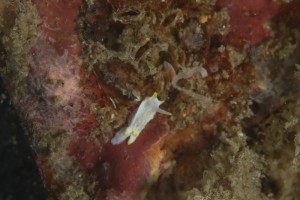
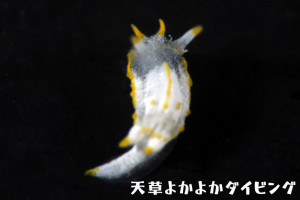
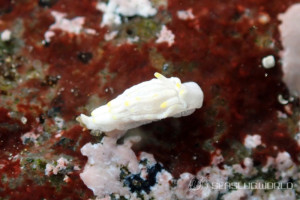
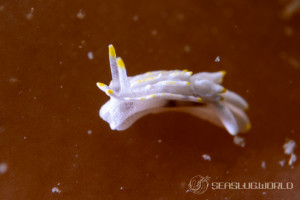
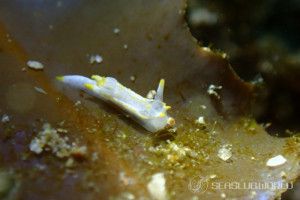
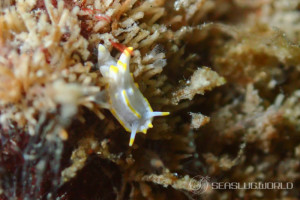
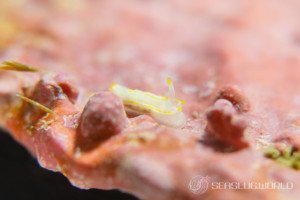
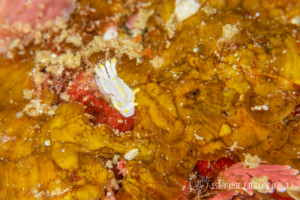
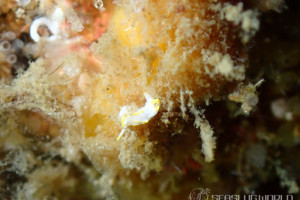
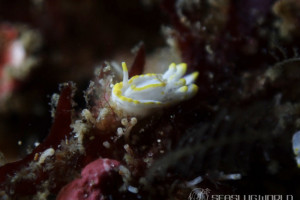
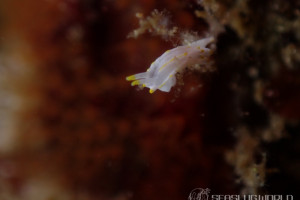
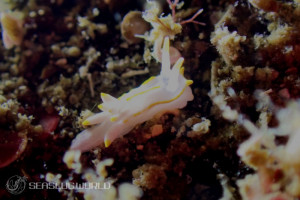
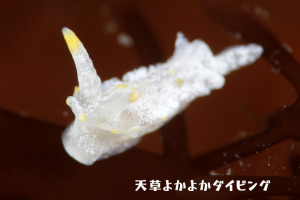
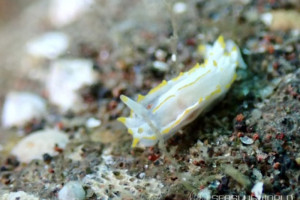
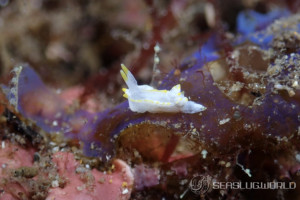
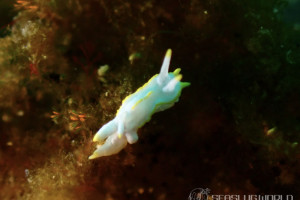
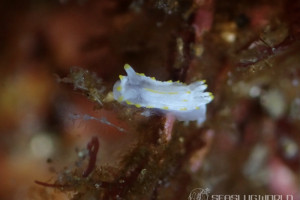
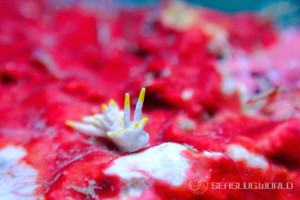
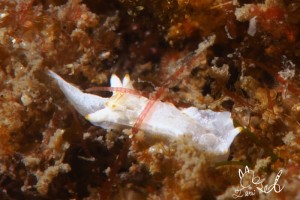
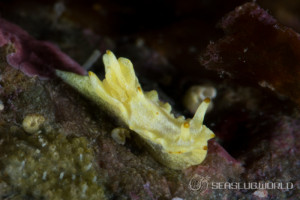
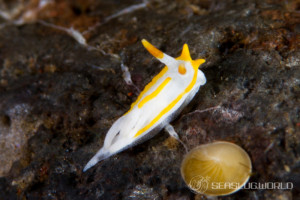
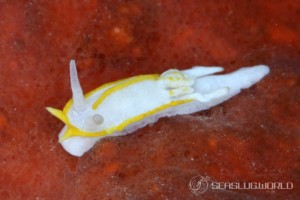
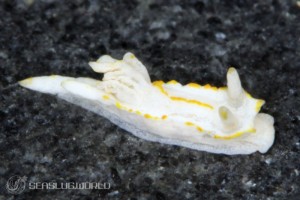
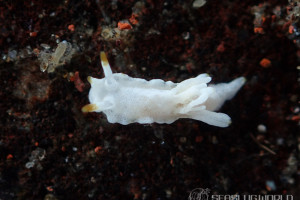
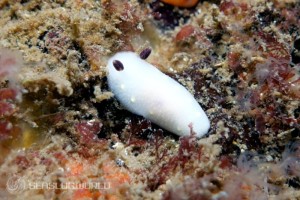
A small nudibranch, 3-8 mm in length. The ground colour is translucent white, with bright yellow markings on the mantle edge, the mid-dorsum, the tips of the rhinophores and the tips of the elongate posterior papillae.A single yellow mid-dorsal crest runs along the back, and short lateral crests are often present on either side, giving the appearance of three yellow longitudinal lines. The mantle edge is raised and bears small marginal papillae tipped with yellow. Behind the gill there is a pair of long, slender white papillae with yellow tips. The rhinophores are smooth, club-shaped and non-retractile. The gill consists of three bipinnate branches arranged in a semicircle around the anus.
Distribution
Sea of Japan (Russian coast, Peter the Great Bay region). Type locality: Klerk Peninsula, Boysmana Bay, Peter the Great Bay, Russian Far East, 2-2.5 m depth, 29 August 1993, A. V. Martynov leg. (holotype ZMMU Op-421). Specimens previously reported from Japanese waters as Goniodoridella savignyi may be referable to this species, though confirmation requires further molecular work.Etymology
From the original description (Martynov et al. 2015), translated verbatim from the Russian Этимология paragraph:From the Latin boreale (northern), since this species is the only representative of the predominantly tropical genus Goniodoridella inhabiting the northern part of the Sea of Japan, where in winter the water temperature reaches Arctic values.The Japanese name "Kotohime-umiushi" was proposed by a 1960 study for Japanese material then identified as Goniodoridella savignyi; because G. borealis was not described until 2015, the relationship between Baba's specimens and the present species awaits molecular confirmation.
Remarks
The most similar congener is Goniodoridella savignyi Pruvot-Fol, 1933 (described from the Red Sea), which shares the translucent white body with yellow dorsal crest and a single pair of elongate posterior papillae. In the Замечания section, Martynov et al. 2015 state that the Sea-of-Japan Goniodoridella "differs from all the listed tropical morphs of Goniodoridella "savignyi" s.l. in colour and details of the structure of the dorsal processes and represents an independent species" — Gosliner et al. 2008 had already shown that G. savignyi is a composite of several undescribed species. The molecular phylogeny of Paz-Sedano et al. 2023, based on COI, 16S and H3, recovers G. borealis as the sister species of G. savignyi and supports its status as a distinct species. It remains unresolved whether populations on the Pacific side of Japan are conspecific with those on the Sea of Japan side.References
- Goniodoridella savignyi PRUVOT-FOL, 1933 Kotohime-umiushi (n. n.), Baba K. (1960). THE GENERA OKENIA, GONIODORIDELLA AND GONIODORIS FROM JAPAN (NUDIBRANCHIA-GONIODORIDIDAE). Publications of the Seto Marine Biological Laboratory. 8(1): 79-83. https://doi.org/10.5134/174698
- コトヒメウミウシ, 中野理枝. (2004). 本州のウミウシ. ラトルズ.
- Goniodoridella borealis sp. nov., Martynov A.V., Sanamyan N.P., Korshunova T. A. (2015). [in Russian] New data on the opisthobranch molluscs (Gastropoda: Opisthobranchia) of waters of Commander Islands and Far-Eastern seas of Russia. In: Conservation of biodiversity of Kamchatka and coastal waters. Proceedings of XV international scientific conference Petropavlovsk-Kamchatsky. Kamchat Press: Petropavlovsk-Kamchatsky, Russia. pp. 55-69, pl. 2-6.
- Paz-Sedano S., Ekimova I., Smirnoff D., Gosliner T.M. & Pola M. (2023). Shedding light on a species complex within the genus Goniodoridella Pruvot-Fol, 1933 (Nudibranchia: Goniodorididae), with the description of three new species. Journal of Molluscan Studies. 89(4): eyad020. https://doi.org/10.1093/mollus/eyad020
- Paz-Sedano S., Moles J., Smirnoff D., Gosliner T.M. & Pola M. (2024). A combined phylogenetic strategy illuminates the evolution of Goniodorididae nudibranchs (Mollusca, Gastropoda, Heterobranchia). Molecular Phylogenetics and Evolution. 192: 107990. https://doi.org/10.1016/j.ympev.2023.107990
A Kindle field guide by the site author
Kimoto N. (2026). Sea Slugs of Japan & the Indo-Pacific, 2nd Edition.
Kindle Edition
View on Amazon PR (Amazon Associates)Seasonality
Shooting Locations
Loading shooting locations...
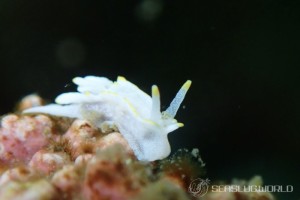
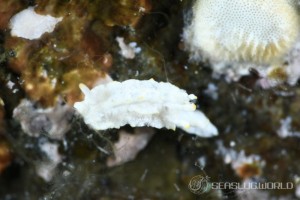
Photos of Goniodoridella borealis
Tag:


















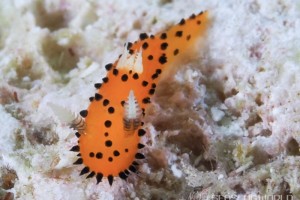
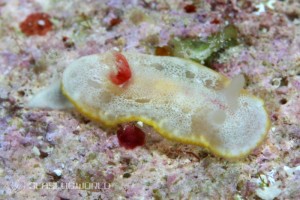
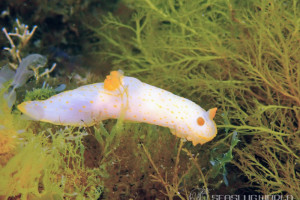
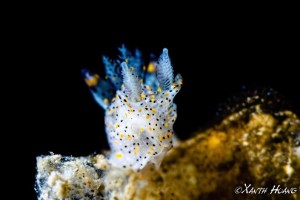
Same Genus Nudibranchs

Similar Colors Nudibranchs
Academic Database
Sea slug observation data is available in international marine biodiversity databases.