Goniodoridella unidonta Paz-Sedano, Ekimova, Smirnoff, Gosliner & Pola, 2023
Goniodoridella unidonta
No field photograph submitted for this species yet
Have you photographed this species?Description
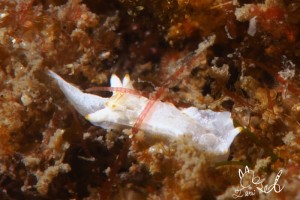
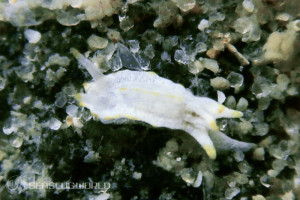
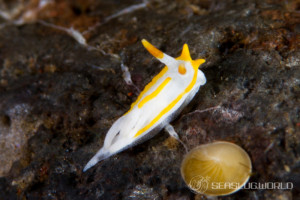
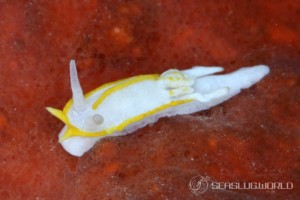
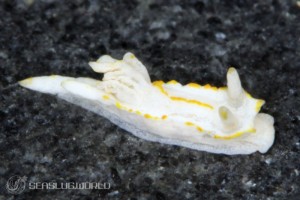
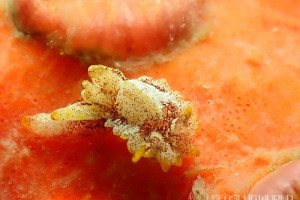
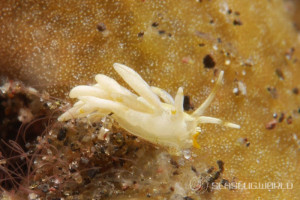
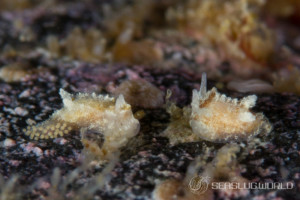
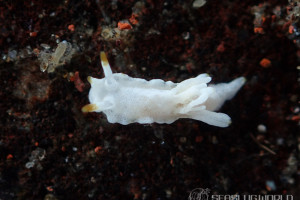
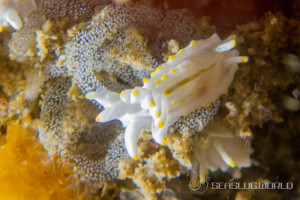
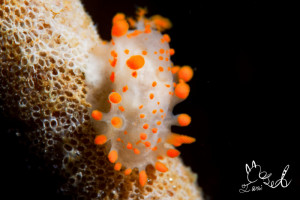
A small species reaching about 3 mm in length. The body is hyaline white, with yellow-orange pigmentation on the protuberances of the mantle edge, the mid-dorsal crest, the tips of the rhinophores, the gill branches, and both the anterior and posterior papillae. The mantle edge is short and bears small, pointed protuberances supported by spicules; a small mid-dorsal crest, also supported by spicules, runs along the back. Two small, conical anterior papillae are present in front of the rhinophores, and two posterior papillae behind the gill have a triangular shape with a broad base, wider than the gill branches. The rhinophores are smooth, slender, and nonretractile, lacking sheaths. The gill consists of four simple branches arranged in a semicircle around the anus, with the two anteriormost branches sharing a basal stalk. The radular formula is 12-15 × 1.0.1, lacking a rachidian tooth and outer lateral teeth, with only a single lateral tooth on each side. Penial spines are present.Distribution
Known from Queensland, Australia (Mooloolah River, type locality) and the Philippines (Lubang Island, Occidental Mindoro).Etymology
The specific name unidonta is derived from Latin uni- (one) and dont- (tooth), meaning "one tooth," in reference to the single lateral tooth on each side of the radula in this species.Remarks
One of three new species described together with Goniodoridella geminae and Goniodoridella serrata in 2023. The congener Goniodoridella savignyi has a radular formula of 17 × 1.1.0.1.1, with a rachidian tooth and two pairs of lateral teeth, clearly distinguishing it from G. unidonta, which lacks the rachidian and has only one pair of laterals. Externally, G. unidonta closely resembles Goniodoridella geminae, but is distinguished by its more translucent body and the broad-based, triangular posterior papillae, whereas G. geminae has an opaque white body and slender, sausage-shaped posterior papillae similar in form to the gill branches. Because the external differences are subtle, reliable identification requires examination of internal anatomy and molecular data.References
- Goniodoridella unidonta n. sp., Paz-Sedano S., Ekimova I., Smirnoff D., Gosliner T.M. & Pola M. (2023). Shedding light on a species complex within the genus Goniodoridella Pruvot-Fol, 1933 (Nudibranchia: Goniodorididae), with the description of three new species. Journal of Molluscan Studies. 89(4): eyad020. https://doi.org/10.1093/mollus/eyad020
- Paz-Sedano S., Moles J., Smirnoff D., Gosliner T.M. & Pola M. (2024). A combined phylogenetic strategy illuminates the evolution of Goniodorididae nudibranchs (Mollusca, Gastropoda, Heterobranchia). Molecular Phylogenetics and Evolution. 192: 107990. https://doi.org/10.1016/j.ympev.2023.107990
A Kindle field guide by the site author
Kimoto N. (2026). Sea Slugs of Japan & the Indo-Pacific, 2nd Edition.
Kindle Edition
View on Amazon PR (Amazon Associates)Seasonality
Shooting Locations
Loading shooting locations...
Photos of Goniodoridella unidonta


Same Genus Nudibranchs

Similar Colors Nudibranchs
Academic Database
Sea slug observation data is available in international marine biodiversity databases.