Gymnodoris aurita (A. A. Gould, 1852)
Gymnodoris aurita
No field photograph submitted for this species yet
Have you photographed this species?Description
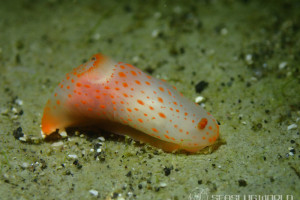
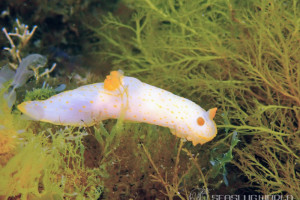
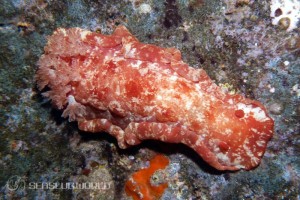
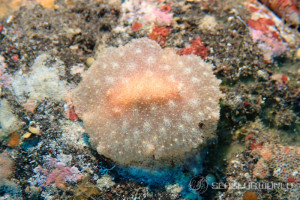
The body is firm and limaciform, with a reduced and indistinct mantle. Living animals reach over 100 mm in length; preserved specimens are up to 70 mm. Body color is orange to deep red, with large white to yellowish white tubercles dispersed uniformly over the body surface, situated on a series of longitudinal wrinkles and folds in the notum. The foot margin and the bases of the auriculate oral tentacles bear a yellowish white band. The eight multipinnate gills are large, twice the body width, translucent white to red with white to yellowish white ridges. The rhinophores are short and perfoliate, white to yellow, with 15 steeply set lamellae. A dense network of subcutaneous glandular tubes lies beneath the body wall, more densely distributed anterior to the gills than posteriorly.Distribution
Originally described from Fiji (Gould 1852). Re-collected and redescribed by Gosliner & Behrens 1997, who designated a neotype from Batangas Province, Philippines (CASIZ 096243). Also recorded from Rinca Island, Indonesia.Etymology
From Latin auritus (eared), referring to the prominent ear-shaped oral tentacles.Remarks
Inhabits shallow water reefs and is active nocturnally. Feeds on tritoniid nudibranchs of the genus Marionia. The subcutaneous glandular network is presumed to have a defensive function. The original type material from Gould's 1852 description was lost, so Gosliner & Behrens 1997 designated a neotype to fix the species concept.References
- Doris aurita n. sp., Gould A.A. (1852). Mollusca and Shells. United States Exploring Expedition during the years 1838, 1839, 1840, 1841, 1842, under the command of Charles Wilkes, U.S.N. Vol. 12. Boston: Gould & Lincoln. xv + 510 pp.
- Gymnodoris aurita (Gould, 1852), Gosliner T. M. & Behrens D. W. (1997). Description of four new species of phanerobranch dorids (Mollusca: Nudibranchia) from the Indo-Pacific, with a redescription of Gymnodoris aurita (Gould, 1852). Proceedings of the California Academy of Sciences 49(9): 287-308.
- ギュンノドリス・アウリタ, 殿塚孝昌. (2003). ウミウシガイドブック〈3〉. TBSブリタニカ.
- ギュムノドーリス・アウリタ, 小野篤司. (2004). 沖縄のウミウシ. ラトルズ.
- Gymnodoris aurita, Terrence Gosliner, Ángel Valdés and David Behrens. (2015). Nudibranch and Sea Slug Identification Indo-Pacific. New World Pubns Inc.
- オオアカキヌハダウミウシ(新称), 中野理枝. (2018). 日本のウミウシ. 文一総合出版.
Featured in this book
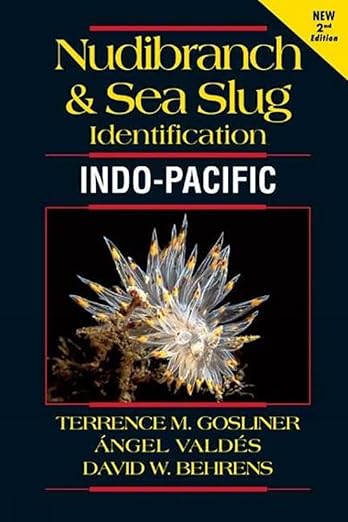
Terrence Gosliner, Ángel Valdés and David Behrens. (2018). Nudibranch and Sea Slug Identification Indo-Pacific 2nd Edition. New World Pubns Inc.
New World Publications
This species, Gymnodoris aurita, is included in the book.
View on Amazon PR (Amazon Associates)Seasonality
Shooting Locations
Loading shooting locations...
Same Genus Nudibranchs

Similar Colors Nudibranchs
Academic Database
Sea slug observation data is available in international marine biodiversity databases.