Gymnodoris fassioae De Souza-Canal & Valdés, 2025
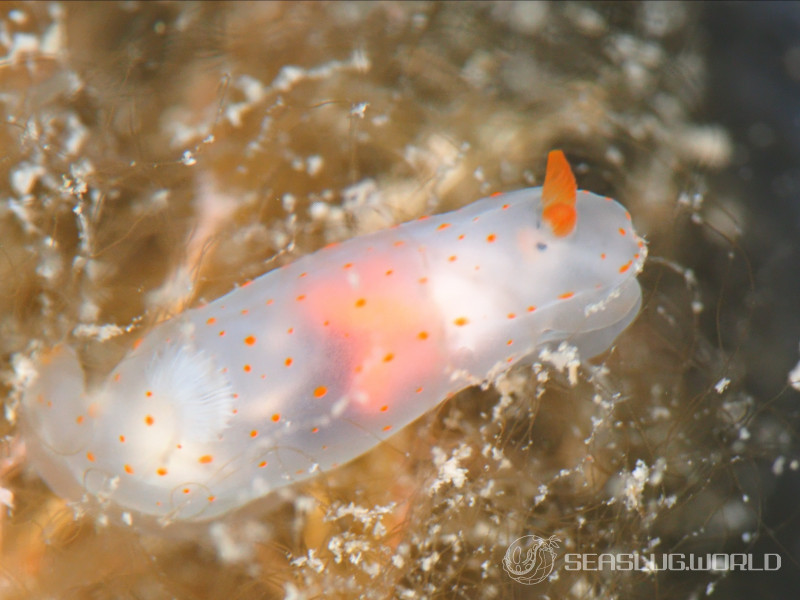
- Location
- Ohjima, Okinawa Island (Chatan and Southern area), Okinawa, Japan
- Date
- 2024/02/16
- Length
- 8mm
- Depth
- 4.0m
- Water temperature
- 20.0℃
Description
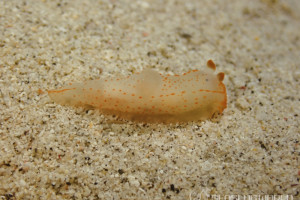
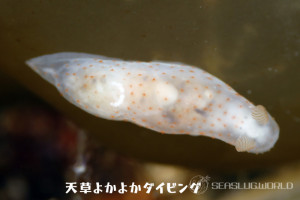
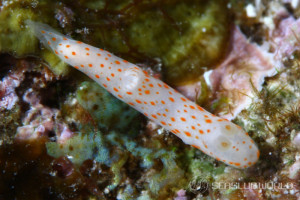
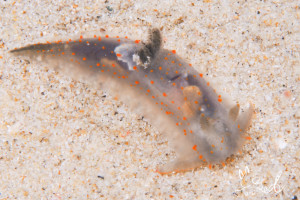
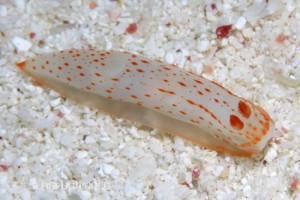
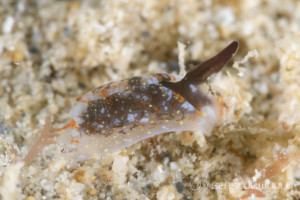
Body oval to elongate, with numerous small to elongate conical tubercles of varying sizes. Notal rim distinct, with several tubercles larger than those on the dorsum; velum absent, the notal rim fusing into the head and forming an arched anterior protuberance edged by smaller tubercles oriented toward the rhinophores. Color translucent white; tubercles red with blurry edges; longitudinal blurry red pigment lines connect some tubercles on the dorsum. Posterior end of foot translucent grey with a red tip. Internal organs visible through the body wall as orange and white masses. Rhinophores closely set at the base, bulbous, with 8 lamellae; club red, stalk white. Gill of 35 small, simple, translucent leaves with red tips and opaque white bases, arranged in a circle around the anus, opening posteriorly. Foot narrower than notum, opaque white; oral tentacles small, blunt. Radular formula 24 × 21.0.21 in the 5 mm preserved holotype; innermost lateral teeth small with irregular broad bases and a central curved cusp; other lateral teeth elongate with broad bases and long, slightly curved cusps. Reproductive system with a large, broad, slightly curved ampulla; penial spines slightly curved, elongate (about 80 µm), with narrow bases.Distribution
Described from Passe Deverd, Koumac, North Province, New Caledonia, at 21 m depth, and presently known only from the type locality.Etymology
Verbatim from De Souza-Canal & Valdés 2025:This species is named in honor of Dr. Giulia Fassio in appreciation for her help and support during the expeditions to New Caledonia.
Remarks
Externally similar in body shape to Gymnodoris inariensis Hamatani & Osumi, 2003, described from Kagoshima Bay, Japan: both species have rhinophores very close together at the base, a well-defined notal rim, and an anterior protuberance instead of a velum. However, G. fassioae sp. nov. lacks a gill (present in G. inariensis), and G. inariensis is blackish with densely scattered minute dark brown to black spots, whereas G. fassioae sp. nov. is translucent white with red, blurry-edged tubercles. No species included in Knutson & Gosliner 2022 is externally or genetically similar.References
- Gymnodoris fassioae, Knutson V.L. & Gosliner T.M. (2022). The first phylogenetic and species delimitation study of the nudibranch genus Gymnodoris reveals high species diversity (Gastropoda: Nudibranchia). Molecular Phylogenetics and Evolution. 171: 107470. https://doi.org/10.1016/j.ympev.2022.107470
- Gymnodoris fassioae De Souza-Canal & Valdés sp. nov., SOUZA-CANAL J.D. & VALDÉS Á. (2025). The genus Gymnodoris Stimpson, 1855 (Mollusca, Nudibranchia) in New Caledonia, with descriptions of eleven new species. Zootaxa. 5710(1): 1-73. https://doi.org/10.11646/zootaxa.5710.1.1
A Kindle field guide by the site author
Kimoto N. (2026). Sea Slugs of Japan & the Indo-Pacific, 2nd Edition.
Kindle Edition
View on Amazon PR (Amazon Associates)Seasonality
Shooting Locations
Loading shooting locations...
Photos of Gymnodoris fassioae
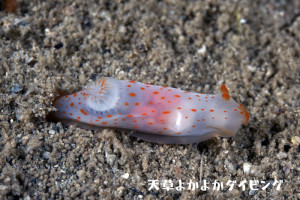


Same Genus Nudibranchs

Similar Colors Nudibranchs
Academic Database
Sea slug observation data is available in international marine biodiversity databases.