Gymnodoris wanaporum De Souza-Canal & Valdés, 2025
- Location
- Minna Island, Okinawa Island (Motobu and Northern area), Okinawa, Japan
- Date
- 2025/05/01
- Length
- 20mm
- Depth
- 16.0m
- Water temperature
- 22.0℃
Description
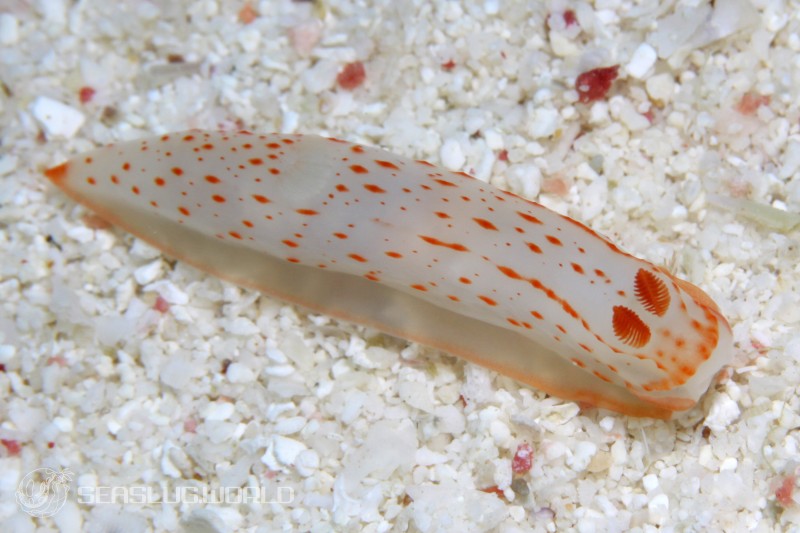
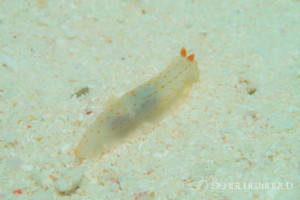
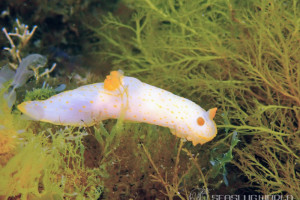
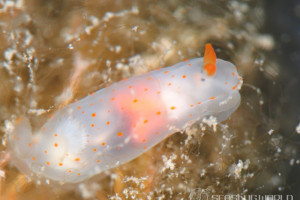
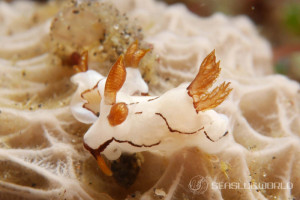
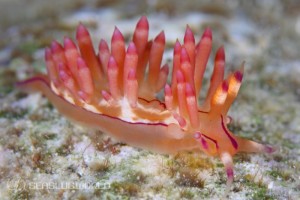
Body oval to elongate, with few, small conical to elongate tubercles of varying sizes. Velum distinct, with 8 irregular tubercles, merging with the notal rim, which also bears tubercles; an inner rim interior to the notal rim, with the velum and inner rim bearing several tubercles. Color translucent white; tubercles orange; red line edging the velum and inner rim; posterior end of foot translucent grey with an orange tip. Internal organs visible through the body wall as orange and white masses. Rhinophores bulbous to conical, with 11 lamellae, white stalk, with red tips. Gill of 15 small, simple, translucent leaves arranged in a row anterior to the anus. Foot wider than notum, expanded laterally near the head, opaque white; oral tentacles very small, blunt. Radular formula 15 × 28.0.28 in a 12 mm preserved specimen; innermost lateral teeth hook-shaped, with straight, flat smooth cusps and broad bases; other lateral teeth elongate, with broad bases, long, slightly curved cusps. Reproductive system with a large, broad, slightly curved ampulla; prostate large, flattened, partially covering the bursa copulatrix; bursa copulatrix spherical, about five times as large as the ovoid seminal receptacle. Penial spines elongate (about 100 µm), with relatively curved cusps and narrow bases.Distribution
Known from a few specimens collected around Koumac, North Province, New Caledonia, at 11-18 m depth.Etymology
Verbatim from De Souza-Canal & Valdés 2025:This species is named to honor the Tribu de Wanap, located in Koumac, New Caledonia, in appreciation for their hospitality during the field work in their land, and in recognition of their cultural heritage.
Remarks
Superficially similar to Gymnodoris sp. A, sp. 49 and sp. 53 (sensu Gosliner et al. 2018; Knutson & Gosliner 2022), but distinguished from them by lacking lateral anterior expansions of the foot and by possessing a distinctive glandular structure on the posterior end of the foot. Members of the G. lebouteillerorum sp. nov. clade have a similar body profile, but the foot is much narrower and the gill smaller in G. wanaporum sp. nov., and they also lack the glandular structure visible behind the gill of G. wanaporum sp. nov.References
- Gymnodoris wanaporum, Knutson V.L. & Gosliner T.M. (2022). The first phylogenetic and species delimitation study of the nudibranch genus Gymnodoris reveals high species diversity (Gastropoda: Nudibranchia). Molecular Phylogenetics and Evolution. 171: 107470. https://doi.org/10.1016/j.ympev.2022.107470
- Gymnodoris wanaporum De Souza-Canal & Valdés sp. nov., SOUZA-CANAL J.D. & VALDÉS Á. (2025). The genus Gymnodoris Stimpson, 1855 (Mollusca, Nudibranchia) in New Caledonia, with descriptions of eleven new species. Zootaxa. 5710(1): 1-73. https://doi.org/10.11646/zootaxa.5710.1.1
- シブキキヌハダウミウシ(新称), 今川郁. (2026). 沖縄のウミウシ: DNA解析による最新の分類図鑑1089種. 誠文堂新光社.
Related articles
Sea Slugs of Okinawa (Imagawa 2026): 16 species with DNA-confirmed identity
A Kindle field guide by the site author
Kimoto N. (2026). Sea Slugs of Japan & the Indo-Pacific, 2nd Edition.
Kindle Edition
View on Amazon PR (Amazon Associates)Seasonality
Shooting Locations
Loading shooting locations...
Photos of Gymnodoris wanaporum


Specimen & DNA
| Observation | Database | COI | 16S | H3 |
|---|---|---|---|---|
| #53883 | BOLD Systems | SSWBP534-25 |
Same Genus Nudibranchs

Similar Colors Nudibranchs
Academic Database
Sea slug observation data is available in international marine biodiversity databases.