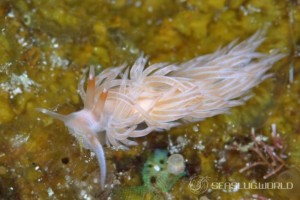
Gymnodoris fleuroti De Souza-Canal & Valdés, 2025
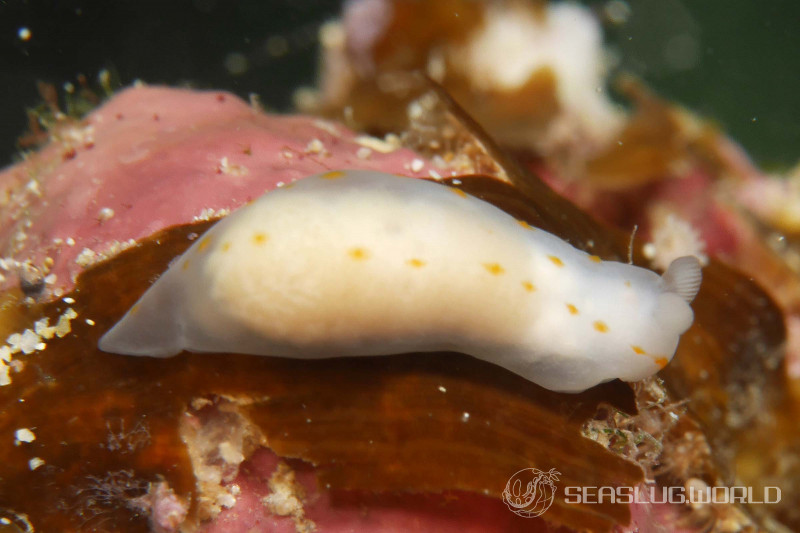
- Location
- Tengan(Kombu), Okinawa Island (East coast), Okinawa, Japan
- Date
- 2017/02/17
- Length
- 8mm
- Depth
- 5.0m
- Water temperature
- 21.0℃
Description
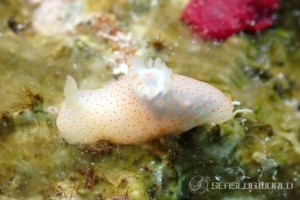
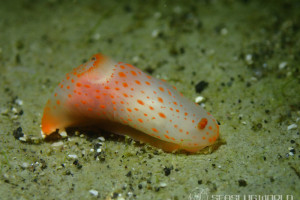
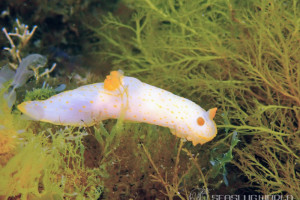
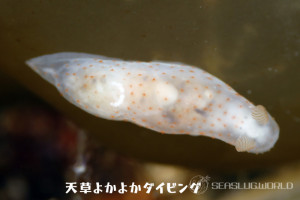
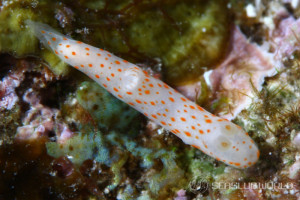
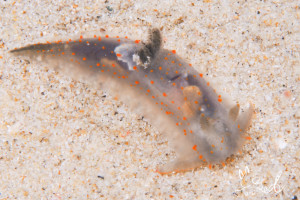
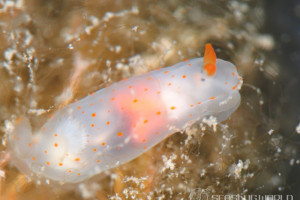
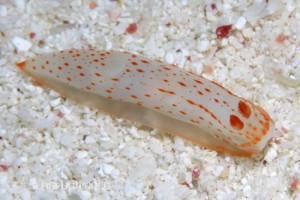
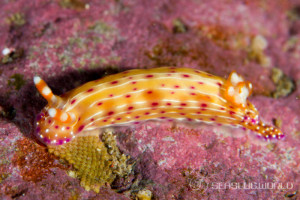
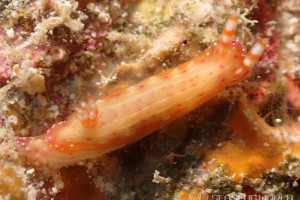
Body narrow, elongate, with several low conical tubercles mainly arranged around the notal rim, a few on the dorsum and velum. Velum differentiated, bearing 12 tubercles, continuing posteriorly into the notal rim. Color translucent white; tubercles orange-red with a thin orange-red line connecting velum tubercles; posterior end of foot translucent. Internal organs visible through the body wall as orange and white masses. Rhinophores conical, with 6 lamellae, white stalk, with orange tips. Gill inconspicuous, of 6 small, simple, white leaves arranged in a circle around the anus, opening posteriorly. Foot narrower than notum, opaque white; oral tentacles small, flattened. Radular formula 15 × 7.0.7 in the 4 mm preserved holotype; innermost lateral teeth large, hook-shaped, with curved smooth cusps; other lateral teeth elongate, straight, with short curved cusps. Reproductive system with an elongate, broad, curved ampulla; prostate large, tubular, curved around the bursa copulatrix; bursa copulatrix spherical, about five times as large as the ovoid seminal receptacle. Penial spines small (about 50 µm), triangular.Distribution
Described from South Îlot Yandé, Poum, North Province, New Caledonia (0 m), and presently known only from the type locality.Etymology
Verbatim from De Souza-Canal & Valdés 2025:This species is named in honor of Dominique Fleurot, naturalist, author of several floristic treaties, and coordinator of the ABC (Atlas de la Biodiversité Communale) project in Poum, New Caledonia. The ABC project is a large-scale biodiversity census operation centered in Poum, which produced the holotype of Gymnodoris fleuroti sp. nov. and many other species.
Remarks
Externally similar to Gymnodoris mariefranceae sp. nov. but recovered as a separate group in the species delimitation analyses. The two are distinguished by: (1) the orange tubercles of G. mariefranceae are larger and more densely arranged at the center of the dorsum; (2) G. mariefranceae bears a branched glandular structure visible at the posterior end of the foot, absent in G. fleuroti sp. nov.; and (3) the shape of the penial spines, which are triangular in G. fleuroti sp. nov. and elongate in G. mariefranceae. The radulae of the two species are similar, but G. fleuroti sp. nov. has fewer lateral teeth with stronger curve at the tip.References
A Kindle field guide by the site author
Kimoto N. (2026). Sea Slugs of Japan & the Indo-Pacific, 2nd Edition.
Kindle Edition
View on Amazon PR (Amazon Associates)Seasonality
Shooting Locations
Loading shooting locations...
Photos of Gymnodoris fleuroti

Same Genus Nudibranchs

Similar Colors Nudibranchs
Academic Database
Sea slug observation data is available in international marine biodiversity databases.