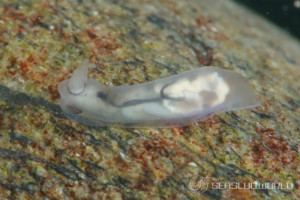
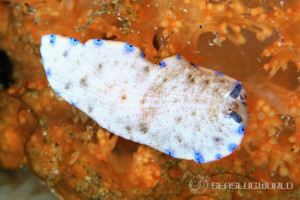
Gymnodoris inariensis Hamatani & Osumi, 2004
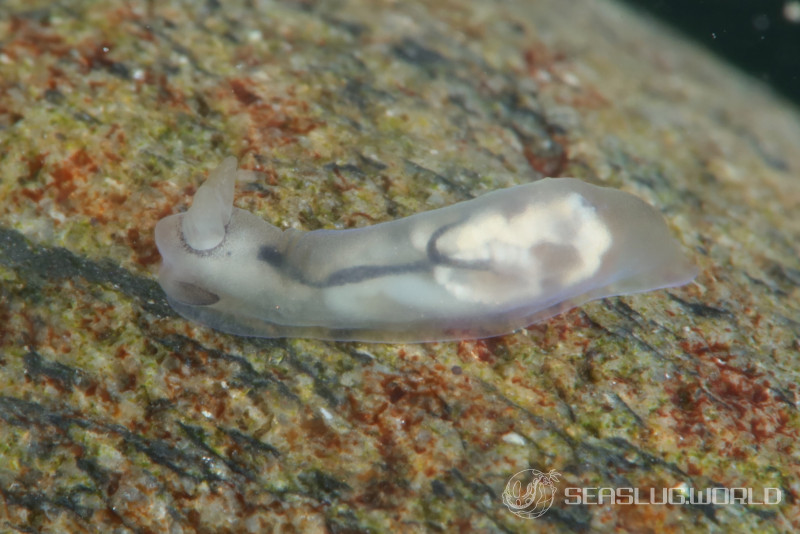
- Location
- Futami, Okinawa Island (Oura Bay), Okinawa, Japan
- Date
- 2016/01/22
- Length
- 10mm
- Depth
- 3.0m
- Water temperature
- 20.0℃
Description
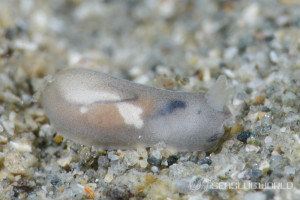
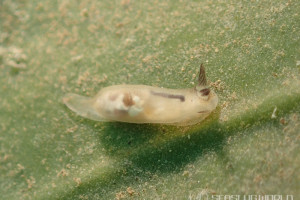
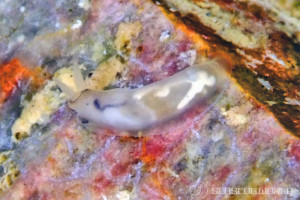
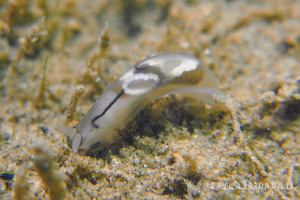
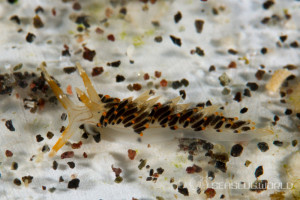
A very small Gymnodoris species, up to 5 mm in body length, limaciform with a circular cross section. The mantle margin does not project over the foot, the dorsal surface is smooth, and branchial gills are completely absent. The body is generally blackish with densely scattered minute dark brownish-black spots. The rhinophores are very small, retractile, and situated close together; in the holotype they are elongated and triangular, tapering toward the tips, while in some specimens they are clavate with rounded tips. They are colorless and translucent, sometimes yellowish or slightly orange, and tinged orange when preserved. Rhinophoral sheaths are absent, and only three weak folds are present bilaterally. Eyes are buried deeply beneath the cutaneous layer just behind the rhinophore bases. Oral tentacles were not observed. The anal opening lies on the midline of the posterior dorsal surface; the genital orifice is on the right side, slightly posterior to the head. The sole is translucent white.Distribution
Kagoshima Bay, southern Japan. Found on muddy sand substrates near a river mouth at depths of 5-20 m.Etymology
From the original description (Hamatani & Osumi, 2004):The specific epithet, inariensis, refers to the type locality of this new species.The name derives from the mouth of the Inari river in Kagoshima Bay, where the type material was collected.
Notes
Resembles G. nigricolor Baba, 1960 in body color, but is clearly distinguished by its much smaller size and the complete absence of branchial gills. Superficially recalls Limapontia and Veyssierea in lacking dorsal gills, but Limapontia has no true rhinophores, and Veyssierea has finger-shaped rhinophores without folds.References
- Gymnodoris inariensis n. sp.クロヒメキヌハダウミウシ(新種・新称), Hamatani I. & Osumi D. (2004 ["2003"]) A new gill-less species of Gymnodoris Stimpson, 1855 (Opisthobranchia: Nudibranchia) from Kagoshima Bay, southern Japan. Venus 62(3-4)
- Gymnodoris sp. 42 ?, Terrence Gosliner, Ángel Valdés and David Behrens. (2018). Nudibranch and Sea Slug Identification Indo-Pacific 2nd Edition. New World Pubns Inc.
Featured in this book

Terrence Gosliner, Ángel Valdés and David Behrens. (2018). Nudibranch and Sea Slug Identification Indo-Pacific 2nd Edition. New World Pubns Inc.
New World Publications
This species, Gymnodoris inariensis, is included in the book.
View on Amazon PR (Amazon Associates)Seasonality
Shooting Locations
Loading shooting locations...
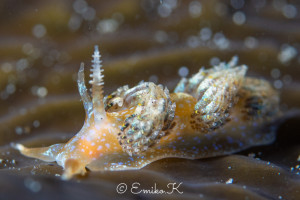
Photos of Gymnodoris inariensis








Same Genus Nudibranchs

Similar Colors Nudibranchs


Academic Database
Sea slug observation data is available in international marine biodiversity databases.